Angel Investors or VCs: How They Differ and Whom to Approach First
Angels invest their own money; VCs invest a fund with a fixed life. See how that shapes what each wants, and choose your first investors based on your stage and market size.
In this article
Many founders start fundraising by sending their pitch deck to every venture capital (VC) fund they can find, and hear nothing back. The business may not be bad at all. It may simply not be at the stage VCs invest in, or it may not need to grow the way a VC fund needs. Other founders take money from individual investors on terms that make the next round harder to raise.
This article explains how angel investors and VCs differ, why VCs are so selective, and how to use your stage, the amount you need and your market size to decide whom to approach first, along with what to prepare for each.
The difference starts with whose money it is
The U.S. Securities and Exchange Commission (SEC) explains in its small business resources that angel investors are generally high-net-worth individuals who invest their own money directly in emerging businesses. Many are current or former entrepreneurs. They tend to invest in early rounds such as seed and Series A, and often syndicate, which lets them join larger deals with smaller amounts each.
A VC fund is a private fund that invests in rapidly growing companies, often with a specific industry focus, using money from the fund's own investors (limited partners) rather than the fund managers' own money. Almost every other difference follows from this one.
| Topic | Angel investor | VC fund |
|---|---|---|
| Money invested | Their own | The fund's investors' |
| Stage | Early rounds such as seed and Series A | From Series A through a public offering |
| Instrument | Equity or convertible debt | Mostly equity, such as preferred stock |
| Role after investing | Often brings industry knowledge, serves as a director or advisor | Often mentors the company and takes a board or advisory seat |
| Time frame | Depends on the individual | Funds typically last at least 10 years and must exit before the fund ends |
Why VCs need companies that can become very large
The SEC explains that VC funds are typically structured to last at least ten years: the first few years go to investing, then to monitoring the portfolio, and then to exiting and, ideally, returning a profit to the fund's investors. A fund must get its money back within a fixed period, and its overall return must justify the risk its investors take.
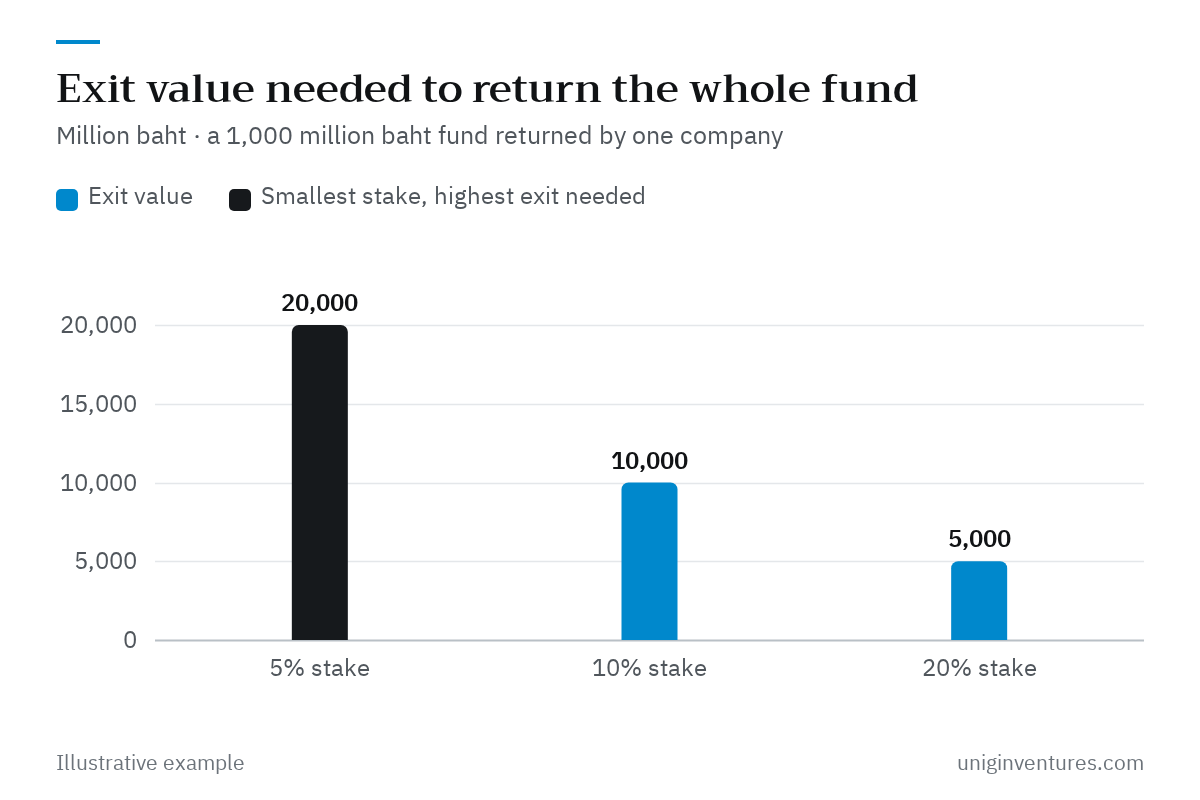
As a result, VCs always ask about market size and the company's value at exit. Take an illustrative example: a 1,000 million baht fund wants its single best company to return an amount equal to the whole fund. The exit value it needs is:
Required exit value = fund size ÷ fund's ownership at exit
If the fund owns 10% at exit, the company must sell for 1,000 ÷ 10% = 10,000 million baht. At 5%, it must sell for 20,000 million baht. At 20%, it must sell for 5,000 million baht.
A profitable business that grows steadily in a market worth only a few hundred million baht can be a very good business, yet still not fit a fund like this. A VC's "no" does not always mean the business is weak. Such a business may suit an angel who is happy with a different kind of return, or a bank loan. For loan preparation, see Preparing an SME Loan Application.
VCs are highly selective, and the team comes first
The study How Do Venture Capitalists Make Decisions? by Gompers, Gornall, Kaplan and Strebulaev surveyed almost 900 venture capitalists and was summarized on the Harvard Law School Forum on Corporate Governance in August 2019. It found that:
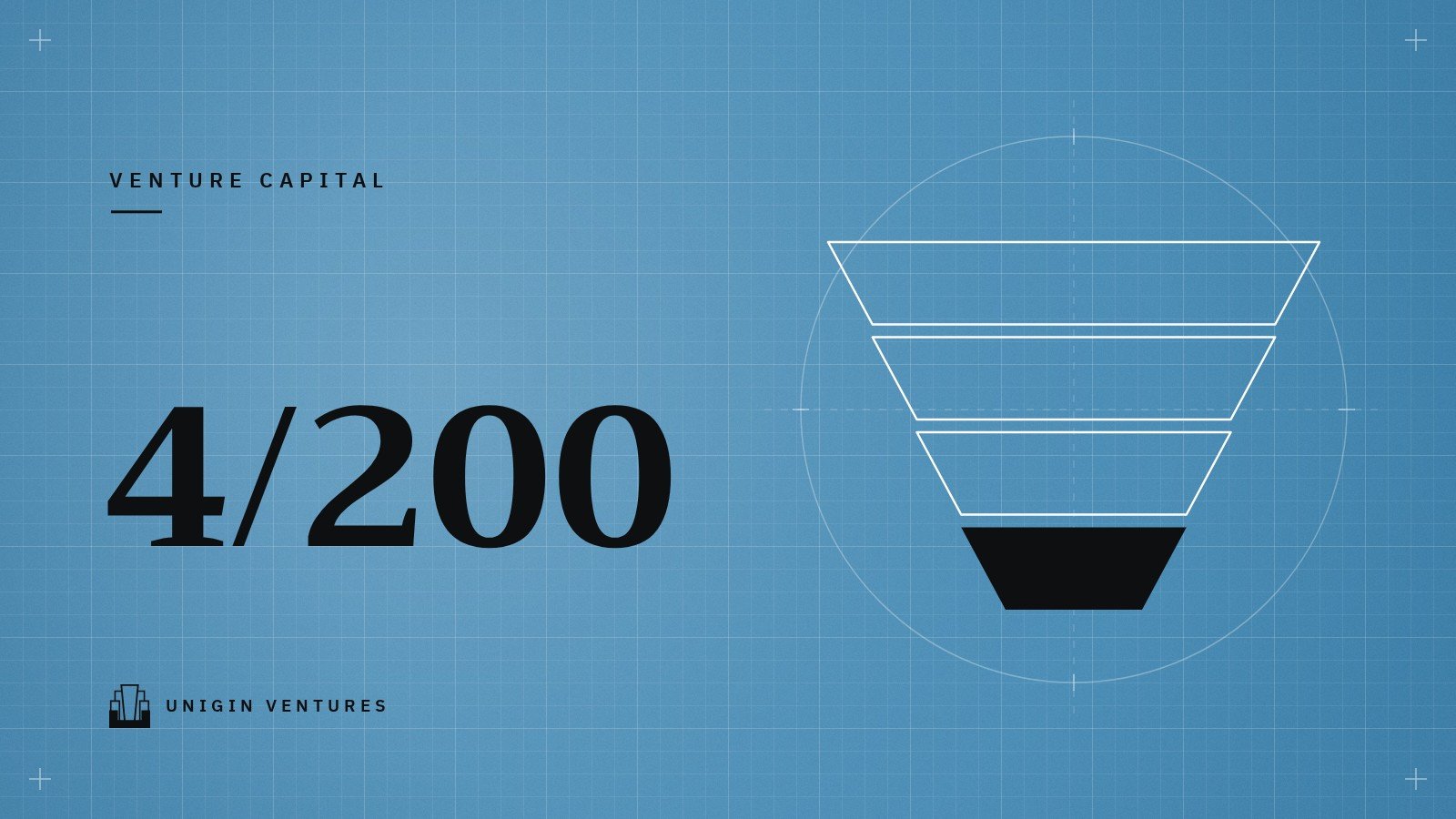
- The average VC firm screens 200 companies and makes only 4 investments in a given year.
- The management team was the factor mentioned most often: 95% of VC firms called it important and 47% called it the most important.
- Over 30% of deals come through professional networks, 20% are referred by other investors, 8% are referred by portfolio companies, almost 30% are generated by the VCs themselves, and only 10% come inbound from company management.
These figures say two things. First, cold e-mails to VCs are the channel that produces the fewest deals. Second, other investors are an important source of referrals, so an angel who backs you early may be the one who introduces you to VCs in the next round.
Whom to approach first
Answer three questions: what stage is the business at, how much money do you need, and if it succeeds, will the company be large enough to give a VC the return calculated above?
| Where the business is | Start with | Why |
|---|---|---|
| An idea or prototype, no paying customers yet | Angel investors who know the industry | There is little for a VC to evaluate yet. An angel can decide based on the founder and their own industry knowledge. |
| Paying customers but small revenue, money needed to prove growth | A group of angels, or VCs that invest at seed | According to the SEC, seed is a stage where angels invest. Before approaching a VC, check whether its policy covers this round. |
| Clear growth figures, a large amount needed to expand | VCs focused on your industry | According to the SEC, VC funds invest from Series A onward and can provide large amounts. |
| Profitable and growing steadily, but the market is too small for a VC | Angels seeking long-term returns, or a loan | You avoid giving equity to investors who expect growth the business does not plan for. |
Also compare terms. Angels invest their own money and decide for themselves, so their terms vary widely. VCs use recurring contract structures, such as preferred shares with special rights. Whichever you choose, read every clause of the term sheet before signing. See Reading Your First Term Sheet.
What to prepare before the first meeting
Before meeting angel investors
- Pick people who bring more than money. The SEC notes that angels often bring industry knowledge and serve as directors or advisors. Ask what they have invested in or built, and how they will help.
- Agree on the instrument. Early rounds often use convertible debt or an agreement that converts into shares in the next round. See SAFEs and Convertible Notes for Thai Startups. If you issue new shares, a Thai limited company must follow the capital increase procedure. See Issuing New Shares to Investors.
- Clean up the cap table. The stake you give an angel today will be visible in every later round. See Cap Table Basics Before Fundraising.
Before meeting VCs
- Find someone to introduce you. For example, an investor already in your company, a founder in the fund's portfolio, or someone in your network the VC knows.
- Target the right funds. Check which industries, rounds and check sizes each fund invests in. Sending your deck to every fund wastes everyone's time.
- Make the team and the market size clear, because these are what VCs look at first. See the structure in A 12-Slide Pitch Deck and prepare documents as in The Data Room Before Due Diligence.
Where to start
- Write one paragraph on where the business stands today: whether customers are paying, how much revenue you have, and how fast it grows each month.
- Work out how much you need from your next milestone rather than picking a round number. See How Much to Raise.
- Estimate honestly what the company could be worth if it succeeds, and compare that with the exit value formula a VC needs.
- List 10 to 20 first-target investors using the stage table, and note who could introduce you to each one.
- Prepare the documents for the group you chose, then start meetings with the best-matched investors.
The fund and company figures in this article are illustrative examples to explain the reasoning. Figures from the study come from a survey of VCs, not data on the Thai market.