
Founder Vesting and Cliffs: What Happens When a Co-Founder Leaves Early
How four-year vesting with a one-year cliff works, the numbers when a co-founder leaves at month 18, revesting at funding, double-trigger acceleration and Thai company limits.

In this article
- What founder vesting is and why investors ask for it
- The standard formula: four years, one-year cliff, then monthly
- Worked example: a co-founder leaves at month 18
- Good leavers and bad leavers
- Does the clock restart when you raise money
- Acceleration on a sale: single and double trigger
- Applying this to a Thai limited company
- Where to start
Three founders split the shares equally on the day they register the company. Eighteen months later, one of them leaves for another job and takes a third of the company along. The two who stay will spend years building value for that block of shares. And on the day they raise money, the first question from investors will be what happens to shares held by someone who no longer works there.
The standard fix is founder vesting with a cliff. This article explains how the usual schedule works, a worked example of a co-founder leaving early, revesting when an investor comes in, acceleration when the company is sold, and what changes when you apply all of this to a Thai limited company.
What founder vesting is and why investors ask for it
Vested shares are shares the holder keeps for good. Unvested shares can be bought back if the holder stops working for the company before the schedule ends. The law firm Orrick explains that when service ends, the holder of the repurchase right may buy back the unvested shares at a set price, usually the original price paid.
This differs from an employee equity grant. Founders already own all their shares and are on the shareholder register from day one, so founder vesting runs in reverse: the shares stay with the founder, but the unvested part is open to repurchase. Some people call it reverse vesting. For employee equity, see ESOP Design for Thai Companies.
Orrick notes that angel and venture investors expect a startup's founders to put their shares on a vesting schedule, to keep the founders motivated to stay and build the company. The Holloway Guide to Raising Venture Capital says that because many founders fail to set up vesting among themselves, investors usually require all founders to vest, just like employees.
The standard formula: four years, one-year cliff, then monthly
Orrick describes the structure known as a "4-year vest with a 1-year cliff": 25% of the shares vest on the first anniversary, and the rest vest at 1/48 of the total each month until month 48. Leave before the first anniversary and nothing vests.
Vested shares = total shares under vesting × months worked ÷ 48 (zero if under 12 months)
Illustrative example: founders A, B and C each hold 480,000 shares, 1,440,000 in total, a third each. All three are on four-year vesting with a one-year cliff, so after the cliff each founder vests 10,000 shares a month.
| Time worked | Vested shares | Percent of 480,000 | Shares still subject to repurchase |
|---|---|---|---|
| 11 months | 0 | 0% | 480,000 |
| 12 months (cliff) | 120,000 | 25% | 360,000 |
| 18 months | 180,000 | 37.5% | 300,000 |
| 24 months | 240,000 | 50% | 240,000 |
| 36 months | 360,000 | 75% | 120,000 |
| 48 months | 480,000 | 100% | 0 |
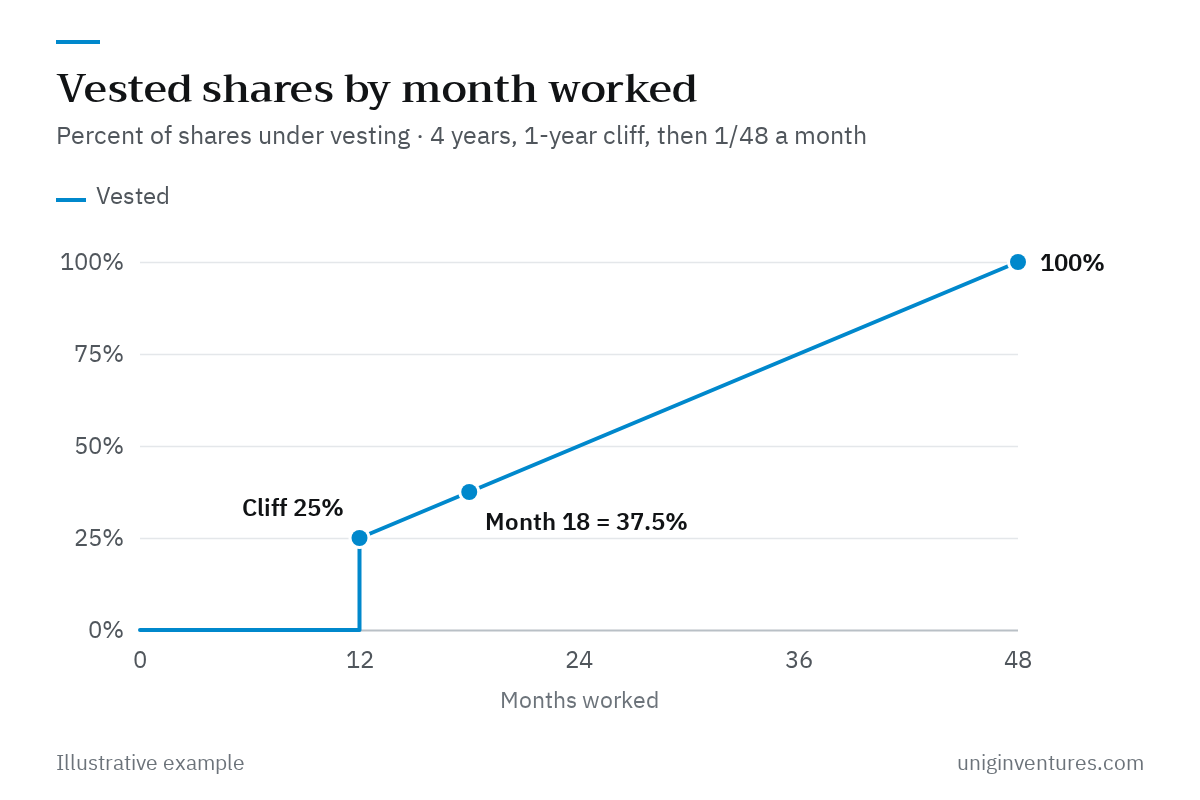
The cliff covers the case where a team finds out in year one that it cannot work together: someone who leaves that early should not walk away with equity. Monthly vesting after that avoids a single date when a large block vests and creates a reason to quit the next day. A Taylor Wessing guide gives another schedule in use, a one-year cliff followed by three years of quarterly vesting, so the length and the frequency are both negotiable.
Worked example: a co-founder leaves at month 18
Continuing the example, founder C resigns after 18 months. C has vested 180,000 shares, and the other 300,000 are open to repurchase at the agreed price. Assume the agreement lets A and B buy them pro rata, 150,000 shares each.
| Shareholder | No vesting | With vesting and repurchase |
|---|---|---|
| Founder A | 480,000 shares (33.3%) | 630,000 shares (43.75%) |
| Founder B | 480,000 shares (33.3%) | 630,000 shares (43.75%) |
| Founder C (left) | 480,000 shares (33.3%) | 180,000 shares (12.5%) |
| Total | 1,440,000 shares | 1,440,000 shares |
Without vesting, a founder who worked 18 months owns as much as founders who stay for years. With vesting, C keeps 12.5% for the time actually worked, and 300,000 shares return to the people still building the company, or can be set aside for whoever replaces C.
Good leavers and bad leavers
The Taylor Wessing guide explains that the parties usually agree on objective scenarios that make a founder a "good leaver" or a "bad leaver," and that status decides which part of the founder's shares can be bought back. These leaver terms are often heavily negotiated. The guide mentions an extreme case in which investors ask for an option to buy all of a founder's equity for nil value, vested or not.
- Keep the definitions narrow and testable. A bad leaver should be a provable event, such as fraud or a breach of a non-compete, not broad wording that one side can interpret alone.
- Price the two parts separately. Unvested shares are bought back at the price paid. Vested shares should stay with the founder, or for a bad leaver be bought at a price set by a formula agreed in advance.
- Cover events the founder did not choose. Serious illness, death, or being let go without cause should count as a good leaver.
Does the clock restart when you raise money
The Holloway guide says investors often ask founders to reset the vesting clock when the deal closes, especially when founders have already vested more than 25% of their stock. Investors want assurance that the founders will stay after the money arrives. The guide's example is a founder two years into a four-year schedule with a one-year cliff, half vested, who is asked to start over.
The founder's counter is credit for time served. Illustrative example: founder A has worked 24 months and vested 240,000 of 480,000 shares. These are the options on the table.
| Option | Vested at closing | Still vesting | Time remaining |
|---|---|---|---|
| Full restart | 0 | 480,000 | 48 months |
| Credit for time served, rest on the original schedule | 240,000 | 240,000 | 24 months |
| Middle ground: 25% vested now, the rest over 36 months | 120,000 | 360,000 | 36 months |
These figures are an illustrative comparison, not a formula every investor uses. A team that set up vesting on the day it formed the company has a record of time already worked, which makes this negotiation much easier than for a team that never had vesting at all.
Acceleration on a sale: single and double trigger
If the company is sold midway, what happens to unvested shares? The acceleration clause answers that, and it comes in two forms.
- Single trigger accelerates vesting on one event, most commonly the sale of the company.
- Double trigger needs two events: the sale, and the founder being let go without cause within a set period after it.
Buyers usually want the team to stay. Single trigger vests everything at once and removes the reason to stay, so double trigger is the more balanced design: the founder is protected if the new owner pushes them out. The Holloway guide says 100% double-trigger acceleration is standard for founders, even though many venture firms propose a lower percentage, and advises founders to push for 100%.
Illustrative example: the company is sold at month 30. Founder A has vested 300,000 shares, with 180,000 still unvested. Under 100% double trigger, if the new owner lets A go without cause within the agreed period, all 180,000 shares vest at once. At 50%, A gets another 90,000. Read this together with Drag-Along and Tag-Along Rights, because every share may be forced into the same sale.
Applying this to a Thai limited company
Most model documents you will find follow U.S. law, where the company itself buys the shares back. A Thai limited company needs a different design on at least two points.
- The company cannot hold its own shares. Section 1143 of the Civil and Commercial Code forbids a limited company from owning its own shares or taking them in pledge. A workable route is a call option in the shareholders' agreement that gives the right to buy unvested shares to the remaining founders, the investors or another agreed person, as with A and B in the example.
- Share transfers have a required form. Section 1129 requires a transfer of registered shares to be in writing, signed by the transferor and the transferee, and certified by at least one witness, or it is void. It cannot be set up against the company or third parties until it is entered in the register of shareholders. Even with a call option, the departing founder still has to sign the transfer, so have counsel spell out what happens if they refuse.
Until unvested shares are transferred, they still belong to the founder on the register, so the agreement should also cover voting and dividends on that portion, and the company's articles must not conflict with the shareholders' agreement. A repurchase price below the shares' value on the day may also have tax consequences for the buyer or the seller, so have a tax adviser review the pricing formula.
Where to start
- Agree among the founders, before any investor arrives, which shares vest, over how many years, with what cliff, and whether vesting is monthly or quarterly.
- Fix a clear start date, such as the day each founder went full time, and keep the evidence for any revesting talks.
- Write testable good leaver and bad leaver definitions, with a repurchase price for each part of the shares.
- Choose a holder of the repurchase right that works under Thai law, and a transfer process under Section 1129 that works in practice.
- Ask for double-trigger acceleration and read it alongside the sale terms in your term sheet.
- Track every founder's schedule in your cap table, so anyone can check how many shares each person has vested today.
The company, founders and figures in this article are illustrative examples to explain the reasoning. This article is not legal or tax advice. Have a lawyer and a tax adviser review any real documents.
Sources
- What is vesting? Should initial shares sold to founders be subject to vesting? — Orrick Total Access
- Vesting — The Holloway Guide to Raising Venture Capital
- Founder share vesting and clawbacks — Taylor Wessing, The Middle East Venture Capital Guide
- Civil and Commercial Code Section 1143 (a company holding its own shares, in Thai) — Thai Law Online
- Civil and Commercial Code Section 1129 (share transfers, in Thai) — Thai Law Online