Cap Table Basics Before You Raise: Fully Diluted Ownership and Thai Records
What a cap table shows, how founder ownership changes when a SAFE converts and an option pool is added, which records Thai law requires, and how to clean up before investors look.
In this article
Early in a startup, ownership is easy to remember: two founders, sixty-forty. Then a friend invests on a SAFE, an early employee is promised shares, an advisor gets a small stake, and a few years later nobody is sure who owns what. Investors find out in due diligence, and a messy shareholder table can delay a round by weeks or reduce what founders keep.
This article explains what a capitalization table (cap table) is, how ownership changes through a typical round, which records Thai law requires you to keep, and how to clean up your table before you start raising.
What a Cap Table Shows
A cap table is a list of everyone who owns, or has a right to own, shares in the company. A useful one has at least these columns:
- Holder: founders, investors, employees and advisors, by name.
- Issued shares: shares that legally exist and appear in the shareholder register, by class if you have more than one.
- Rights to future shares: SAFEs and convertible notes that have not yet converted, options or share promises to employees, and any unallocated option pool.
- Ownership two ways: the percentage of issued shares, and the percentage on a fully diluted basis, which assumes every right to future shares has turned into shares.
Investors negotiate on the fully diluted figure. A founder who owns 60% of issued shares may own much less once a 10% option pool and outstanding SAFEs are counted.
The Legal Record in Thailand
A spreadsheet is a management tool. For a Thai private limited company, the legal record is the shareholder register, and the two must match.
- Shareholder register. Under the Civil and Commercial Code (Section 1138), a private limited company must keep a register of shareholders showing each holder's name, address, shares held, amount paid and the dates they became or ceased to be a shareholder. It is kept at the company's registered office (Section 1139).
- Share transfers. A transfer of registered shares must be made in writing, signed by the transferor and transferee and witnessed by at least one person, or it is void. It cannot be used against the company or third parties until the transferee's name and address are entered in the register (Section 1129).
- Annual list of shareholders. The company must submit a copy of its list of shareholders (form Bor.Or.Jor.5) to the Department of Business Development (DBD) at least once a year, within 14 days of the annual general meeting.
- Issuing new shares. Increasing capital by issuing new shares requires a special resolution of shareholders (Section 1220). New shares must first be offered to existing shareholders in proportion to their holdings (Section 1222), so a new investor usually needs the others to waive that right in writing. Shares cannot be issued below par value (Section 1105), and the DBD requires a par value of at least 5 baht.
Investors will compare your cap table with the register, the latest Bor.Or.Jor.5 and the DBD company certificate. Any difference becomes a question in due diligence.
How Ownership Changes: A Worked Example
In a simplified illustrative example, two founders start a company with 100,000 shares: Founder A holds 60,000 and Founder B holds 40,000.
- Pre-seed SAFE. An angel invests 3 million baht on a post-money SAFE with a 30 million baht valuation cap. Under Y Combinator's post-money SAFE, the ownership the investor buys equals the investment divided by the post-money cap: 3 ÷ 30 = 10%. When the SAFE converts, the angel receives 11,111 shares, so the company has 111,111 shares.
- Seed round. A fund invests 10 million baht for 20% of the company after the round, a post-money valuation of 50 million baht. The term sheet asks for an unallocated option pool equal to 10% after the round, included in the 40 million baht pre-money valuation. This is the standard approach in the US National Venture Capital Association's model term sheet. The company issues 31,746 new shares to the fund at about 315 baht each and reserves 15,873 shares for the pool.
| Holder | Shares | At founding | After SAFE converts | After seed, fully diluted |
|---|---|---|---|---|
| Founder A | 60,000 | 60.0% | 54.0% | 37.8% |
| Founder B | 40,000 | 40.0% | 36.0% | 25.2% |
| Angel (SAFE) | 11,111 | — | 10.0% | 7.0% |
| Option pool | 15,873 | — | — | 10.0% |
| Seed fund | 31,746 | — | — | 20.0% |
| Total | 158,730 | 100% | 100% | 100% |
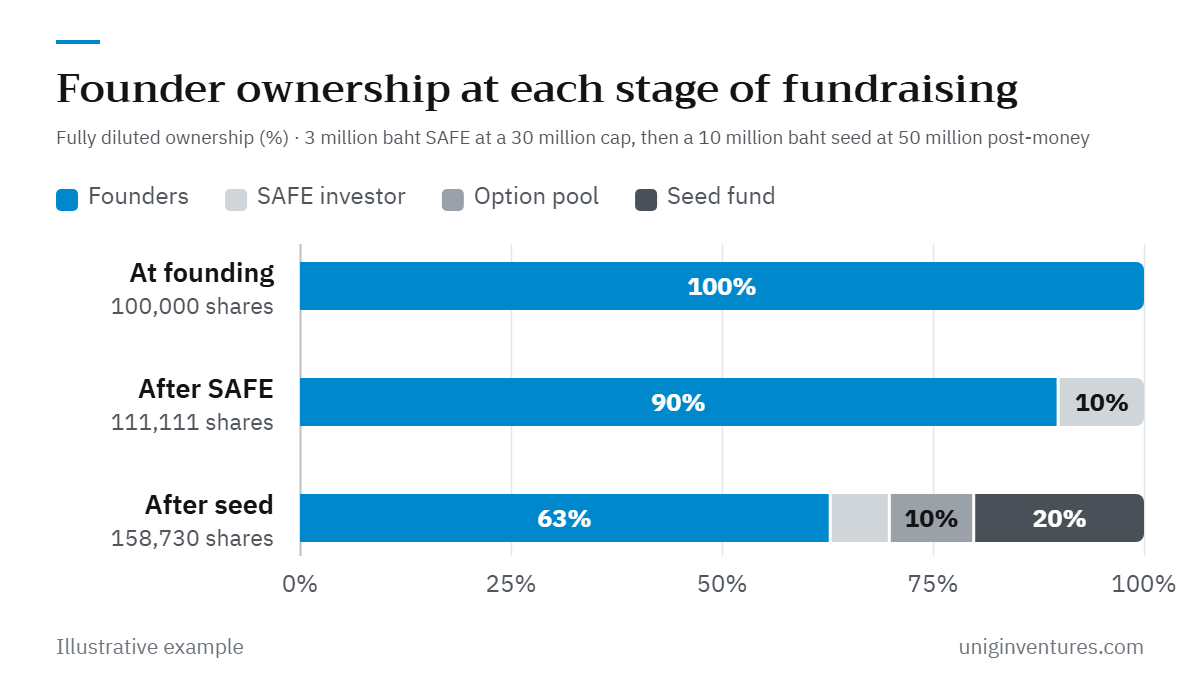
Two points stand out. First, the founders lost 27 points in the seed round, not 20, because the pool was created at the same time. Second, everyone diluted proportionally: each founder kept the same 60:40 ratio between them. Dilution is normal. Surprises are the problem. Model each round before you sign the term sheet (see also ESOP design for Thai companies and SAFEs and convertible notes in Thailand).
Common Cap Table Problems
- Verbal promises. "You'll get 2% when we raise" said to an early employee or advisor becomes a dispute later. Write every promise down with the number of shares, vesting and conditions, or do not make it.
- Transfers not recorded. A founder sells shares to a cofounder but nobody updates the register or files the change. Legally, the company may still treat the seller as the holder.
- Lost instrument terms. SAFEs or loans that convert to shares are signed and filed away. When the round comes, nobody remembers the cap, discount or which version of the document was used.
- Shares held for someone else. Shares registered in one person's name while another person is the real owner make due diligence slow and can raise legal issues. Investors will ask.
- No founder vesting. If a cofounder leaves after six months holding 40%, the remaining team carries the company with a large passive shareholder. Investors often ask for founder vesting before they invest.
- Rounding and share count errors. Percentages that do not add up to 100, or share counts that differ from the register by a few shares, suggest that other records may also be wrong.
Where to Start
- Collect the legal documents: the shareholder register, the latest Bor.Or.Jor.5, the DBD company certificate, every share transfer document and every SAFE, convertible note or share promise.
- Build one spreadsheet with issued shares by holder, rights to future shares, and ownership on both an issued and a fully diluted basis. Reconcile the share count to the register exactly.
- Fix the gaps first: record unregistered transfers, put verbal promises in writing or withdraw them, and agree on founder vesting.
- Model the next round: add the expected investment, valuation, pool size and conversion of outstanding SAFEs, and see what each founder keeps.
- Keep it current. Update the cap table and the register on the same day as every change, and place both in your data room (see preparing a data room).
This article is general information, not legal or investment advice for a specific company. The law is as checked in October 2026. The company, valuations and figures above are a simplified illustrative example; actual SAFE conversion depends on the exact terms signed. Consult a lawyer before issuing or transferring shares.
Sources
- DBD e-Filing questions and answers, including the annual list of shareholders (Bor.Or.Jor.5) — Department of Business Development
- Registering a memorandum of association and incorporating a private limited company — Department of Business Development
- Civil and Commercial Code, Section 1129 (share transfers) — compiled by Legardy
- Civil and Commercial Code, Section 1222 (offering new shares to existing shareholders) — compiled by Legardy
- The SAFE: post-money valuation cap — Y Combinator
- NVCA model term sheet (option pool included in pre-money valuation) — National Venture Capital Association