SAFEs and Convertible Notes for Thai Startups: Caps, Discounts and Legal Limits
SAFEs and convertible notes let startups raise money before setting a share price, but the templates follow foreign law. How caps and discounts work, the Thai legal limits, and the SEC PP-SME route.
In this article
Founders raising their first money often face the same problem. The company is too young to value sensibly, but it needs cash now. In the United States and Singapore, the usual answer is a SAFE or a convertible note: the investor pays now, and the money turns into shares in the next round, when a real share price is set.
The catch is that these documents are written for foreign law. If your company is a Thai limited company, using the templates as they are can run into several legal obstacles. This article explains how the two instruments work, how valuation caps and discounts are calculated, and which routes actually work for a Thai limited company.
How a SAFE differs from a convertible note
The SAFE (Simple Agreement for Future Equity) was created at Y Combinator in 2013. It is a short contract under which an investor pays today in exchange for the right to shares later. A SAFE is not a loan: it carries no interest and has no maturity date. Since 2018 Y Combinator's standard has been the post-money SAFE, whose valuation cap is the company's valuation after the investment.
A convertible note is a loan that can convert into shares, so it usually carries interest and a maturity date. If the maturity date arrives without a new round, the investor may ask for repayment, or the parties negotiate an extension or a conversion under the terms of the note.
| SAFE | Convertible note | |
|---|---|---|
| Legal nature | Not debt | Debt |
| Interest | None | Usually |
| Maturity date | None | Yes |
| Converts when | A priced equity round happens | A priced round happens, or on other terms in the note |
| Founder risk | No scheduled repayment | Without a new round, may have to repay or renegotiate |
How valuation caps and discounts work
Two terms matter most in both instruments:
- Valuation cap: the maximum valuation used to set the conversion price, however high the next round is priced.
- Discount: a reduction on the next round's share price, rewarding the investor for taking the risk earlier.
When both apply, the investor usually gets whichever price is lower.
Cap price = valuation cap ÷ shares outstanding before the new round
Discount price = new round share price × (1 − discount)
Conversion price = the lower of the two
A worked example
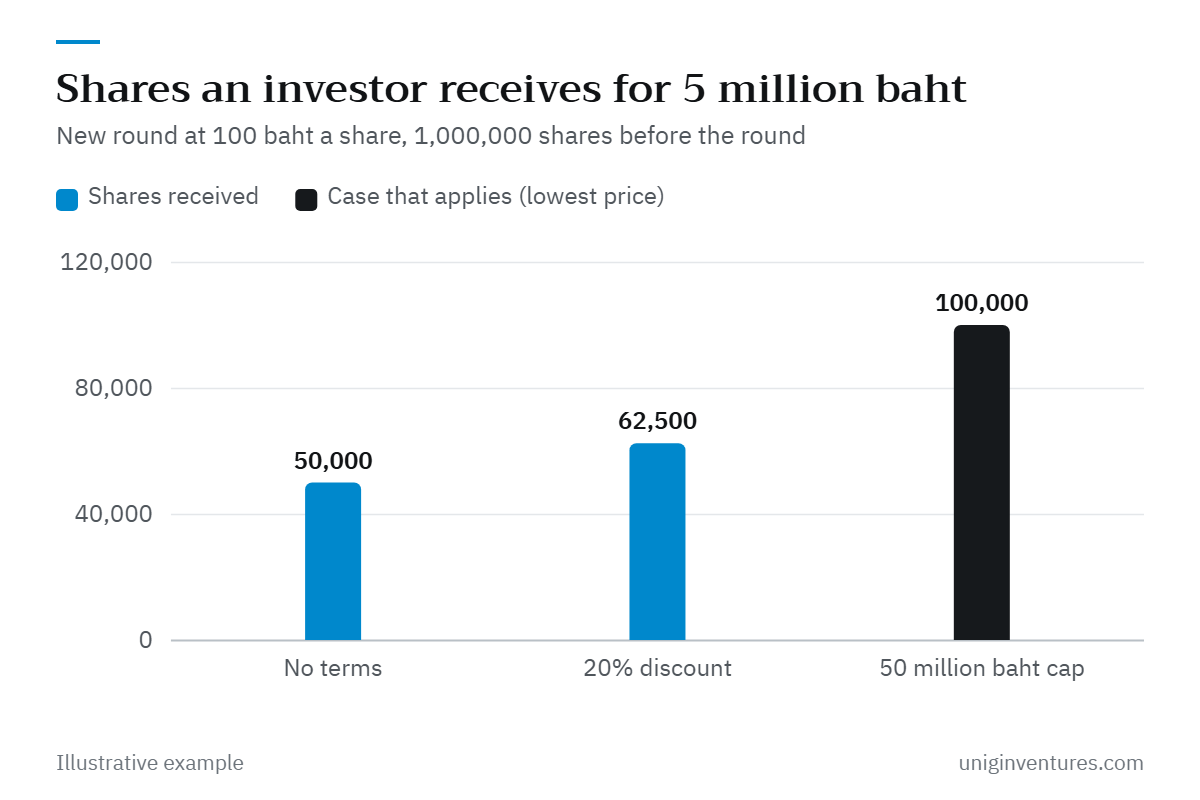
In an illustrative example, an investor puts in 5 million baht with a 50 million baht valuation cap and a 20% discount. The company later raises a round at a 100 million baht pre-money valuation with 1,000,000 shares outstanding, so the new share price is 100 baht. (The example uses a pre-money cap to keep the arithmetic simple.)
| Case | Conversion price (baht per share) | Shares for 5 million baht |
|---|---|---|
| No cap, no discount | 100 | 50,000 |
| 20% discount | 100 × 0.8 = 80 | 62,500 |
| 50 million baht cap | 50,000,000 ÷ 1,000,000 = 50 | 100,000 |
The investor takes the lower price, 50 baht, and receives 100,000 shares, twice as many as with no terms at all. The point for founders: the further the next round's valuation rises above the cap, the more shares the early investor receives. A valuation cap is an indirect valuation, not a way of truly postponing the valuation question.
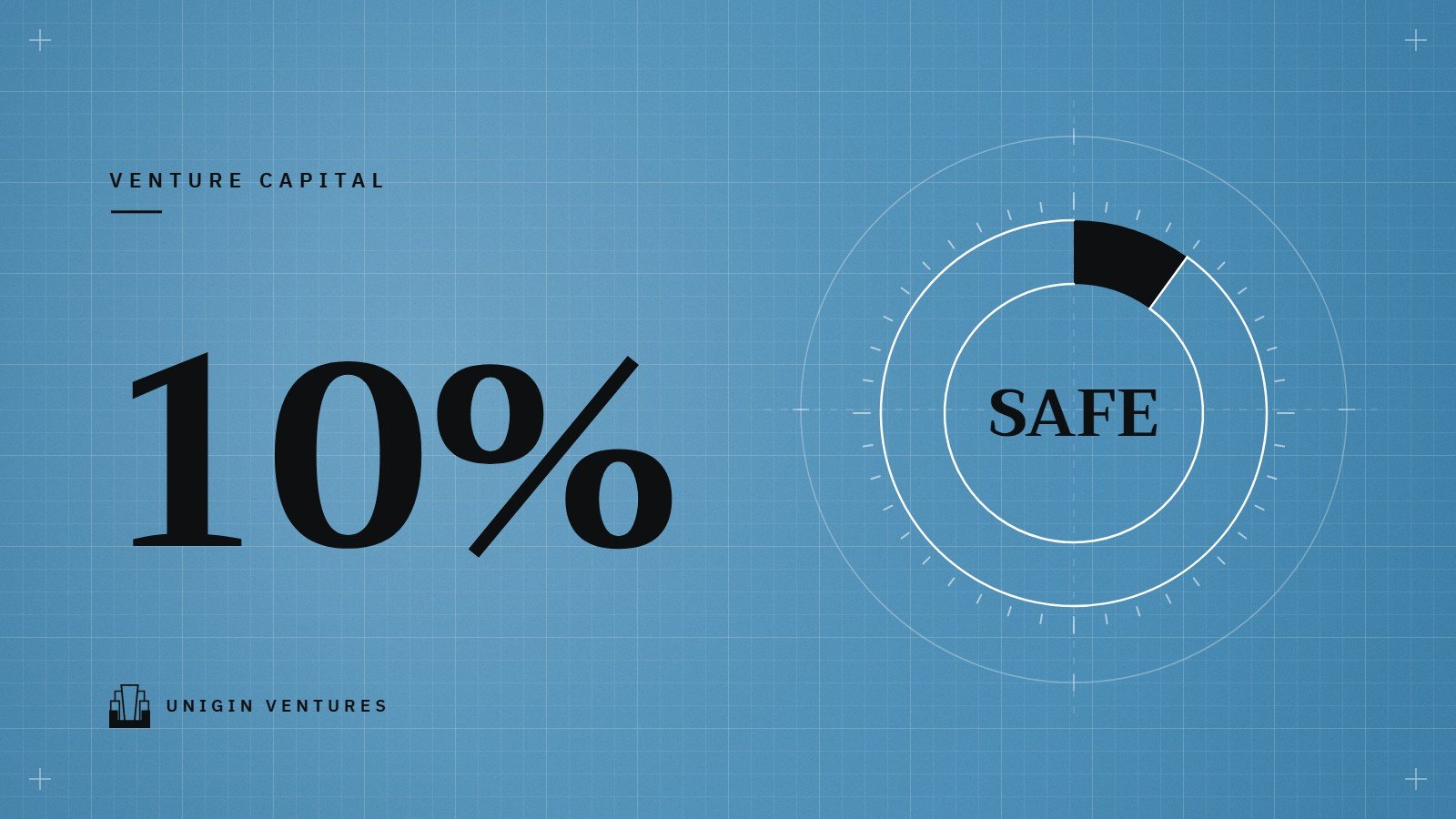
A post-money SAFE is simpler for founders to read, because the cap is the valuation after the money comes in. The investor's stake before the next round equals the investment divided by the cap: 5 million baht at a 50 million baht cap is 10%. If you issue several SAFEs, add up the stakes from all of them to see what the founders will hold going into the new round.
The constraints on a Thai limited company
Several sections of the Civil and Commercial Code make converting money into shares harder in a Thai limited company than abroad:
- Section 1229 states that a company may not issue debentures. A limited company that wants to issue convertible debt therefore has to work within securities law and the rules of the Securities and Exchange Commission (SEC).
- Section 1119 requires shares to be paid for in money and bars shareholders from setting off debts against the company. Lending money in the ordinary way and later setting the loan off against the share price does not work directly.
- Section 1220 requires a special resolution of shareholders to increase capital by issuing new shares.
- Section 1222 requires new shares to be offered first to existing shareholders in proportion to their holdings, so allocating them to an investor needs the right process.
- Section 1105 prohibits issuing shares below par value, so the calculated conversion price cannot fall below the registered par value.
Y Combinator's SAFE is written for US-incorporated companies, with versions for Canada, the Cayman Islands and Singapore. It was not designed for Thai limited companies, and Y Combinator itself advises consulting a lawyer licensed in the relevant country before using it.
Routes that work in Thailand
Convertible debentures by private placement for SMEs (PP-SME)
SEC rules allow a limited company that is an SME under the legal definition, or a large enterprise, to offer shares or convertible debentures to a limited group of investors without applying for approval or filing a registration statement. The key points, as the SEC summarizes them:
- The company must register for the SEC and OSMEP capital market funding program through the OSMEP website.
- It may sell to institutional investors without limits on amount or number. Under SEC notification Kor Jor. 39/2564 that definition includes private equity, venture capital entities and qualifying angel investors. Sales to directors and employees are also unlimited.
- Medium and large enterprises may also sell to up to 10 other investors, for no more than 50 million baht in total across shares and convertible debentures.
- The company must prepare a factsheet, must not advertise the offer widely, must register a transfer restriction with the SEC for each convertible debenture offering, must report sales within 15 days of the offer closing, and must report conversions within 15 days of each conversion.
This is the closest thing to a convertible note available to a Thai limited company. Terms such as a cap, a discount, interest and maturity can be written into the debenture terms, but they have to be designed around the constraints above, such as a conversion price no lower than par and a capital increase to support conversion.
Other options
- Issue new shares directly at an agreed price, also possible under PP-SME. Simple to understand, but you have to agree a valuation now.
- Crowdfunding through an SEC-licensed portal, another route under SEC rules.
- Set up an offshore holding company so you can use a SAFE under that country's law. Setup, tax and maintenance costs need to be weighed against the benefit. Decide early with a lawyer and a tax adviser, not after several investors are already on board.
Terms to negotiate clearly
- Valuation cap: pre-money or post-money, and is it reasonable for the company's progress?
- Discount: combined with the cap, or on its own?
- Conversion trigger: how large a round must be to force conversion.
- A sale before conversion: does the investor get the money back, shares, or a multiple?
- For debt instruments: interest rate, maturity, and what happens at maturity without a new round.
- Special rights such as MFN (receiving the best terms given to any later investor) or a right to invest in the next round.
Before you sign
- Build a cap table and model conversion at several next-round valuations, including one below the cap.
- Include every convertible instrument already issued, not just the one in front of you.
- Check that the company qualifies for PP-SME or whichever route you plan to use, and prepare the shareholder resolutions.
- Have a lawyer who knows Thai company and securities law review the documents before any money arrives.
Convertible instruments really do close deals faster, but the speed comes from postponing the arithmetic, not from removing it. Founders who understand the numbers on day one are not surprised by the cap table on conversion day.
This article is general information, not legal advice. The SEC rules described reflect the position as of September 2026.