Your First Term Sheet: Six Clauses Every Founder Should Understand Before Signing
Valuation is one line of a term sheet. Pre-money, the option pool and liquidation preference decide how much founders keep and how much they take home when the company is sold.

In this article
A term sheet is a short document that sets out the main terms of an investment before the lawyers draft the full agreements. Most of it is not legally binding, but in practice it is the deal. Once both sides sign, the share subscription agreement and the shareholders' agreement are written from it, and reopening a point later costs time and goodwill.
First-time founders tend to look at one number, the valuation. The clauses around it often matter more. They decide how much of the company you still own after a few rounds, how much you take home when the company is sold, and which decisions you can still make on your own. Here are six to understand before you sign.
1. Pre-money and post-money valuation
The pre-money valuation is what the company is worth before the new money comes in. The post-money valuation is the pre-money valuation plus the investment. The investor's stake is calculated on the post-money figure:
Investor's stake = investment ÷ post-money valuation
If an investor puts in 10 million baht at a 40 million baht pre-money valuation, the post-money valuation is 50 million baht and the investor owns 10 ÷ 50 = 20%. If the same 10 million baht is offered at a 40 million baht post-money valuation instead, the investor owns 25%. Always confirm which one a number refers to. It is one of the most common misunderstandings in early rounds.
2. The option pool
Investors usually want shares set aside for future employees, an employee stock option pool (ESOP), so the company can hire without renegotiating every time. The question is when the pool is created. If the term sheet puts it inside the pre-money valuation, it dilutes only the existing shareholders, not the new investor. A 10% pool created this way costs the founders 10% of the company before the round has even closed.
Size the pool from a hiring plan: who you need over the next 18 to 24 months and roughly how much equity each role needs. A pool bigger than the plan simply lowers the effective price the investor pays.
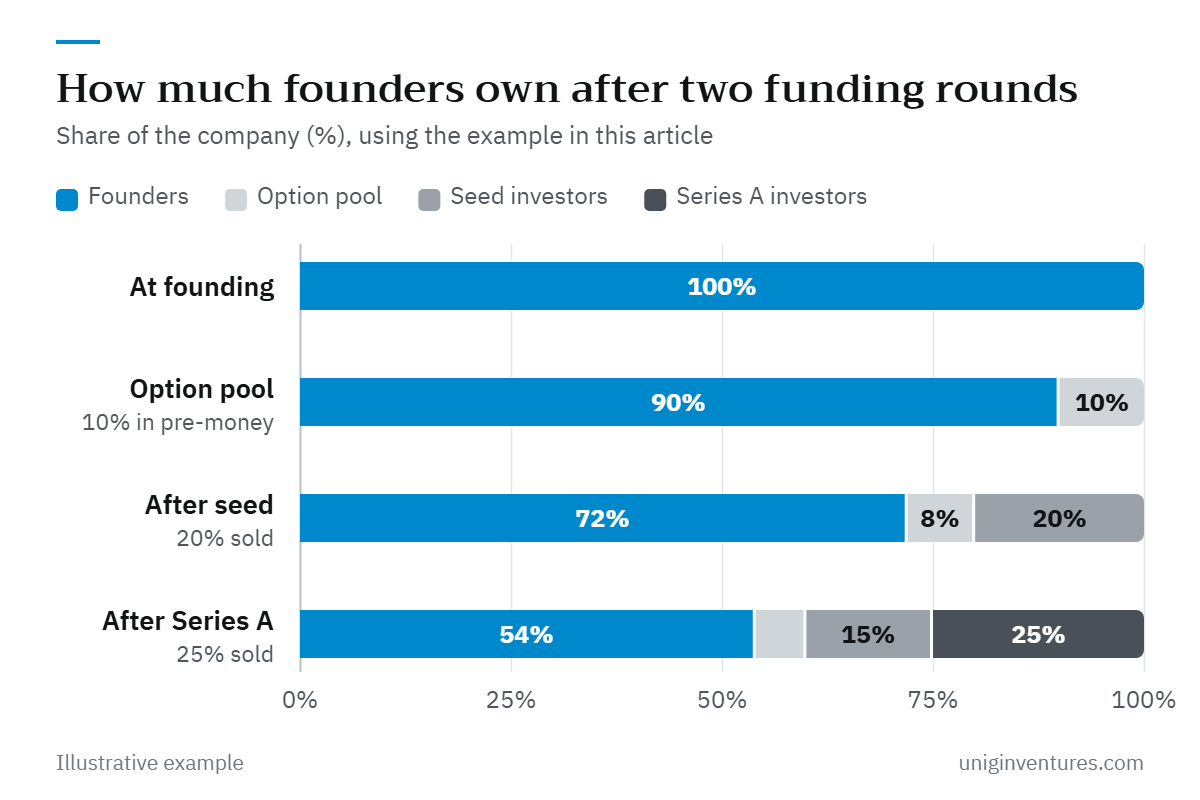
The chart shows how quickly this adds up. After a 10% pool, a seed round that sells 20% and a Series A that sells 25%, founders who started with 100% own 54%. None of those steps is unusual. The point is to model them before you agree, not after.
3. Liquidation preference
A liquidation preference decides who is paid first, and how much, when the company is sold or wound up. The market standard for early-stage rounds is a 1x non-participating preference: the investor receives either their money back or their percentage of the sale proceeds, whichever is higher. A participating preference lets the investor take their money back and then also share in what is left, which is why it is sometimes called a double dip.
Take an investor who puts in 20 million baht for 25% of the company, a 60 million baht pre-money valuation:
| Sale price | Non-participating: investor | Non-participating: everyone else | Participating: investor | Participating: everyone else |
|---|---|---|---|---|
| 16 million baht | 16 million | 0 | 16 million | 0 |
| 40 million baht | 20 million | 20 million | 25 million | 15 million |
| 200 million baht | 50 million | 150 million | 65 million | 135 million |
In a modest sale the difference is large. At 40 million baht, participation moves 5 million baht from the founders and team to the investor. Preferences above 1x, such as 2x or 3x, widen the gap further. Asking for a non-participating preference, or participation with a cap, is reasonable at seed and Series A.
4. Anti-dilution protection
If a later round is priced below this one, a so-called down round, anti-dilution clauses adjust the investor's conversion price so that they receive extra shares. The common, balanced version is broad-based weighted average, which adjusts according to how much new money comes in at the lower price. Full ratchet resets the investor's price all the way down to the new price, however small the new round, and can wipe out a large part of the founders' stake. Full ratchet is rare in healthy markets and worth pushing back on.
5. Board seats and veto rights
Control terms deserve as much attention as the economics. A typical early-stage board is two founders and one investor, sometimes with an independent director added later. Investors will also ask for protective provisions, decisions that need their consent. Consent over major events is normal: issuing a new class of shares, selling the company, changing the core business or taking on significant debt. Consent over day-to-day operations such as budgets, hiring or ordinary contracts slows the company down and is worth negotiating out.
6. Vesting, pro-rata rights and the binding clauses
- Founder vesting. Investors often ask founders to earn their shares over time, commonly four years with a one-year cliff, so that a co-founder who leaves early does not keep a full stake. It protects the founders who stay, too. Ask for credit for time already served.
- Pro-rata rights let the investor keep their percentage by joining future rounds. They are standard. Super pro-rata rights, the right to buy more than their share, are not.
- Drag-along and tag-along clauses decide how a sale works when shareholders disagree. Check the voting thresholds.
- Exclusivity (no-shop) stops you talking to other investors for a period, typically 30 to 60 days, and confidentiality binds both sides. These are usually the clauses that are legally binding even though the rest of the term sheet is not.
A note for Thai companies
In a Thai limited company, most of these rights are implemented through the shareholders' agreement and the company's articles of association, and preference rights have to be structured carefully to be enforceable. Some startups use a holding company abroad partly for this reason. Either way, work with a lawyer who has done venture deals before, and have your accountant check the numbers.
Before you sign
- Build a simple cap table and run it through this round and the next one.
- Work out what the founders would receive in a modest sale, not only in a big one.
- Ask the investor to explain any clause you do not understand. Good investors are happy to.
- Compare the terms with what is normal for the stage, and put control and exit terms ahead of a slightly higher valuation.
- Agree a timetable for closing, so the exclusivity period does not run out while nothing moves.
A fair term sheet is one that both sides can live with for the next five to ten years. Getting it right takes an afternoon with a spreadsheet and a few direct questions, far less effort than fixing it later.