The 13-Week Cash Flow Forecast: A Simple Tool That Keeps SMEs Solvent
Profitable businesses still run out of cash. A rolling 13-week forecast shows, week by week, when cash will get tight, early enough to do something about it.

In this article
Many SMEs that fail were profitable on paper. The income statement records a sale when you issue the invoice, but the cash arrives when the customer pays, often 30, 60 or 90 days later. Meanwhile salaries, suppliers, rent and taxes fall due on fixed dates. A growing business can make more profit every month and still run out of money along the way.
The simplest tool for seeing this coming is a 13-week cash flow forecast: a week-by-week list of the cash you expect to receive and pay over the next quarter, updated every week.
Why 13 weeks, and why weekly
Thirteen weeks is one quarter. It is long enough to spot a problem while there is still time to fix it, and short enough to forecast with reasonable confidence. Weekly detail matters because cash pressure follows a calendar. Payroll goes out at the end of the month. In Thailand, withholding tax is due by the 7th and VAT by the 15th of the following month for paper filing (online filing gets extra days, as announced by the Revenue Department), and social security contributions by the 15th. A monthly average smooths these peaks away. A weekly view shows the weeks where they pile up.
How to build one
- Start from the bank. Use today's actual combined balance of every business account. Not the balance in the accounting system, and not the figure you hope for.
- List receipts by customer and by the week you realistically expect to be paid, based on how each customer actually pays rather than the due date on the invoice. Keep money that is certain, from invoices already issued, separate from money that is likely, from deals still in progress.
- List payments on the dates they will really leave the account: suppliers by due date, payroll, rent and utilities, loan repayments, and taxes and social security on their statutory dates. Include the items that come once a quarter or once a year, such as insurance, annual fees or half-year corporate income tax.
- Calculate each week's closing balance (opening balance plus receipts minus payments) and compare it with a minimum cash buffer. One month of fixed costs is a common starting point.
For a small trading business, the first four weeks might look like this (thousands of baht):
| Week 1 | Week 2 | Week 3 | Week 4 | |
|---|---|---|---|---|
| Opening cash | 1,200 | 1,350 | 1,130 | 1,210 |
| Receipts from customers | 900 | 520 | 610 | 780 |
| Suppliers | −380 | −330 | −420 | −300 |
| Payroll | 0 | 0 | 0 | −830 |
| Tax and social security | −70 | −250 | 0 | 0 |
| Rent, utilities and loan | −300 | 0 | 0 | 0 |
| Other expenses | 0 | −160 | −110 | −60 |
| Closing cash | 1,350 | 1,130 | 1,210 | 800 |
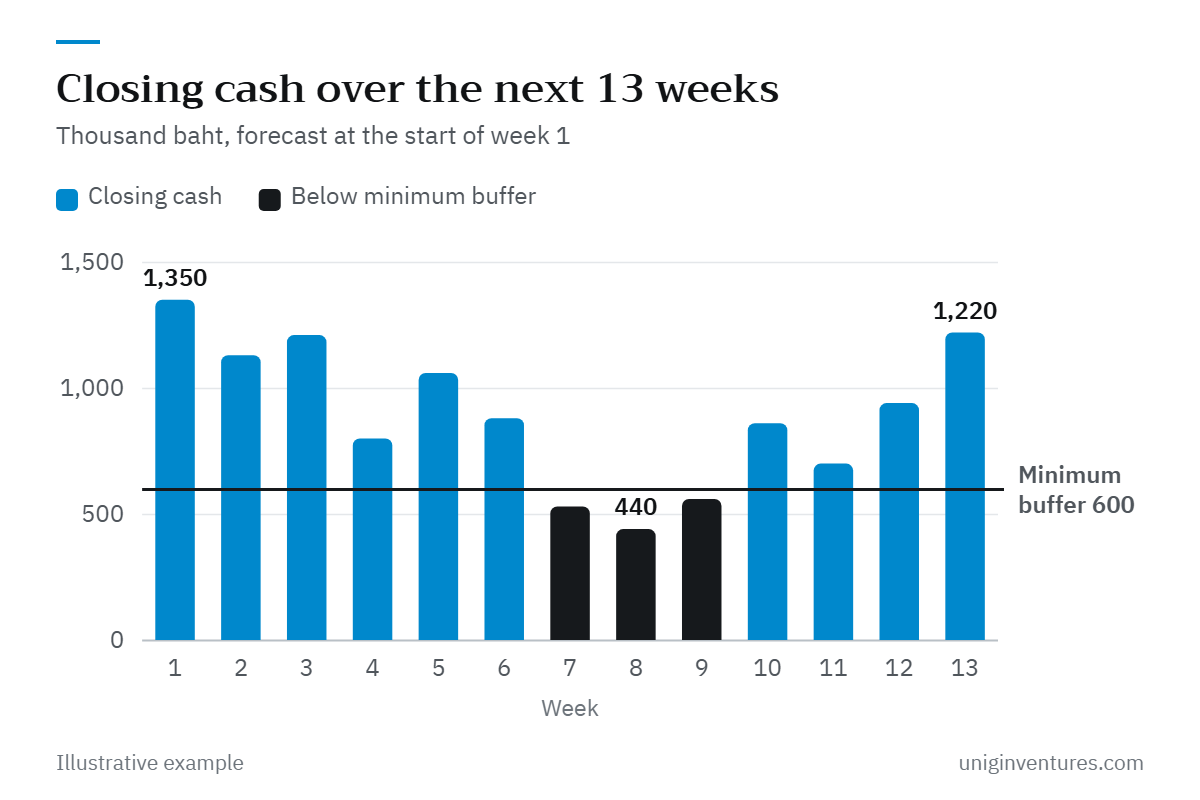
Extended over the full quarter, the same business drops below its 600,000 baht buffer in weeks 7 to 9, even though every month on its own ends with a comfortable balance. Knowing that in week 1 leaves six weeks to act. Finding out in week 7 leaves none.
Make it a weekly habit
A forecast is only useful while it is current. Pick a fixed time each week; Monday morning works for many teams:
- replace last week's forecast with the actual figures from the bank;
- add a new week at the end, so you always look 13 weeks ahead;
- look at any line that missed by more than about 10% and ask why. It is usually a customer paying late or a cost nobody listed.
After a month or two the forecast becomes noticeably more accurate, because you learn how your customers really pay.
What to do when you see a gap
- Speed up collections. Invoice on the day the work is delivered, remind customers before the due date rather than after it, take deposits on large projects, and make paying easy with bank details or a QR code on every invoice.
- Time your payments. Pay suppliers on the due date rather than early unless there is a discount, and talk to key suppliers early if you need longer terms. Most would rather agree a plan than chase a late payment.
- Release cash from stock. Slow-moving inventory is cash sitting on a shelf.
- Arrange financing before you need it. Banks lend more readily to a business that can show a forecast and a buffer than to one asking in a hurry.
- Postpone spending that can wait, such as new equipment, extra hires or campaigns, until the tight weeks have passed.
Common mistakes
- Forecasting receipts on invoice due dates instead of the dates customers actually pay.
- Leaving out quarterly or annual payments, bonuses, or tax on profits.
- Mixing personal and business money, so the balance never matches reality.
- Building the forecast once for a bank loan and never updating it.
Why investors care
When an investor asks about runway, how many months the cash will last, a founder who can open a current 13-week forecast alongside a longer monthly plan shows more than the numbers. It shows that the business knows where its cash is going. That is one of the fastest ways to build confidence in a first meeting, and one of the cheapest habits to start.