The Cash Conversion Cycle: Freeing the Cash Tied Up in Stock and Receivables
Sales are up but cash is tight because money is stuck in stock and receivables. How to calculate DIO, DSO and DPO from your own accounts, turn days into baht, and shorten the cycle.
In this article
A business can sell more every month and still find its bank balance getting tighter. In a trading or manufacturing business, cash travels in a loop: you pay for goods, the goods sit in the warehouse, you sell them on credit, and then you wait for the customer to pay. The longer that loop, the longer your money is stuck in stock and receivables, and the more you sell, the more money gets stuck.
The number that measures the loop is the cash conversion cycle, counted in days. This article shows how to calculate it from your own financial statements, turn the days into baht, and decide where to pull trapped cash back first.
The three parts of the cycle
- Days inventory outstanding (DIO): how many days stock sits before it is sold.
- Days sales outstanding (DSO): how many days after a sale you get paid.
- Days payable outstanding (DPO): how many days after buying you pay your suppliers.
Cash conversion cycle = DIO + DSO − DPO
The Stock Exchange of Thailand uses the same formula for listed companies. The result is the number of days your own money has to fund trade, from the day you pay a supplier to the day a customer pays you. Lower is better. Some businesses that sell for cash on the spot but buy on credit have a negative cycle: customers pay them before they have to pay for the goods.
Calculate it from your financial statements
Take full-year figures from the income statement and balances from the balance sheet. Where you can, use the average of the opening and closing balances.
DIO = inventory ÷ cost of sales × 365
DSO = trade receivables ÷ revenue × 365
DPO = trade payables ÷ cost of sales × 365
Two details matter. DIO and DPO divide by cost of sales, because inventory and payables are recorded at cost. DSO divides by revenue, because receivables are recorded at selling price. If you sell both for cash and on credit, dividing by credit sales alone gives a more realistic DSO. For DPO, annual purchases are more accurate than cost of sales if you have the figure.
A worked example
Take an illustrative equipment distributor with annual revenue of 36.5 million baht (100,000 baht a day on average) and cost of sales of 25.55 million baht (70,000 baht a day).
| Item | Balance (baht) | Divided by daily | Days |
|---|---|---|---|
| Inventory | 2,800,000 | Cost of sales 70,000 | DIO 40 |
| Trade receivables | 3,500,000 | Revenue 100,000 | DSO 35 |
| Trade payables | 2,100,000 | Cost of sales 70,000 | DPO 30 |
| Cash conversion cycle | 40 + 35 − 30 = 45 days |
The cash tied up in trade is inventory plus receivables minus payables: 2.8 + 3.5 − 2.1 = 4.2 million baht. The business has to fund that amount at all times, from the owners' capital or from borrowing.
Turn days into baht
Days only become useful once you know what each one is worth. The rule of thumb:
- Cut DSO by one day and you release one day of revenue, 100,000 baht in the example.
- Cut DIO by one day and you release one day of cost of sales, 70,000 baht.
- Extend DPO by one day and you keep one day of cost of sales, 70,000 baht, in the business a little longer.
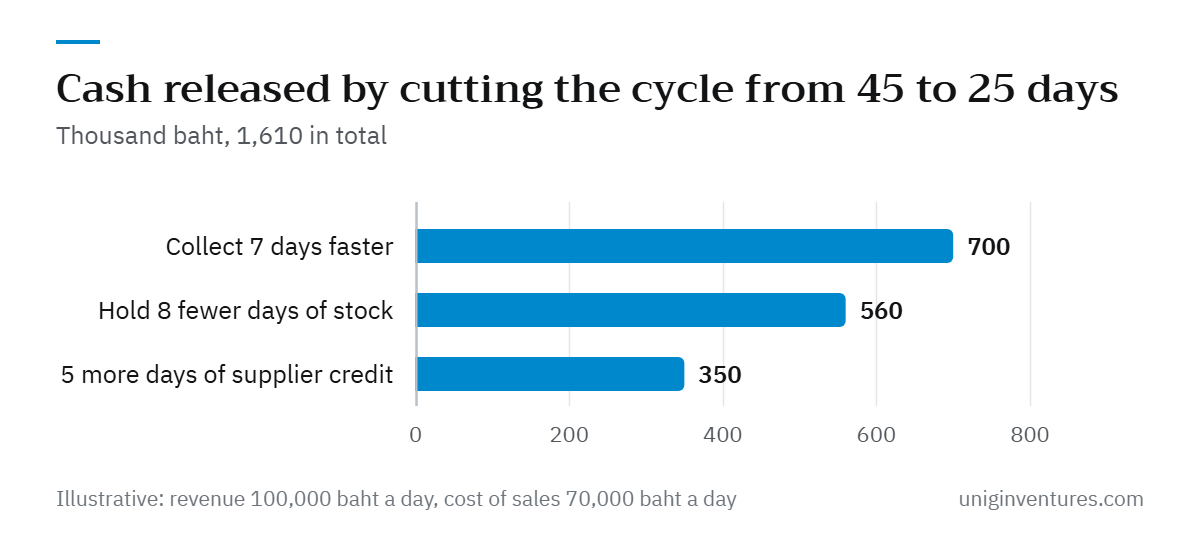
If the company collects seven days faster (DSO 35 → 28), holds eight fewer days of stock (DIO 40 → 32) and negotiates five more days of supplier credit (DPO 30 → 35), the cycle falls to 25 days and 1.61 million baht of cash comes back, without a single extra sale.
The other side is easy to miss: growth consumes cash. If revenue grows 20% and the days stay the same, the cash tied up in trade grows to 5.04 million baht. The business needs another 840,000 baht just to carry the extra sales. That is why fast-growing companies often run short of cash while reporting a profit.
Five ways to shorten the cycle
1. Collect faster
- Invoice on the day you deliver the goods or the work. Every day of delay adds a day to DSO.
- Review the receivables aging report every week, and remind customers before the due date rather than after it.
- Put credit terms in writing, and review the limits of customers who pay late as a habit.
- On project work, take a deposit or bill in stages as the work progresses.
2. Cut slow-moving stock
Rank products by how fast they sell. A handful of slow lines usually holds a large share of the money in the warehouse. Order smaller quantities more often, reset reorder points from actual sales, and clear old stock even at a discount. The cash you recover is usually worth more than goods waiting on a shelf.
3. Negotiate supplier terms openly
Ask for longer credit and offer something the supplier values in return: steady orders, a forecast, or consolidating your purchases with them. Do not simply pay later than agreed. That makes DPO look better on paper while destroying trust, and many of your suppliers are SMEs that need cash as much as you do.
4. Price early-payment discounts properly
Terms of "2/10 net 30" mean you get a 2% discount for paying within 10 days, or you pay the full amount within 30. Skip the discount and you pay 2% extra to keep the money for another 20 days.
Annual cost of skipping the discount = 2 ÷ 98 × 365 ÷ 20 ≈ 37.2%
That is far above typical borrowing rates. If you have cash or a credit line that costs less, taking the discount usually beats stretching DPO.
5. Service businesses have a cycle too
A service business has no inventory, but work that is done and not yet billed plays the same role. Count the days from starting the work to issuing the invoice. Billing by milestone instead of waiting for the project to finish is often the biggest single improvement.
Read the numbers with care
- Compare with yourself before comparing with others. Cash cycles vary widely by industry. A cash retailer, a manufacturer and a distributor should not use the same benchmark. Your own monthly trend matters more.
- Year-end balances can mislead. A seasonal business may carry unusually high or low stock or receivables at year end. Averages or monthly calculations give a truer picture.
- Averages hide big customers. A DSO of 35 days can mean most customers pay in 20 days while one large customer pays in 90. Always read it alongside the aging report.
- Check improvements that look too fast. A sudden drop in DIO may mean stock-outs and lost sales. A big jump in DPO may mean late payment, not better terms.
Start this week
- Pull last year's financial statements and calculate DIO, DSO, DPO and the cash conversion cycle.
- Work out what one day of each is worth in baht (revenue per day and cost of sales per day).
- Pick one target you can hit within a quarter. DSO is usually the easiest place to start.
- Recalculate every month from the monthly accounts, and put it in the management report next to the cash balance.
Investors and banks always ask about working capital, because it shows whether their money will fund growth or sit in a warehouse and a receivables ledger. A founder who knows the company's cash cycle in days, and what is being done to shorten it, comes across as far better prepared than one who only knows revenue.