Unit Economics for SMEs: CAC, LTV and Payback, the Numbers Investors Ask About First
Growth only creates value when each customer is worth more than it costs to win them. How to calculate CAC, LTV and payback correctly, and the mistakes that make the numbers look better than they are.

In this article
Revenue growth is easy to show and easy to misread. A business can double its sales and still destroy value if every new customer costs more to win than they will ever bring back. Unit economics answers the more useful question: how much does one customer cost you, and how much do they earn you over time? It is usually the first thing an investor tries to work out, and it is just as useful to an owner deciding where to spend the next baht of marketing.
The examples below use a subscription business, but the same logic works for any company with repeat customers.
Customer acquisition cost (CAC)
CAC = total sales and marketing cost in a period ÷ new customers won in that period
"Total" means everything it takes to win customers: advertising, sales and marketing salaries, commissions, agency fees, events and software. If a business spent 450,000 baht on all of these last month and won 50 new customers, its CAC is 9,000 baht.
Calculate CAC for each channel as well as overall. A blended figure can look healthy while one expensive channel quietly loses money.
Gross profit per customer
A customer's value comes from the gross profit they generate, not their revenue. If the average customer pays 1,500 baht a month and the gross margin after the direct costs of serving them is 70%, each customer contributes 1,050 baht a month.
Churn and lifetime value (LTV)
Churn is the share of customers who leave in a given period. With monthly churn of 3%, the average customer stays about 1 ÷ 0.03, or roughly 33 months. A simple estimate of lifetime value is:
LTV = monthly gross profit per customer ÷ monthly churn = 1,050 ÷ 3% = 35,000 baht
The two ratios investors look at
| Measure | Example | Common benchmark |
|---|---|---|
| CAC | 9,000 baht | |
| Monthly gross profit per customer | 1,050 baht | |
| LTV | 35,000 baht | |
| LTV : CAC | 3.9 : 1 | 3 : 1 or better |
| CAC payback | 8.6 months, about 10 once churn is included | Under 12 months |
LTV to CAC compares what a customer is worth with what they cost. Around 3 to 1 is a common benchmark. Much lower and growth burns cash; much higher can mean you are under-investing in growth.
CAC payback is the number of months of gross profit it takes to earn back the cost of winning a customer: 9,000 ÷ 1,050 ≈ 8.6 months. Payback matters as much as LTV, because it decides how much cash growth consumes before it starts paying for itself.
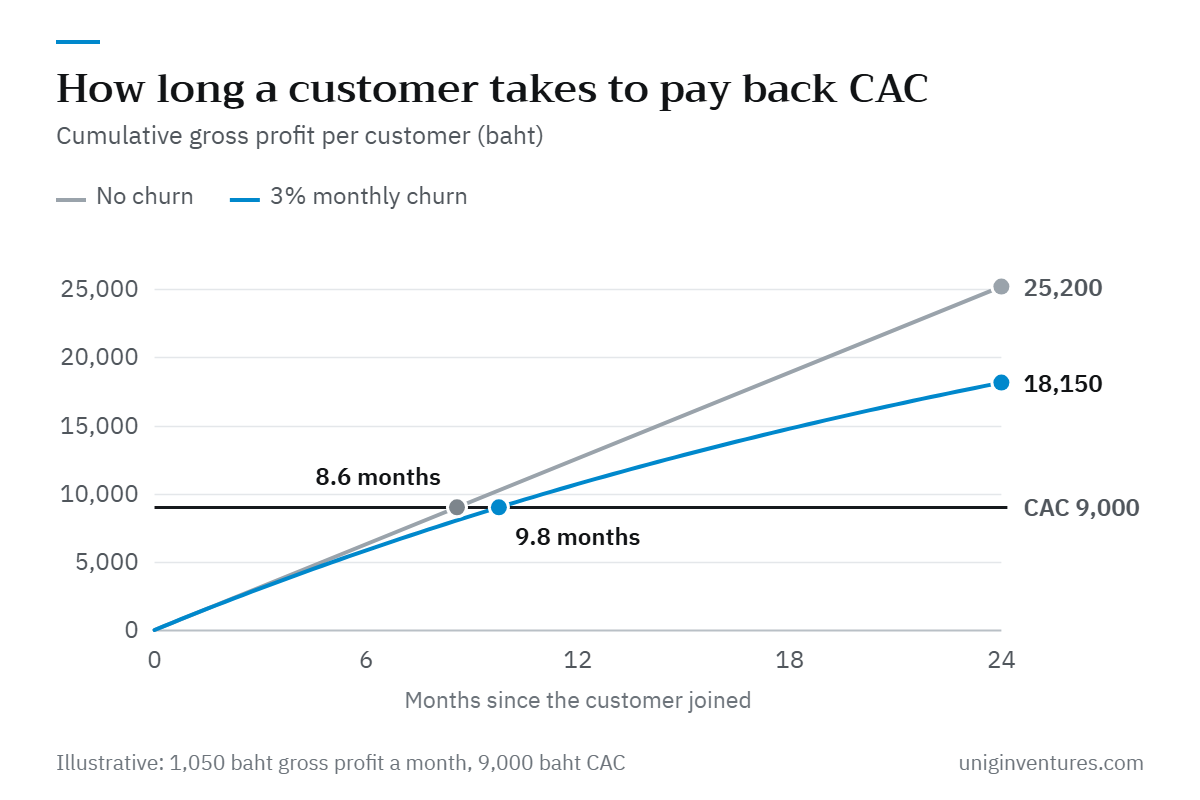
The simple payback figure assumes every customer stays. Once churn is included, the expected cumulative gross profit per customer crosses 9,000 baht about a month later, and the gap keeps widening. Use the churn-adjusted figure when you plan cash.
Mistakes that flatter the numbers
- Using revenue instead of gross profit in LTV, which can overstate it by half or more.
- Leaving salaries out of CAC and counting only advertising.
- Trusting churn from young cohorts. Customers in their first months often behave differently from those who have stayed a year. Track retention by the month customers joined.
- Averaging across channels, which hides the channel that loses money.
- Letting lifetime run forever. With very low churn the formula produces enormous LTVs, so many investors cap lifetime at three to five years.
- Ignoring discounts and free trials that reduce real revenue in the first months.
How to improve unit economics
- Retention first. Good onboarding and regular contact in the first months reduce churn, which raises LTV and shortens payback at the same time.
- Pricing. Small price changes flow almost entirely into gross profit, and annual plans bring cash in earlier.
- Channel mix. Shift budget toward the channels with the best payback, and grow referrals, which usually have the lowest CAC.
- Upselling. Revenue from existing customers costs far less to win than revenue from new ones.
For businesses without subscriptions
If customers buy repeatedly rather than subscribe, replace churn with the repeat purchase rate and the average number of orders per customer over a year or two. The questions stay the same: what does a customer cost, what do they earn you, and how long until they pay back.
What investors want to see
Bring a simple cohort table showing how many customers from each month are still active, CAC for each channel, and the assumptions behind your LTV. Honest numbers with clear assumptions build more confidence than impressive numbers that fall apart after a few questions.