Investor-Ready Books: A 10-Day Monthly Close That Stands Up to Due Diligence
Clean, timely accounts speed up fundraising and build trust. A practical monthly close routine for Thai SMEs, and the documents investors usually ask for in due diligence.

In this article
Before an investor puts money into a business, they check its numbers, usually in detail. If the accounts are late, inconsistent or hard to explain, due diligence drags on, the valuation comes down, or the deal quietly dies. The same numbers also tell you, the owner, whether the business is actually making money. Getting them right every month is one of the most valuable habits an SME can build, long before it raises any capital.
Get the foundations right
- Separate business and personal money. Every business receipt and payment should go through the company's own bank accounts. Mixed accounts are the most common problem found in small-company due diligence, and they make every other number doubtful.
- Use the accrual basis. Record revenue when it is earned and costs when they are incurred, not when cash moves. Cash-basis records hide what is really happening in a growing business.
- Follow the right standard. Most private Thai companies report under TFRS for NPAEs, the standard for non-publicly accountable entities. If you plan to list on a stock exchange, or your investors require it, you may need full TFRS, and switching is easier early.
- Keep a clear chart of accounts that separates revenue streams and major cost types, so your reports answer the questions investors ask.
- Keep the evidence. File tax invoices, receipts, contracts and payroll records so that any number can be traced back to a document.
A 10-day monthly close
The monthly close is the routine that turns a month of transactions into reliable financial statements. For most SMEs, ten working days is a realistic target; larger finance teams aim for five. The order matters more than the speed: reconcile first, then adjust, then report.
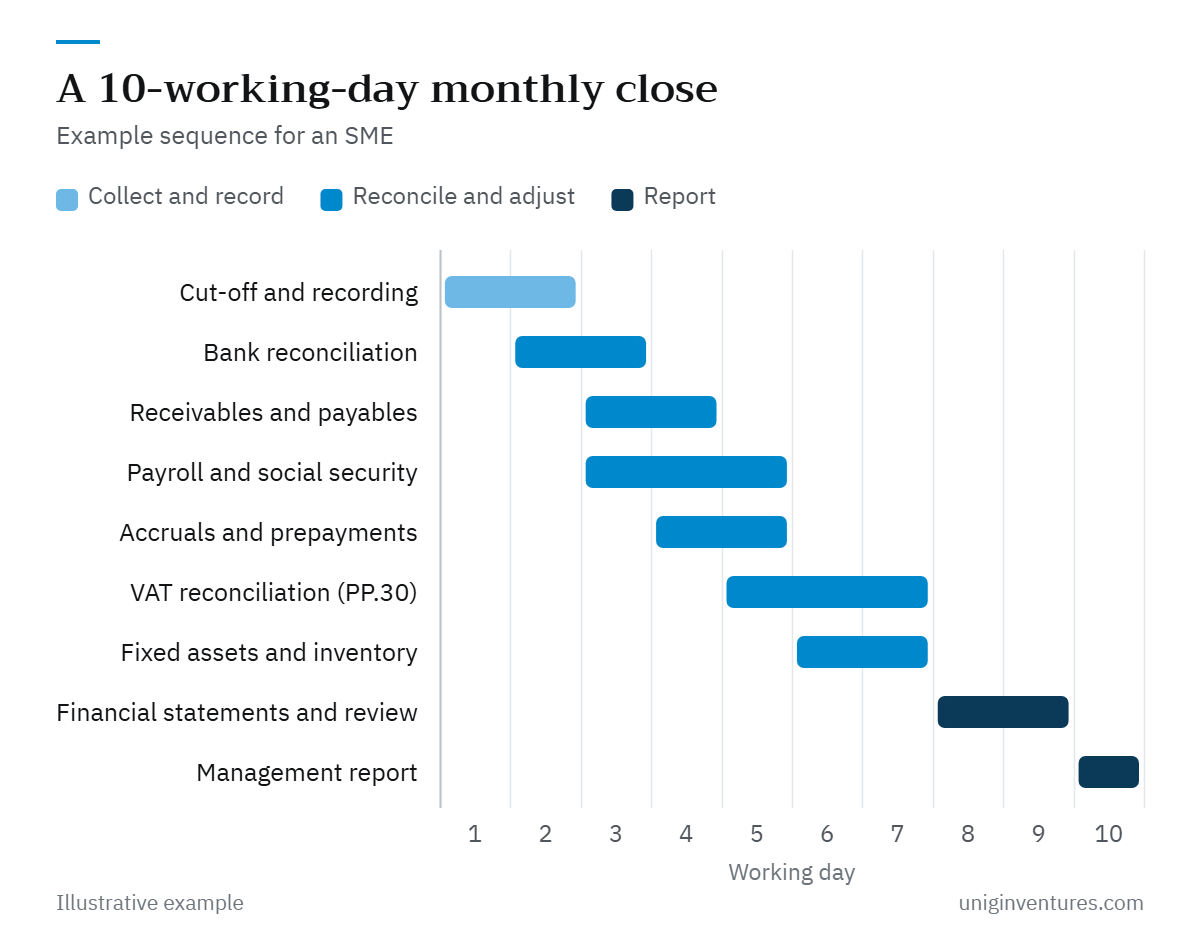
- Days 1–2: cut-off and recording. Collect every invoice, receipt and bank statement for the month and record all transactions. Chase missing documents now, not at year end.
- Days 2–3: bank reconciliation. Match every business bank account to the ledger, down to the last baht, and investigate anything unexplained.
- Days 3–4: receivables and payables. Review the aging of what customers owe you and what you owe suppliers, follow up overdue invoices, and check supplier statements.
- Days 3–5: payroll, social security and withholding tax. Make sure salaries, contributions and tax withheld are recorded correctly and match what was filed and paid.
- Days 4–5: accruals and prepayments. Record costs incurred but not yet invoiced, spread prepaid expenses over the right months, and defer revenue received for work not yet delivered.
- Days 5–7: VAT reconciliation. Agree output and input VAT in the ledger with the tax invoices and the monthly VAT return (PP.30), which is due by the 15th of the following month.
- Days 6–7: fixed assets and inventory. Post depreciation, record new assets, and count or review inventory and its value.
- Days 8–9: financial statements and review. Produce the income statement, balance sheet and cash flow statement, and look for anything that moved unexpectedly compared with last month or the budget.
- Day 10: management report. Send a short pack to the founders, and later to investors.
What goes in the monthly report
Investors do not need a thick binder. A few pages, sent on time every month, are worth far more:
- the income statement against budget and against the same month last year;
- the balance sheet and cash flow, with cash on hand and runway in months;
- a handful of key figures: gross margin, operating expenses, receivable days, payable days and monthly cash burn;
- a few lines explaining what changed and why.
What investors ask for in due diligence
A typical financial due diligence request for a Thai SME includes:
- audited financial statements for the last two to three years, and management accounts for the current year;
- tax filings: corporate income tax returns (PND.50 and PND.51), monthly VAT returns (PP.30) and withholding tax filings;
- bank statements, aging reports for receivables and payables, and a fixed asset register;
- payroll and social security records;
- major customer, supplier and loan contracts;
- company registration documents and the current list of shareholders.
If you can produce all of this within a few days, the process moves quickly and the investor starts from a position of trust.
Red flags that slow deals down
- Revenue in the accounts that does not match the sales declared in VAT returns.
- Personal expenses paid by the company, or company income received into personal accounts.
- Unreconciled accounts, or large balances parked in "suspense" or "other" accounts.
- Unrecorded liabilities, such as unpaid tax, social security or supplier bills.
- Transactions with related parties that have no contract or unusual prices.
- Large adjustments made only at year end.
Tools and responsibilities
Cloud accounting software with bank feeds removes much of the manual work, and e-Tax Invoice makes documents easier to issue and track. Many SMEs outsource bookkeeping, which is sensible, but the owner or a finance lead should still review the numbers every month. Remember the annual obligations too: an audit by a certified public accountant, approval of the financial statements at the annual general meeting within four months of year end, filing them with the Department of Business Development within one month of that approval, and filing the corporate income tax return within 150 days of year end.
A business that closes its books reliably every month rarely has a stressful due diligence, and it makes better decisions long before any investor arrives.