Building a Data Room Before Due Diligence: Eight Folders to Prepare
After a term sheet, investors send a long document request. How to build an eight-folder data room for a Thai limited company, what must match your filings, and a three-week plan.
In this article
Most founders think the hard part of fundraising ends with the term sheet. In practice, the paperwork is just starting. Once the term sheet is signed, the investor and its lawyers begin due diligence and send a long document request. If the company has to hunt for each item, closing slows down, and every question you cannot answer gives the investor a reason to revisit the terms.
Y Combinator's Series A diligence checklist notes that closing a round can take more than a month, much of it spent tracking down documents for lawyers, and that having everything in one place before signing a term sheet can cut as much as a week off the closing process. This article shows how to build a data room for a Thai limited company: which folders to create, what goes in each, where SMEs usually get stuck, and a three-week plan to finish.
What a data room is
A data room is an organized store of company documents that investors review. Today it is almost always online (a virtual data room), either a specialist service or a cloud folder with proper access controls. The structure matters more than the tool. Investors should be able to find documents without asking, and every number in the documents should match what the founders said in the pitch deck.
Remember that investors can already see some of your information. Financial statements a company files with the Department of Business Development (DBD) are searchable through DBD DataWarehouse+. If the numbers in your data room differ from what you filed, investors will notice right away.
Eight folders
Y Combinator's checklist groups documents into corporate records and charter documents, business plan and financials, intellectual property, securities issued, material agreements, disputes, and employees. The table below adapts those groups to the documents a Thai limited company actually holds, and gives tax its own folder.
| Folder | Key documents |
|---|---|
| 1. Company and governance | Latest company affidavit (certificate of registration), memorandum of association, articles of association, minutes of every shareholder and board meeting, group structure chart (if any) |
| 2. Shareholders and securities | Share register, every year's Bor Or Jor 5 shareholder list, cap table, shareholders' agreement, convertible instruments, ESOP plan and grant agreements |
| 3. Finance | Audited financial statements for the past 2–3 years, monthly management accounts for the current year, financial projections, receivables and payables aging reports |
| 4. Tax | PND 50 and PND 51 corporate tax returns, monthly PP 30 VAT returns, withholding tax returns, letters or summonses from the Revenue Department |
| 5. Material agreements | Contracts with major customers and suppliers, loan and security agreements, leases, insurance policies, standard contract templates and terms of service |
| 6. Intellectual property | List of trademarks, patents and domain names with registration evidence, assignment agreements from founders, employees and freelancers |
| 7. People | Organization chart, roles and compensation, standard employment contract, work rules, consulting agreements, loans the company has made to employees or directors |
| 8. Disputes and licenses | Pending or threatened disputes, significant complaints, business licenses, personal data protection policy |
Number every folder and document (for example 2.3) and put an index file at the top. When investors ask questions, everyone refers to the same document, and you can see at a glance which slots are still empty.
Documents that must match your official filings
The first thing the investor's lawyers do is compare your internal documents with what the company has filed with the authorities. The relevant legal deadlines are:
- Financial statements: a limited company must present financial statements audited by a licensed auditor to a general meeting for approval within 4 months of the fiscal year-end, and file them with the registrar within 1 month of approval.
- Bor Or Jor 5: a limited company must file a copy of its shareholder list as of the annual general meeting with the registrar within 14 days of that meeting, under Section 1139 of the Civil and Commercial Code.
The usual mismatch is between the cap table in the founders' spreadsheet and the share register and latest Bor Or Jor 5, for example a share transfer or a promise of shares that was never properly documented. Another is between management accounts and audited statements. If revenue in the management accounts differs from the filed statements, prepare a reconciliation that explains each difference line by line. A difference you can explain is not a problem. One you cannot explain is.
Where SMEs usually get stuck
Intellectual property is not in the company's name
The trademark is registered to a founder, the domain sits in a personal account, and the software was written by a freelancer with no assignment agreement. Y Combinator's checklist asks for evidence of every assignment of IP to the company, because investors are buying shares in the company, not in the founders. If anything important sits outside the company, complete the assignments before you open the data room, and have a lawyer check that your employment and contractor agreements clearly deal with ownership of work.
Money between founders and the company is undocumented
Money a director has lent to the company, or that the company has paid on a director's behalf, needs an agreement or record showing the amount, the terms and the repayment. Y Combinator's checklist specifically asks for documents on any loans the company has made to employees, directors or consultants.
Key contracts are only verbal
Investors treat revenue from a major customer with no contract as at risk, even after years of trading. If you cannot sign a contract yet, collect purchase orders, invoices and emails confirming the terms instead. Also check existing contracts for clauses that require the other party's consent when ownership changes.
Opening access safely
- Open in stages. Before a term sheet, share summary information such as financial statements, key metrics and the ownership structure. Open contracts and full detail after signing.
- Sign a non-disclosure agreement (NDA) before sharing trade secrets such as customer-level pricing or technical detail. If an investor prefers not to sign early on, opening in stages means you do not have to share sensitive material too soon.
- Redact personal data. Information that identifies employees or customers is covered by the Personal Data Protection Act B.E. 2562 (2019). List employees by role rather than name, and remove ID card numbers, addresses and bank account numbers from copies. If you are unsure how much you can share, ask a lawyer first.
- Set permissions per person. Use view-only access, disable downloads for sensitive documents, and keep a log of who opened what and when.
A three-week plan
As an illustrative example, take a company with 20 employees where one founder and one accountant do this alongside their regular work. It takes about 15 working days: days 1–7 to collect documents, days 6–12 to reconcile, fix mismatches and redact personal data, and days 13–15 to set permissions and have an adviser review.
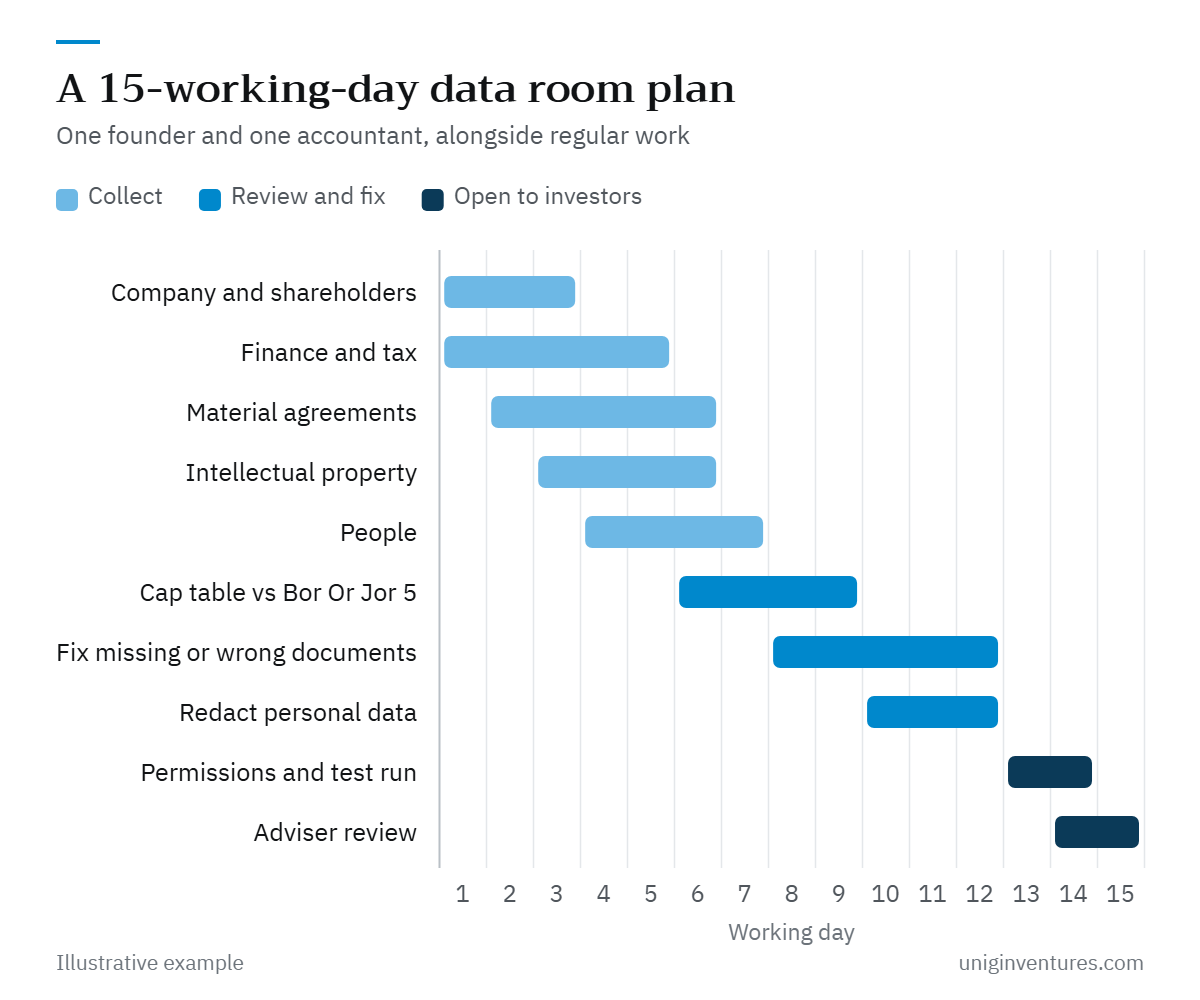
The time goes into fixing inconsistencies, not scanning paper: chasing signatures on IP assignments, or holding a shareholder meeting to ratify something already done. The earlier you start before talking to investors, the less pressure you face at this stage.
Where to start
- Create the eight folders and the index file today, even if most slots are empty.
- Get a current company affidavit and lay it next to the share register, the latest Bor Or Jor 5 and the cap table. Check that every line matches.
- Download your own filed financial statements from DBD DataWarehouse+ and compare them with your management accounts.
- List your intellectual property and confirm that every item is in the company's name.
- List contracts that are large or long-term, and find signed originals for all of them.
- Update the data room every quarter after closing the books. A well-maintained data room works for investors, banks and acquirers alike.
A ready data room does not raise your valuation directly. It lets investors see the company as it really is, quickly, and it shows that the founding team handles the basics well, which investors are judging throughout diligence.
This article is general information, not legal advice. The deadlines described reflect the position as of September 2026.
Sources
- Series A Diligence Checklist, Y Combinator Startup Library
- Manual for filing financial statements and shareholder lists, Department of Business Development (in Thai)
- DBD DataWarehouse+ company and financial statement search, Department of Business Development
- Personal Data Protection Act B.E. 2562, Office of the Personal Data Protection Committee (in Thai)