ESOPs in Thai Companies: Law, Vesting and Tax for Employee Equity
A Thai limited company cannot hold its own shares or issue below par, so how do you give employees equity? Workable structures, vesting terms, Section 40(1) tax and how the option pool affects founders.

In this article
Startups that cannot match big-company salaries often offer equity to attract strong people. When Thai founders sit down to set it up, though, they hit questions with no ready-made answers. Can a private limited company grant employees options over shares? What do existing shareholders have to approve? When does the employee pay tax? How much equity should be set aside?
This article explains the limits of Thai limited company law that shape an employee stock ownership plan (ESOP), the structures Thai companies can use, vesting terms, tax, and the effect on founder ownership when investors come in. It is general information. Have a lawyer and a tax advisor review your documents before you issue anything.
Company law limits to know first
ESOPs abroad usually grant options to buy new shares at a low price in the future. The Civil and Commercial Code, which governs private limited companies, has no specific provisions for this, and several rules shape the design:
- No issuing shares below par value (Section 1105). The exercise price for new shares cannot be below par. Companies with a low par value have more room to design.
- Capital increases need a special resolution of the shareholders' meeting (Section 1220), and new shares must first be offered to existing shareholders in proportion to their holdings (Section 1222). Issuing new shares to employees therefore requires existing shareholders to waive their rights to that portion.
- A company cannot hold its own shares (Section 1143). It cannot keep a reserve of its own shares to hand out later. Reserved shares must sit with another party or remain unissued until needed.
- Transfers of named shares must follow a set form (Section 1129): in writing, signed by transferor and transferee, and certified by a witness. The company's articles may add conditions, such as board approval.
Structures Thai companies can use
Founders transfer existing shares
Founders sign an agreement giving the employee the right to buy shares from them on a vesting schedule, and transfer the shares under Section 1129 when they vest. There is no need for a capital increase each time, but the founders are personally party to the agreement and must hold enough shares.
Issue new shares when rights vest
The company grants rights by contract, then increases capital in batches as employees vest, with existing shareholders waiving their subscription rights for that portion. Write this commitment into the shareholders' agreement from the start so you don't need fresh consent every time.
Hold through a vehicle
A company or nominee holds the ESOP shares and allocates the benefit to employees under the plan's conditions. This keeps the main company's shareholder register short, but adds setup and maintenance costs.
Phantom shares
No actual shares change hands. The company promises a cash payment based on the increase in share value when a defined event occurs, such as a sale of the company or a new funding round. The shareholder register is untouched, but the company must have the cash when the time comes, and some employees may not see it as real ownership.
Some startups that raise money from foreign investors set up a parent company abroad and run the ESOP at the parent level. That brings in another country's legal and tax rules, so get expert advice first.
Vesting: earning equity over time
The point of an ESOP is that employees earn shares by staying to build value, not all on day one. A structure widely used in the startup world is four-year vesting with a one-year cliff.
Illustrative example: an employee is granted 4,000 shares. If they leave before 12 months, they get nothing. At 12 months, 1,000 shares vest. After that, about 83 shares vest each month until all 4,000 have vested in month 48.
Terms the documents must spell out:
- Resignation or termination: whether unvested rights end immediately, and how many days the employee has to exercise vested rights.
- Bad leavers: for example, fraud or breach of a non-compete. At what price can the company or founders buy the shares back?
- Sale of the company: whether unvested rights accelerate.
- Employee shareholder obligations: such as drag-along when the majority sells, and limits on selling to outsiders.
Tax: employees may owe tax before they can sell
Several Revenue Department rulings take the position that the benefit an employee gets from buying shares below value because of employment is employment income under Section 40(1) of the Revenue Code, and the employer must withhold tax under Section 50(1).
- Listed shares: the rulings use the average market price in the month the employee acquires ownership, minus the exercise price.
- Shares with no market price: in one ruling, the Revenue Department valued the shares at book value for the accounting period before the one in which ownership was acquired.
Illustrative example: an employee exercises rights to buy 1,000 shares at the par value of 10 baht each, while book value per share for the previous year is 60 baht.
Section 40(1) income = (60 − 10) × 1,000 = 50,000 baht
The employee must include this income in the year they receive the shares, even though they cannot yet sell and have received no cash. Startups with accumulated losses often have low book value, so the tax may be modest. After a funding round at a high price, however, book value rises with the new capital, so timing matters. Rulings answer specific facts and do not automatically apply to every case. Have a tax advisor review the plan before launch, or request your own ruling.
Pool size and the effect on founders
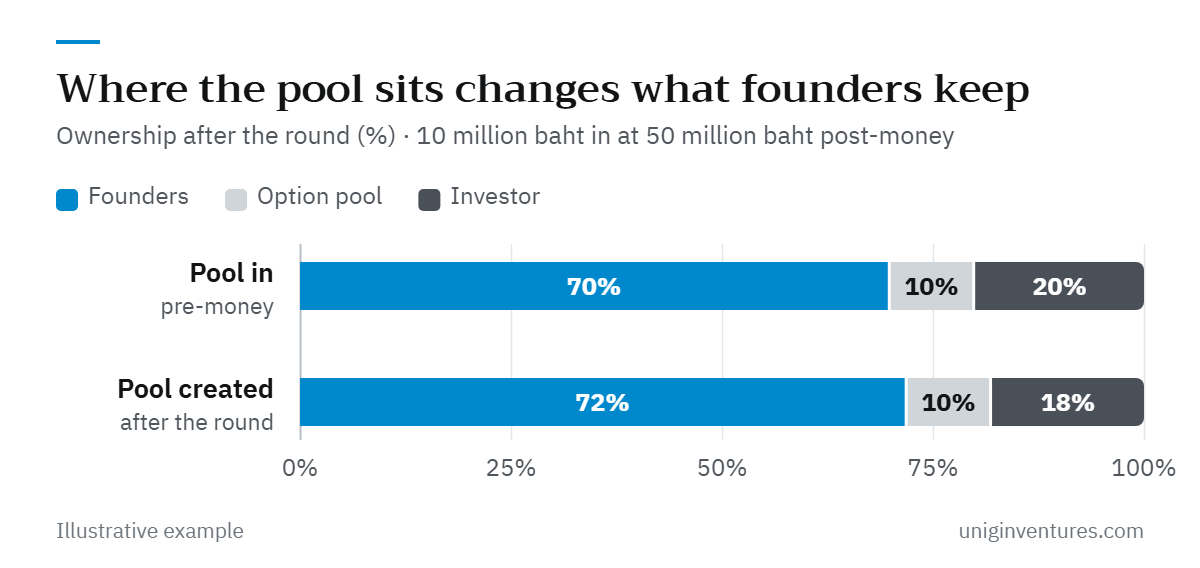
The option pool usually comes up when negotiating the term sheet. The key question is not only its size but whether the pool counts in the pre-money or the post-money valuation.
Illustrative example: an investor puts in 10 million baht for 20% after the round, so the post-money valuation is 50 million baht. The investor also asks for an unallocated pool equal to 10% of all shares after the round.
| Ownership after the round | Pool in pre-money | Pool created after the round |
|---|---|---|
| Founders | 70% | 72% |
| ESOP pool | 10% | 10% |
| Investor | 20% | 18% |
| Value of founder shares at 50 million baht post-money | 35 million baht | 36 million baht |
With the pool in the pre-money, the founders absorb all of the pool's dilution. The term sheet may say the pre-money valuation is 40 million baht, but the value the founders actually keep is 35 million baht. If the pool is created after the round, everyone is diluted equally: the founders keep 80% × 90% = 72%, and the investor keeps 20% × 90% = 18%.
A good way to negotiate is to build a hiring plan for the next 12–24 months: how many key roles you will fill and how much equity each should get, then size the pool to match. Avoid accepting a round number that is larger than you need, because an unused pool has already diluted the founders.
Setting up an ESOP step by step
- Define the goal: attracting new hires, retaining current staff, or both, and who is eligible.
- Review the memorandum and articles of association: par value, number of shares and transfer restrictions.
- Choose a structure: founder transfers, capital increases, a holding vehicle or phantom shares, based on headcount and your funding plan.
- Write complete vesting and leaver terms, and put existing shareholders' commitments into the shareholders' agreement.
- Estimate employees' tax in advance using the share value you expect to apply, and explain it to employees before they accept.
- Build a cap table that includes the pool and model the next funding round before you negotiate a term sheet.
A good ESOP is not measured by how many shares it hands out, but by whether employees understand their rights, the documents are legally sound, and nobody faces an unexpected tax bill. Set it up before your first round, and investor negotiations become much easier.
Sources
- Tax ruling Kor Kor 0702/1034 on employee share purchase rights, Revenue Department (in Thai)
- Tax ruling Kor Kor 0706/9199 on warrants allocated to employees, Revenue Department (in Thai)
- Tax ruling Kor Kor 0706/4006 on employees buying shares below value, Revenue Department (in Thai)
- Civil and Commercial Code, Section 1105, Thai Law Online (in Thai)
- Civil and Commercial Code, Section 1129, Thai Law Online (in Thai)
- Civil and Commercial Code, Section 1143, Thai Law Online (in Thai)
- Civil and Commercial Code, Section 1220, Thai Law Online (in Thai)
- Civil and Commercial Code, Section 1222, Thai Law Online (in Thai)