The 12-Slide Pitch Deck: What Each Slide Must Answer for Investors
A 12-slide pitch deck structure drawn from Sequoia and Y Combinator guidance, the question each slide must answer, a worked traction slide and funding ask, and three rules for clear slide design.
In this article
A pitch deck is usually opened for the first time in an email, with no founder in the room to explain it and several other companies' decks waiting in the same inbox. A deck that only makes sense with a voice-over rarely gets as far as a meeting.
This article sets out a 12-slide structure drawn from guidance by Sequoia Capital, Y Combinator and Guy Kawasaki. It covers the question each slide has to answer, a worked example of a traction slide and a funding ask with numbers, and three design principles that make a deck understandable on first read.
A deck has one job: getting the next meeting
A pitch deck doesn't close a deal. Investment decisions come after several meetings and due diligence. The deck's job is to help an investor understand the business quickly and care enough to book a conversation.
In Y Combinator's seed deck guide, Aaron Harris writes that founders should strive for clarity and concision, because most seed-stage companies don't yet have much meaningful detail to explore. When founders pretend otherwise, the story gets muddled and investors get lost.
In practice, build two versions from the same outline:
- A send-ahead version. Every slide has a headline that states its conclusion, and enough text to be understood with nobody presenting.
- A presenting version. Less text, larger type, and the speaker tells the story.
The 12 slides and the question each must answer
Sequoia Capital recommends 10 sections for a business plan used in a pitch, from company purpose through to vision. Y Combinator's template adds a traction slide and a slide stating the amount being raised. The 12-slide structure below combines the two. It is not a fixed standard. A company with no financials or sales yet can merge slides and present 10.
| Slide | The investor's question | What belongs on the slide |
|---|---|---|
| 1. Title | What does this company do? | The company name and a one-sentence description an outsider would understand |
| 2. Problem | Who has the pain, and how bad is it? | The customer with the problem, how they deal with it today, and where that falls short |
| 3. Solution | How does the company solve it? | What the product does and the benefit to the customer, in as few words as possible |
| 4. Why now | Why hasn't this been built already? | What has changed, such as technology, regulation or customer behavior |
| 5. Market size | How big can this business get? | Who the target customers are, how many there are, and what each can pay |
| 6. Traction | What evidence shows customers want it? | A chart of revenue or paying users, with a headline that states the conclusion |
| 7. Business model | How does the company make money? | Who pays, how much, how often, and the profit per customer |
| 8. Competition and alternatives | Why would customers choose this company? | Direct and indirect competitors, and the reason the company will win |
| 9. Go-to-market | How will it find the next customer? | The sales channels already working, and the cost of acquiring one customer |
| 10. Team | Why is this team right for this problem? | The founders, their directly relevant experience, and who is responsible for what |
| 11. Financials | What do the past and projected numbers look like? | Revenue, costs, cash in the bank, and the main assumptions behind the forecast |
| 12. The ask | How much is needed, and what does it buy? | The amount, how long it lasts, and the milestone it reaches |
Y Combinator suggests treating each topic as a set of slides. One slide per topic is ideal. More is fine if needed, but probably no more than three per topic. Only the title must always be a single slide.
Four slides that deserve the most time
Problem
Sequoia asks founders to describe the customer's pain, how it is addressed today, and the shortcomings of current solutions. Y Combinator adds that particulars of how the problem affects real people or businesses are valuable. A good problem slide therefore talks about one clearly defined customer group and puts a cost on the problem using numbers the company has gathered itself, such as the hours or money customers lose.
Traction
The numbers have to be clear and meaningful. Revenue is the strongest measure, followed by users who keep using the product. The curve doesn't need to be smooth, but the figures must be real and must match the company's books, because investors will check them again in due diligence.
Team
This slide matters a great deal at seed stage. Explain what makes the founders particularly well suited to the problem. The Y Combinator guide is blunt that the team slide should be about founders, not a list of advisors.
The ask
Say how much money you need and where it takes the company. Y Combinator recommends showing where the company will be within a year, which should be the point where it is ready for the next round. The numbers here must be consistent with the financials slide.
Worked example: a traction slide and a funding ask
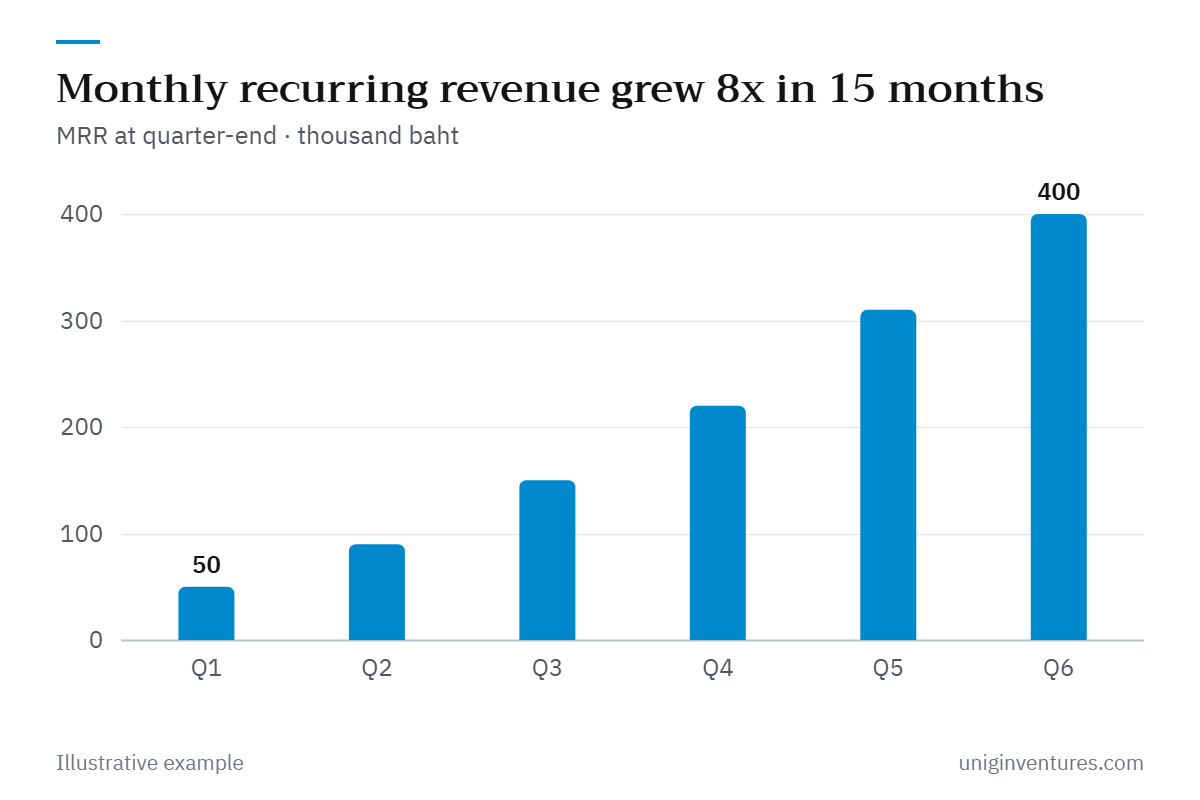
Illustrative example: a subscription software company has had the following monthly recurring revenue (MRR) at the end of each of the last six quarters.
| Quarter | 1 | 2 | 3 | 4 | 5 | 6 |
|---|---|---|---|---|---|---|
| MRR (baht) | 50,000 | 90,000 | 150,000 | 220,000 | 310,000 | 400,000 |
The slide's headline should not be "Traction" or "Revenue." It should state the conclusion outright: "Monthly recurring revenue grew 8x in 15 months" (400,000 ÷ 50,000 = 8). The reader then doesn't have to study the chart and draw the conclusion alone.
The same company's ask slide has three lines:
- Raising 18 million baht to last 18 months, an average net burn of 1 million baht a month
- Milestone at 18 months: MRR of 2,000,000 baht, five times today's level
- Use of funds: product team 7.2 million baht (40%), sales and marketing 5.4 million baht (30%), operations 3.6 million baht (20%), reserve 1.8 million baht (10%)
Before sending the deck, check that three sets of numbers agree. The use of funds adds up to 18 million baht. The monthly burn matches the forecast on the financials slide. Current MRR matches the last bar on the traction slide. Numbers that contradict each other between slides make an investor doubt all the others.
Design it to be legible, simple and obvious
Kevin Hale of Y Combinator sums up slide design in three principles:
- Legible. Large type, bold text, a simple font and good contrast with the background, with the key message at the top of the slide.
- Simple. One slide expresses one idea. He recommends choosing the 5 to 7 points you want investors to remember and building the slides from those.
- Obvious. Test it by showing the slide to someone who doesn't know the company and asking what it means. If they don't immediately say what you intended, the slide fails.
Guy Kawasaki's 10/20/30 rule is stricter: no more than 10 slides, no longer than 20 minutes, and no font smaller than 30 points. The 12-slide structure here runs two over because it separates traction and go-to-market, but the principle is the same. If it takes a lot of slides to explain the business, the problem is usually the story, not the slide count.
Other detail, such as the cap table, monthly projections and customer-level data, belongs in an appendix or a data room, not in the 12 main slides.
Mistakes that make investors stop reading
- Two slides in, it still isn't clear what the company does. The one-sentence description should use plain words, not industry jargon.
- Market size taken from a whole-industry figure with an assumed 1% share. Calculate it bottom-up instead: the number of target customers multiplied by revenue per customer.
- Claiming there are no competitors. Customers are always solving the problem somehow already, even if it's with a spreadsheet or by hiring someone.
- Projections with no stated assumptions. A five-year revenue figure with no basis carries less weight than a one-year figure that shows its working.
- An ask slide with only an amount and nothing about how many months it lasts or what milestone it reaches.
- Walls of text, animations, and complicated diagrams that take time to decode.
Where to start
- Write the one-sentence company description and try it on someone outside your industry. If they can repeat it accurately to someone else, it works.
- Write all 12 headlines as conclusion sentences before opening any slide software. Read in order, the headlines alone should tell the whole story.
- Pull traction numbers from your accounting or billing system, not from memory.
- Calculate the ask from a monthly spending plan and the milestone you intend to reach, then check it against the financials slide.
- Have three people who don't know the company read the deck alone with no explanation, then ask each to summarize what the company does and what it is asking for. Fix whatever they get wrong.
A good deck doesn't make a business look better than it is. It lets investors see the business as it is, faster. When the story is clear and the numbers agree on every slide, meeting time goes to questions about the business instead of questions about what a slide means.