Valuing a Startup With No Profits: How Investors Work Back From the Exit
How pre-money, post-money and ownership fit together, the venture capital method with a worked example, the Berkus and Scorecard methods for pre-revenue companies, and why the highest valuation isn't always the best offer.
In this article
- Why the formulas for profitable companies don't work
- Pre-money, post-money and ownership
- The venture capital method: working back from the exit
- Companies with no revenue: scoring instead of forecasting
- In practice, the price comes from the money needed and the stake given up
- The highest valuation is not always the best offer
- Where to start
A company that is still losing money has no earnings to put a multiple on and no steady cash flow to discount. Investors still have to decide how much of the company their money should buy. Early-stage valuations therefore come from a different set of methods, and many founders first meet them at the negotiating table.
This article explains how pre-money valuation, post-money valuation and ownership fit together, walks through the venture capital method with a worked example, covers two scoring methods used for companies with no revenue, and shows why the highest valuation is not always the best offer.
Why the formulas for profitable companies don't work
Conventional valuation takes one of two routes: discounting future cash flows (DCF), or comparing the company with similar ones using a ratio such as price to earnings (P/E). Both need an operating history and profits as a starting point.
Aswath Damodaran, a finance professor at NYU Stern, lists the traits of young companies that make the standard techniques hard to apply:
- No history. Many have only one or two years of operating data.
- Small or no revenues and operating losses. Most spending goes on getting the business established, not on generating revenue.
- Dependence on private capital, so there is no market price for the shares from which to estimate risk.
- Many don't survive. The value has to reflect the chance that the company fails.
An early-stage investor therefore doesn't ask what the company is worth today. The question is what the investor's shares will be worth on the day they are sold if the plan works, and whether that is enough for the risk.
Pre-money, post-money and ownership
Three numbers are always tied together.
Post-money valuation = Pre-money valuation + New investment
Investor's ownership = New investment ÷ Post-money valuation
Pre-money is the company's value before the money comes in. Post-money is the value after. Know any two of the three and the third follows. An investment of 12 million baht at a pre-money valuation of 48 million baht gives a post-money valuation of 60 million baht, and the investor owns 12 ÷ 60 = 20%.
Whenever you hear a valuation, ask whether it is pre-money or post-money. In the same example, if 48 million baht were mistaken for the post-money figure, the investor would own 12 ÷ 48 = 25%. One word moves the outcome by 5 percentage points.
The venture capital method: working back from the exit
The most widely used approach is the venture capital method, described by Bill Sahlman of Harvard Business School in 1987. It doesn't value the company as it stands. It starts from the value on the day the investor sells (the exit) and works back using the return the investor requires.
- Estimate the company's revenue or earnings in the year an exit is expected, typically two to five years out.
- Multiply by the ratio at which comparable companies trade, such as enterprise value to revenue. This gives the terminal value.
- Divide by the investor's target return. This gives today's post-money valuation.
- Subtract the new investment to get the pre-money valuation.
Post-money valuation = Terminal value ÷ Target return multiple
Worked example
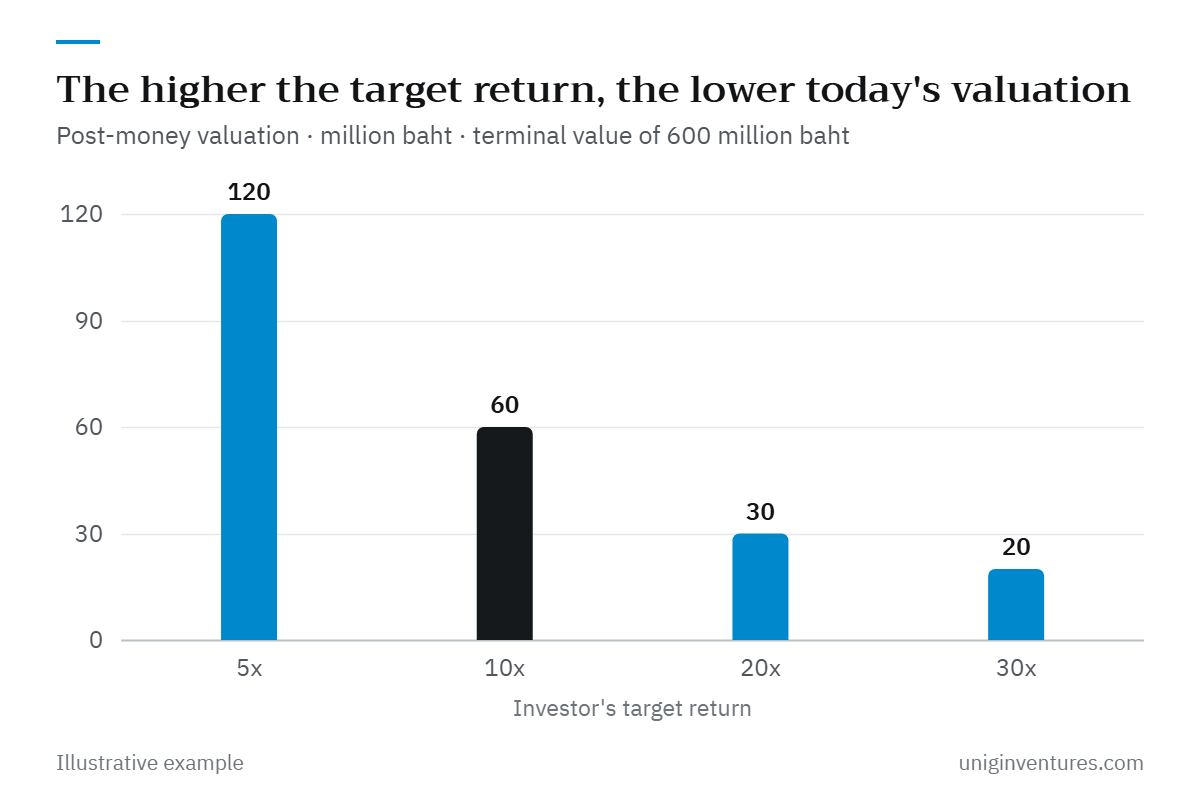
Illustrative example: a loss-making software company needs 12 million baht and expects revenue of 200 million baht in year 5. Similar companies change hands at about 3 times revenue. The investor targets a return of 10 times the money invested.
| Step | Calculation | Result |
|---|---|---|
| Terminal value | 200 million baht × 3 | 600 million baht |
| Post-money valuation | 600 million baht ÷ 10 | 60 million baht |
| Pre-money valuation | 60 − 12 million baht | 48 million baht |
| Investor's ownership | 12 ÷ 60 | 20% |
The check: 20% of a company worth 600 million baht is 120 million baht, or 10 times the 12 million baht invested.
Ten times in five years works out to about 58% a year, inside the 50–70% range Damodaran reports as the typical target return for start-up stage investments. The figure is high because it already includes the chance that the company never reaches an exit. The returns venture funds actually earn in aggregate are far lower than these targets, because most investments don't go to plan.
Investors also allow for dilution
Most companies raise several more rounds before an exit and usually set shares aside for employees. The first investor's stake shrinks over time. In the example above, if the 20% stake has been diluted to 10% by the exit, the investor receives 60 million baht, or 5 times the investment instead of 10.
Bill Payne, an angel investor who wrote a guide to the method for the Kauffman Foundation, cites work by Luis Villalobos showing that dilution can reduce an investor's return by 3 to 5 times. He therefore uses a target of 20 to 30 times in the simplified formula for seed-stage companies. If the investor in our example used 20 times, the post-money valuation would fall to 30 million baht and 12 million baht would buy 40% of the company.
The weakness of the method is that the answer depends on three assumptions: future revenue, the exit multiple and the target return. Damodaran criticizes it for encouraging founders to push projections up and investors to respond by raising their target returns. Founders should know where each number comes from and which ones are negotiable.
Companies with no revenue: scoring instead of forecasting
When a company has no revenue at all, a five-year projection carries almost no weight. Angel investors instead score the risks the company has already reduced. Two methods are cited most often.
The Berkus Method
Dave Berkus, an American angel investor, created this method in the mid-1990s. It credits a basic value for the quality of the idea, then adds value for each of four risks the company has reduced, up to 500,000 US dollars per item.
| What the company has | Risk reduced | Maximum value (US dollars) |
|---|---|---|
| Sound idea | Basic value | 500,000 |
| Working prototype | Technology | 500,000 |
| Quality management team | Execution | 500,000 |
| Strategic relationships | Market | 500,000 |
| Product rollout or sales | Production | 500,000 |
As Berkus explains it, the method allows a pre-revenue valuation of up to 2 million dollars, or up to 2.5 million dollars once the product has been rolled out. He stresses that the amounts are maximums, that they can be adjusted for the market and region, and that the method no longer applies once a company has revenue. He also applies a hurdle: the company must have the potential to reach 20 million dollars in revenue by its fifth year.
These dollar amounts come from the US market and should not be converted into baht and used directly. What carries over is the principle. A company with no revenue earns its value from risks it can show it has reduced, not from the numbers in its forecast.
The Scorecard Method
Bill Payne's method starts from the median pre-money valuation of pre-revenue companies in the same region and sector, then adjusts it up or down across seven factors.
| Factor | Maximum weight |
|---|---|
| Strength of the management team | 30% |
| Size of the opportunity | 25% |
| Product and technology | 15% |
| Competitive environment | 10% |
| Marketing, sales channels and partnerships | 10% |
| Need for additional investment | 5% |
| Other | 5% |
The investor rates each factor against a typical company, for example 125% for a stronger-than-average team, and multiplies by the weight. In Payne's own example the factors sum to 1.155, which multiplied by a median of 4.5 million dollars gives a pre-money valuation of about 5.2 million dollars.
Both methods weight the team more heavily than the product. The limitation in Thailand is that no median valuation is published systematically, so founders have to find comparables from deals they know to be real in the same business.
In practice, the price comes from the money needed and the stake given up
Y Combinator's seed fundraising guide, written by Geoff Ralston, says plainly that no formula will give you an answer on valuation and recommends letting the market set the price. In a real negotiation the number usually comes from two questions.
- How much money does the company need to reach its next milestone? Typically this is enough for 12 to 18 months.
- How much ownership will the founders give up? The same guide says most seed rounds require up to about 20% dilution, that giving up as little as 10% is excellent, and that founders should try to avoid more than 25%.
The example company, needing 12 million baht and willing to give up 20%, arrives at a post-money valuation of 12 ÷ 0.20 = 60 million baht, the same figure the venture capital method produced above. When the two approaches land close together, the price is easy to defend. When they are far apart, go back and find whose assumptions are unrealistic.
The highest valuation is not always the best offer
- This round's valuation is the bar the next round has to clear. If results don't grow into the price, the next raise may have to be at a lower valuation (a down round), which hurts the founders' ownership and the team's morale.
- Other terms change what an offer is really worth. Examples are liquidation preferences and anti-dilution rights. An offer with a high valuation and harsh terms can leave founders worse off than one with a lower valuation.
- Valuation is not money in your pocket. It is only the price used to divide ownership in this round. Founders see a real return when the company builds value all the way to an exit.
Where to start
- Build a monthly spending plan so you know how much money it takes to reach the next milestone, and what that milestone is.
- Set the range of ownership you are willing to give up in this round, then calculate the matching post-money and pre-money valuations.
- Test it with the venture capital method from the investor's side. Use year-5 revenue you can explain, multiples from genuinely comparable companies, and several target returns.
- List the risks the company has already reduced under the Berkus and Scorecard headings, such as a prototype, the team and first customers, to support the price.
- When an offer arrives, read all the terms, not only the valuation line, and confirm whether the figure is pre-money or post-money.
The valuation of a company with no profits is the outcome of a negotiation over assumptions, not a calculation with one right answer. Founders who know what the investor is working back from can negotiate the assumptions, not only the final number.
Sources
- Valuing Young, Start-up and Growth Companies: Estimation Issues and Valuation Challenges (Aswath Damodaran) — NYU Stern
- A Method for Valuing High-Risk, Long-Term Investments: The "Venture Capital Method" (William A. Sahlman) — Harvard Business School
- Valuation of Pre-revenue Companies: The Venture Capital Method (Bill Payne) — Ewing Marion Kauffman Foundation
- After 20 years: Updating the Berkus Method of valuation — Dave Berkus
- Scorecard Valuation Methodology (Bill Payne) — Angel Capital Association
- A Guide to Seed Fundraising (Geoff Ralston) — Y Combinator