Tranched Rounds: Milestone Terms Founders Should Negotiate
When an investor offers to fund in milestone tranches: the mechanisms that work in a Thai limited company, an example of ownership and cash when a milestone slips, and seven terms to negotiate.

In this article
Some investors agree to fund a whole round but do not wire it all on one day. The first part arrives at closing, and the rest arrives when the company hits an agreed milestone, such as a recurring revenue target or a license it needs. This is a tranched round. It sounds fair to both sides, but most of the risk lands on the founders if the milestone is loosely defined or the first tranche is too small to reach it.
This article explains how tranched rounds work, the mechanisms available under Thai limited company law, a worked example of ownership and cash, and the terms founders should negotiate before signing.
What a tranched round is, and why investors propose one
In a tranched round, both sides agree all the round's terms at once: the pre-money valuation, the price per share, and the total amount. Payment is then split. The first tranche is paid at closing, and later tranches are paid when the company meets the agreed conditions.
The investor reduces risk, because the larger sum goes out only after the company has shown that the plan works. The founders lock in the valuation for the full amount and avoid running a new round after the milestone. The trade-off comes in three parts:
- The investor holds an option. If the company does much better than planned, the investor buys the second tranche at the agreed price, which may be below what the market would pay by then. If the company falls short, the investor does not have to pay.
- Only the first tranche is money you can plan with. The second tranche is not the company's money until it arrives.
- The team gets pulled toward the number written in the contract, even if circumstances change and that number is no longer what matters most.
Two ways to do it in a Thai limited company
Option 1: Issue all shares at closing and call the unpaid amount later
The company increases its capital once. The investor subscribes for all the shares, pays part of the price, and the directors call the rest when the milestone is met. Section 1121 of the Civil and Commercial Code requires notice of at least 21 days for each call on unpaid share capital.
The key limit is in Section 1105. The first payment on a share must be at least 25% of its par value, and if shares are issued above par (normal in startup rounds), the premium must be paid together with the first payment. When the price per share is far above par, almost all the money is due on day one. This option therefore barely splits the payment at all (see the numbers in the next section), and the investor receives all the shares at closing.
Option 2: A separate capital increase for each tranche, at a price agreed in advance
At closing, the company increases its capital only by the first tranche's shares. The shareholders' agreement provides that when the milestone is met, the company will increase capital again and issue the second tranche's shares to the investor at the same price per share. Each increase follows the full procedure:
- A special resolution of the shareholders' meeting (Section 1220), which needs at least three quarters of the votes (Section 1194).
- New shares must first be offered to existing shareholders in proportion to their holdings (Section 1222). Shareholders who do not take up the offer must waive it.
- The special resolution to increase capital must be registered within 14 days of the resolution (Section 1228).
Here the investor receives shares only for money actually paid, but the second tranche depends on every shareholder voting again. The agreement must therefore bind all parties to vote as agreed once the conditions are met. (For the full capital increase procedure, see issuing new shares to investors.)
Worked example: a 20 million baht round in two tranches
Illustrative example. A startup has 60,000 shares with a par value of 100 baht each. It agrees a pre-money valuation of 60 million baht, or 1,000 baht per share. The investor will put in 20 million baht in total (20,000 shares): 8 million baht in the first tranche and 12 million baht in the second, once the milestone is met.
| Stage | Investor's shares | Total shares | Investor's stake |
|---|---|---|---|
| After first tranche, 8 million baht | 8,000 | 68,000 | 11.8% |
| After second tranche, 12 million baht | 20,000 | 80,000 | 25.0% |
Under Option 1, all 20,000 shares would be issued at closing. The premium of 900 baht per share, 18 million baht in total, must be paid with the first payment, plus the minimum 25% of par, 25 baht per share or 500,000 baht. The investor must therefore pay at least 18.5 million baht on day one, or 92.5% of the round, leaving only 1.5 million baht to call later. That is why tranched rounds in Thai companies that issue shares well above par usually need Option 2.
The first tranche must reach the milestone, with room for delay
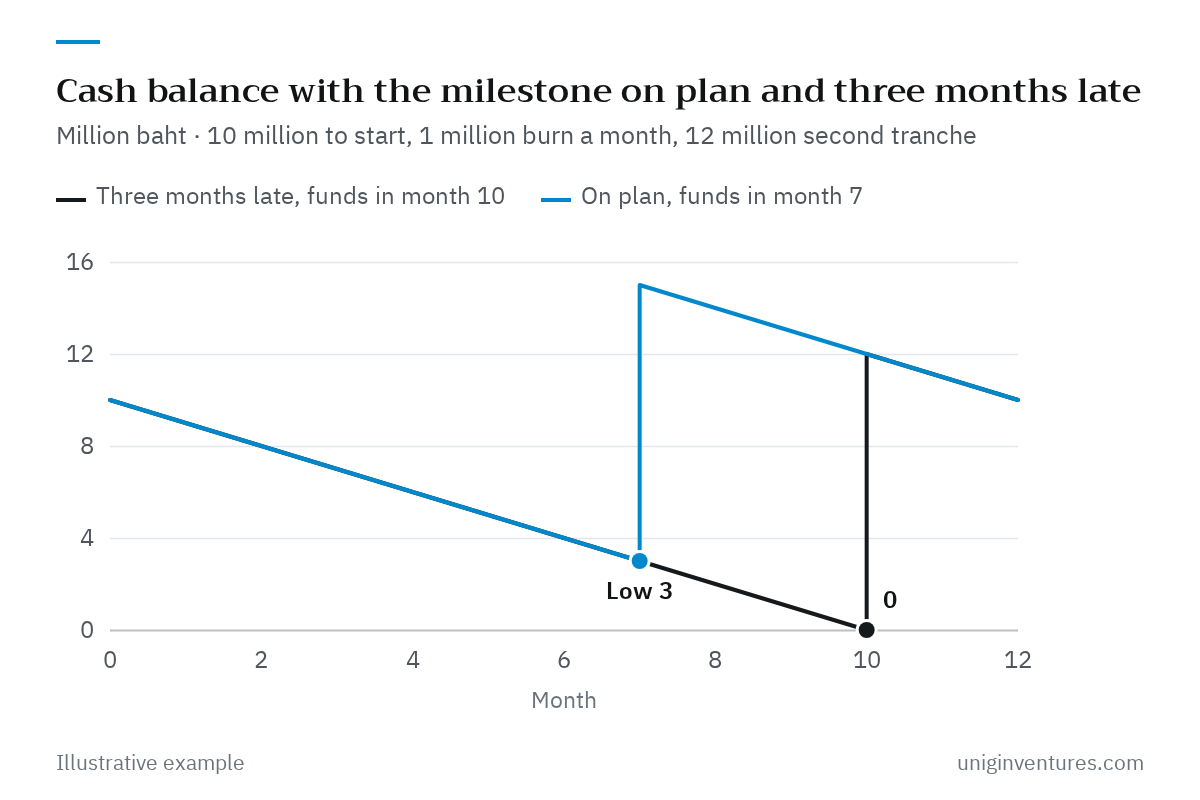
Continuing the example, the company already has 2 million baht in cash, so it holds 10 million baht after the first tranche. Its net burn is 1 million baht a month. The plan is to hit the milestone in month 6 and receive the second tranche in month 7, assuming the capital increase steps take about a month. On this plan, cash bottoms out at 3 million baht just before the second tranche arrives.
If the milestone slips by three months, to month 9, with the money arriving in month 10, cash reaches exactly zero in month 10 before the second tranche lands. A delay of one quarter leaves the company with no cushion at all, and in that window the founders have almost no leverage with their existing investor.
Terms founders should negotiate
- Milestones that are measurable and within the team's control. Write them as numbers with a definition and a data source, for example "monthly recurring revenue (MRR) per closed books of at least X baht for two consecutive months." Avoid conditions that need interpretation, such as "product ready for market," or that depend on outsiders.
- Who confirms the milestone, and how fast. Specify the documents the company must deliver, how many days the investor has to respond, and that silence past the deadline counts as acceptance.
- The second tranche is an obligation, not an option. Once the conditions are met the investor must pay, and the agreement states what happens if it does not, for example that special rights granted at the first tranche are scaled back.
- The investor can waive the conditions. If the company comes close or changes course for a good reason, the investor should be able to fund the second tranche without rewriting the whole agreement.
- A long-stop date and freedom to raise elsewhere. If the second tranche has not been paid by the agreed date, that commitment ends, and the company can raise from other investors without the second tranche terms standing in the way.
- Rights in line with money actually paid. Board seats, reserved matters, and other rights granted at the first tranche should reflect the money that has arrived, not the amount promised (see board seats and reserved matters).
- The size of the first tranche. Base it on actual burn, the time needed to reach the milestone, the time needed for the capital increase, and a buffer for delay. If the first tranche falls short, ask for a larger first tranche or a nearer milestone.
When to accept, and when to steer away
A tranched round fits when the milestone is clear enough that neither side has to interpret it, is near, and the first tranche reaches it with time to spare, for example a company waiting on a license decision or on closing a customer contract already under negotiation. Be careful when the milestone is more than a year away, is measured by numbers the team does not control, or when the first tranche runs out exactly on the day the milestone is due. In those cases a smaller round paid in full on one day may serve you better (see how much to raise).
Where to start
- Rewrite the investor's proposed milestone as a number, a definition, a data source, and a date. If it cannot be written that way, that is the first point to negotiate.
- Build a monthly cash forecast for two cases: on plan, and the milestone three months late. Check the lowest cash balance in each.
- Ask your lawyer which mechanism to use, and draft the commitment to vote for the second capital increase into the shareholders' agreement.
- Before you decide, compare the offer with a smaller amount paid in full on one day.
The company and figures in this article are illustrative. The legal points were checked against the text of the Civil and Commercial Code in November 2026. This article is general information, not legal or investment advice. Have a lawyer review the agreement before you sign.
Sources
- Civil and Commercial Code, Section 1105 (share price and first payment) — Thai Law Online (Thai)
- Civil and Commercial Code, Section 1121 (calls on share capital) — Thai Law Online (Thai)
- Civil and Commercial Code, Section 1194 (special resolutions) — Thai Law Online (Thai)
- Civil and Commercial Code, Section 1220 (capital increase) — Thai Law Online (Thai)
- Civil and Commercial Code, Section 1222 (offering new shares to existing shareholders) — Thai Law Online (Thai)
- Civil and Commercial Code, Section 1228 (registering a capital increase within 14 days) — Thai Law Online (Thai)