Running a Fundraise Like a Pipeline: Timeline and List Size
A round has stages that take real time. Count back from the day your cash runs out, size your investor list from conversion rates, track it weekly, and know when a deal really counts.

In this article
Picture a founder who starts raising when the bank account has a few months left, then meets investors one at a time, waiting for an answer from the first before contacting the next. Every "let's see another quarter of numbers" costs weeks. Yet each round has steps that genuinely take time: preparing documents, meetings, due diligence, drafting the agreements, and finally the capital increase and the money arriving.
This article treats fundraising as a kind of sales process, with a list, stages, conversion rates between stages and a date by which it must close. You will get a way to count back from the day the cash runs out, a formula for how many investors your list needs, a weekly tracking table, and the rules for deciding when a deal actually counts.
Count back from the day the cash runs out
Start with runway, how long your cash will last. If you have not calculated it, see Burn Rate and Runway. Then lay out the round in stages. The plan below is an illustrative seed round that takes 20 weeks in total. Real timelines vary widely between companies, so replace these with your own.
| Stage | Weeks | Output |
|---|---|---|
| Prepare the pitch deck, data room and investor list | 1–4 | Documents ready to send; list scored for fit |
| Ask for warm introductions | 3–5 | First meetings booked in the same window |
| First meetings, in a batch | 5–8 | Know who is genuinely interested |
| Deep-dive meetings and follow-up data | 7–11 | Investor takes the deal to its investment committee |
| Negotiate the term sheet | 11–13 | Signed term sheet |
| Due diligence and drafting | 13–18 | Final agreements |
| Shareholder meeting, capital increase, money in | 18–20 | Cash in the company's account |
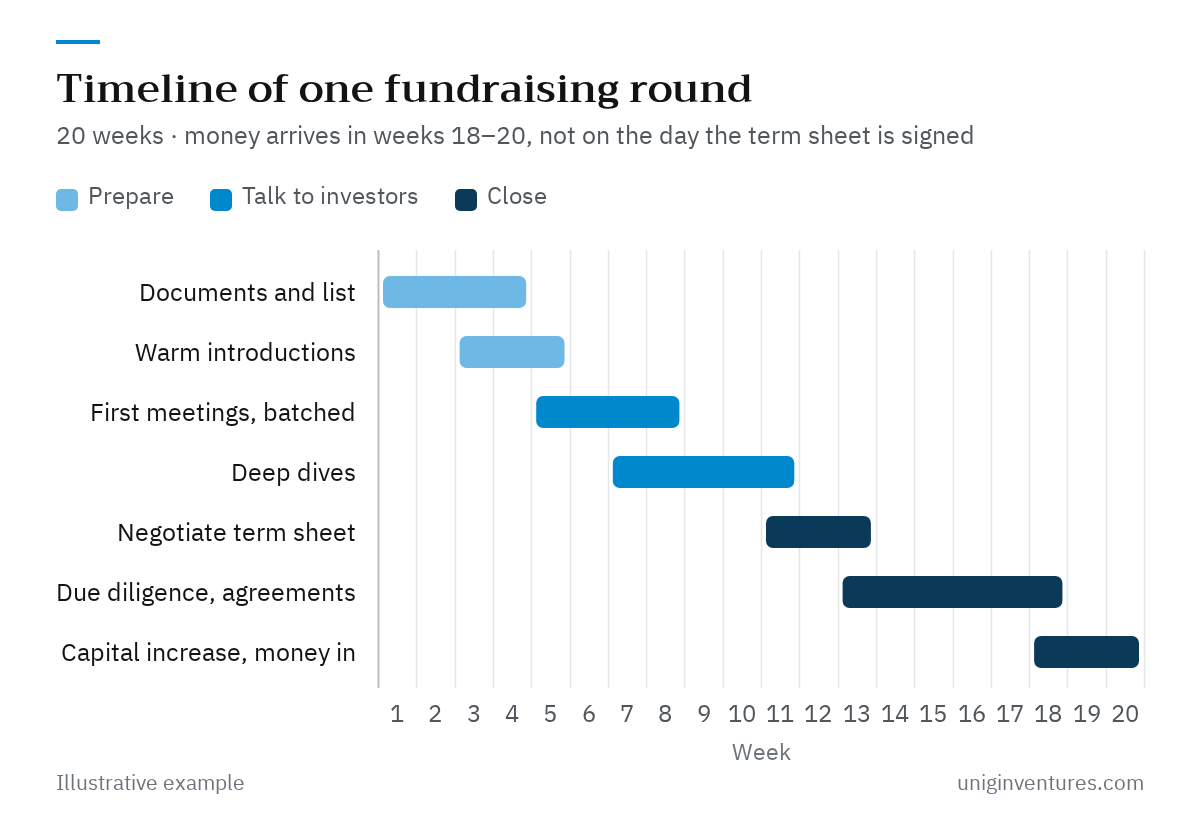
Twenty weeks is about five months. Add three months of buffer for a round that runs late or has to restart with a new list, and this company should start preparing while it still has at least eight months of runway. Start at four months and every negotiation happens while investors can see the cash running out.
The final stage in a Thai limited company includes legal steps that cannot be compressed, such as advance notice of the shareholder meeting, the special resolution and registering the capital increase on time. For the sequence and deadlines, see Issuing new shares to investors in Thailand.
How many investors your list needs
Work backward from the result you want. Suppose you want at least two term sheets, so you have a choice and some leverage on terms. Then divide back through the conversion rate at each stage.
Number needed at the earlier stage = number needed at the next stage ÷ conversion rate of that stage
The rates in this example are illustrative assumptions: 40% of investors contacted agree to a first meeting, 30% of first meetings lead to a deep dive, and 25% of deep dives produce a term sheet.
- Two term sheets need 2 ÷ 25% = 8 investors at the deep-dive stage.
- Eight deep dives need 8 ÷ 30% = 26.7, or 27 first meetings.
- Twenty-seven first meetings need 27 ÷ 40% = 67.5, or 68 investors contacted.
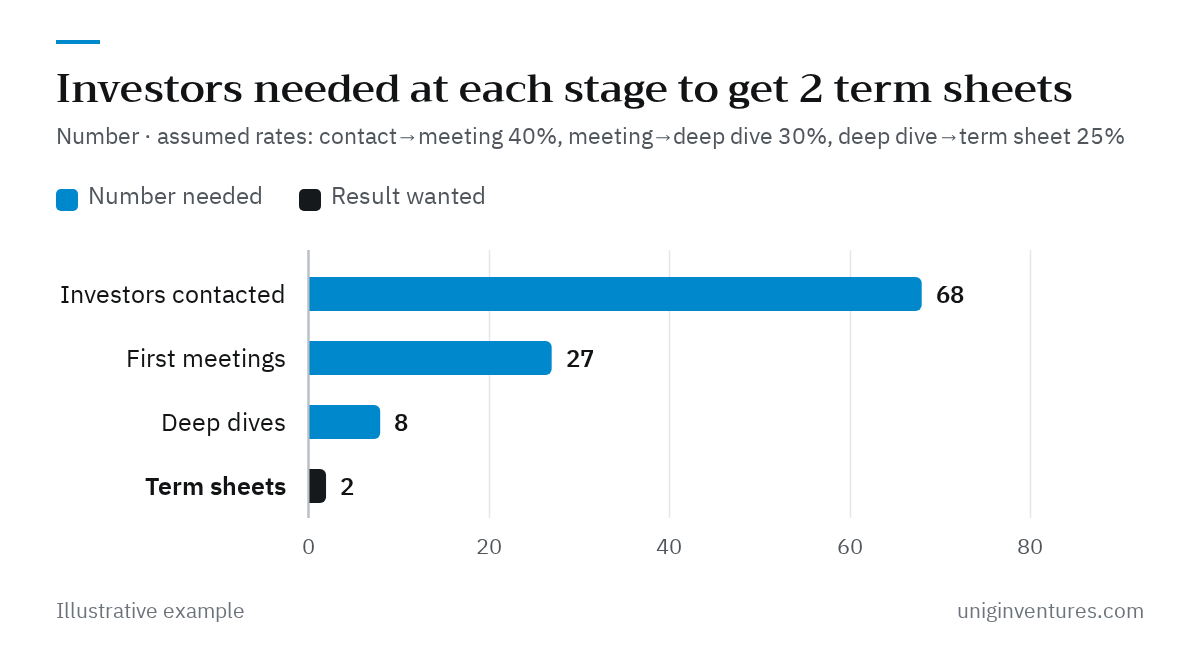
Sixty-eight does not mean emailing 68 firms in one day. It means that if you start with a much shorter list, the round depends on a handful of investors, and a few rejections can force you to rebuild the list halfway through. After you close, record your actual conversion rates; they will make the plan for the next round far more accurate.
Who belongs on the list, and who to meet first
A long list is useless if it is full of investors who do not back companies like yours. Score each one on what you can check.
- Stage: do they invest at pre-seed, seed or Series A?
- Check size: does it fit the size of your round? (See How much to raise.)
- Sector and geography: have they backed similar businesses, and do they invest in Thai companies?
- Lead or follow: a round without a lead investor needs enough names that can lead.
- Access: is there someone who knows both sides and can introduce you?
In his essay How to Raise Money, Y Combinator co-founder Paul Graham advises talking to investors in parallel rather than serially, and prioritizing them by expected value rather than treating every prospect the same. In practice, put your highest-scoring investors in the first batch of meetings; uncertain names can be booked in the same window but get less preparation time. And before taking anyone's money, check them in return (see Reverse due diligence on investors).
Book meetings as a batch in one window
The same essay warns that once you start fundraising, everything else grinds to a halt, and recommends that a startup either be in fundraising mode or not. Packing first meetings into the same three or four weeks helps in two ways. Founders spend a shorter stretch on fundraising, and investors' answers arrive close together, so you can compare offers instead of having to accept or decline the first before you know what the others will propose.
Split the work before you start. One founder leads the fundraising while another keeps the business running so the monthly numbers keep moving, because if sales or users stall while you are talking to investors, last month's figures become a question in the meeting room.
Track it weekly in one table
A spreadsheet or a CRM both work, as long as there is one row per investor and you review it every week.
| Column | What goes in it |
|---|---|
| Fund or investor, and contact | The person who decides or takes the deal to committee |
| Fit score | From the criteria in the previous section |
| Current stage | Contacted · First meeting · Deep dive · Term sheet · Due diligence · Money in |
| Last contact and next step | Who does what, by when |
| What the investor asked for | Outstanding data requests and concerns you heard |
| Possible investment | The amount the investor said, not the amount you hope for |
Each week, look at three things: the number of investors at each stage against the plan, any stage where someone has been stuck for more than two weeks, and whether the timeline still closes before runway reaches your limit. If the deep-dive count is below plan by week 9, add names to the list at once rather than waiting for every rejection and starting over.
The rules for when a deal counts
- No clear answer counts as no. Paul Graham advises treating investors as saying no until they unequivocally say yes, in the form of a definite offer with no contingencies. "Very interesting" or "let's stay in touch" is not a yes.
- It is not a deal until the money is in the bank. That is another rule from the same essay. A signed term sheet is not money, and a deal can still fall apart during due diligence. If the term sheet bars you from talking to other investors for a set period (exclusivity, or no-shop), have a lawyer check how binding that clause is before you sign, and negotiate a short period with a clear end date. Honor it while it runs, but keep your relationships with backup investors warm so you can go back to them at once if the first deal does not close.
- Do not plan spending on money you hope to get. Hiring or expansion plans start when the cash is in the account. Until then, stay on the plan your current runway supports.
Where to start
- Calculate runway and count back with your own timeline plus a buffer to find your start date.
- Set the result you want, such as two term sheets, and divide back through each stage's conversion rate to size the list.
- Build a scored list based on stage, check size, sector, ability to lead and access.
- Finish your documents before the first meeting: the pitch deck and the data room.
- Batch first meetings into three or four weeks and track everything weekly in one table.
- Count only money that has arrived, and keep your backup list warm until the round closes, within any no-shop you have signed.
This article is general information, not investment or legal advice for any particular company. The timeline, conversion rates and investor counts are illustrative assumptions, not market averages. Sources were checked in November 2026.