Bridge Rounds and Down Rounds: Raising When Cash Is Short and the Price Falls
When to start raising, how a bridge compares with a down round and other options, a worked example of founder dilution when the next round prices low, and the Thai company law limits to know.
In this article
Cash will last only a few more months, but the company's numbers are not yet where a new investor would pay more per share than the last round. Founders in this spot usually weigh two options: take a small amount from existing investors to buy time (a bridge round), or raise at a lower price per share than last time (a down round). Both solve the cash problem. They differ a great deal in what they cost founders in ownership and in how hard they are to execute legally.
This article helps you decide with numbers. It starts with when you must begin raising, compares every option, shows what a bridge costs founders if the next round comes in low, and covers the Thai limited company rules to know before you sign.
Bridge rounds and down rounds: the difference
A bridge round is short-term funding between two larger rounds. Its purpose is to give the company enough time to reach the numbers that will let the next round price better. It usually comes from existing investors and often uses an instrument that converts into shares at the next round, such as a convertible note at a discount to the next round's price, or a small share issue at the last round's price.
A down round issues shares at a lower price per share than the previous round. A lower price does not always mean the company has failed. Sometimes the last round was priced ahead of results, or prices for the whole sector have fallen. But a down round has knock-on effects you must manage, including earlier investors' anti-dilution rights and the morale of employees who hold stock options.
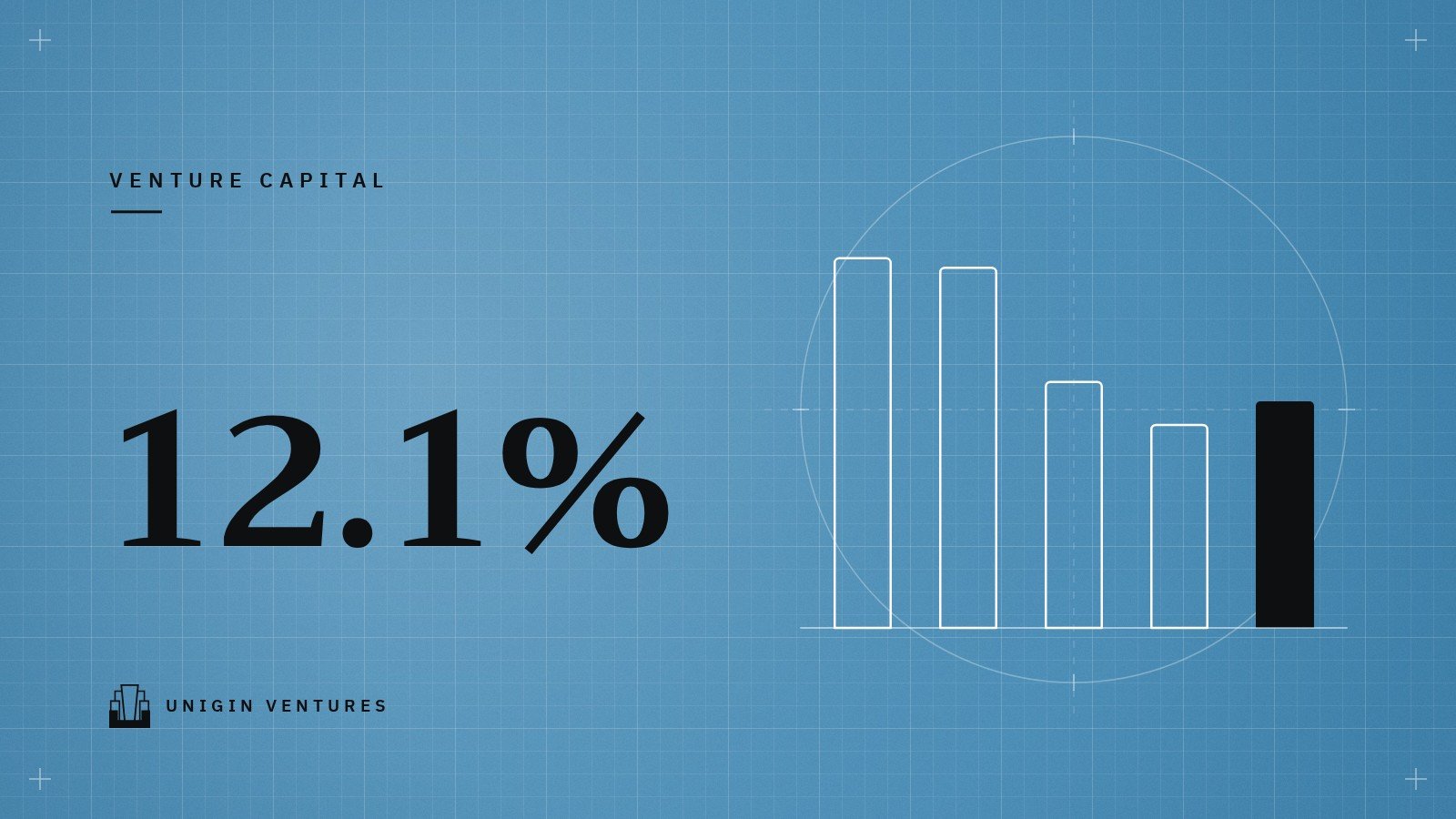
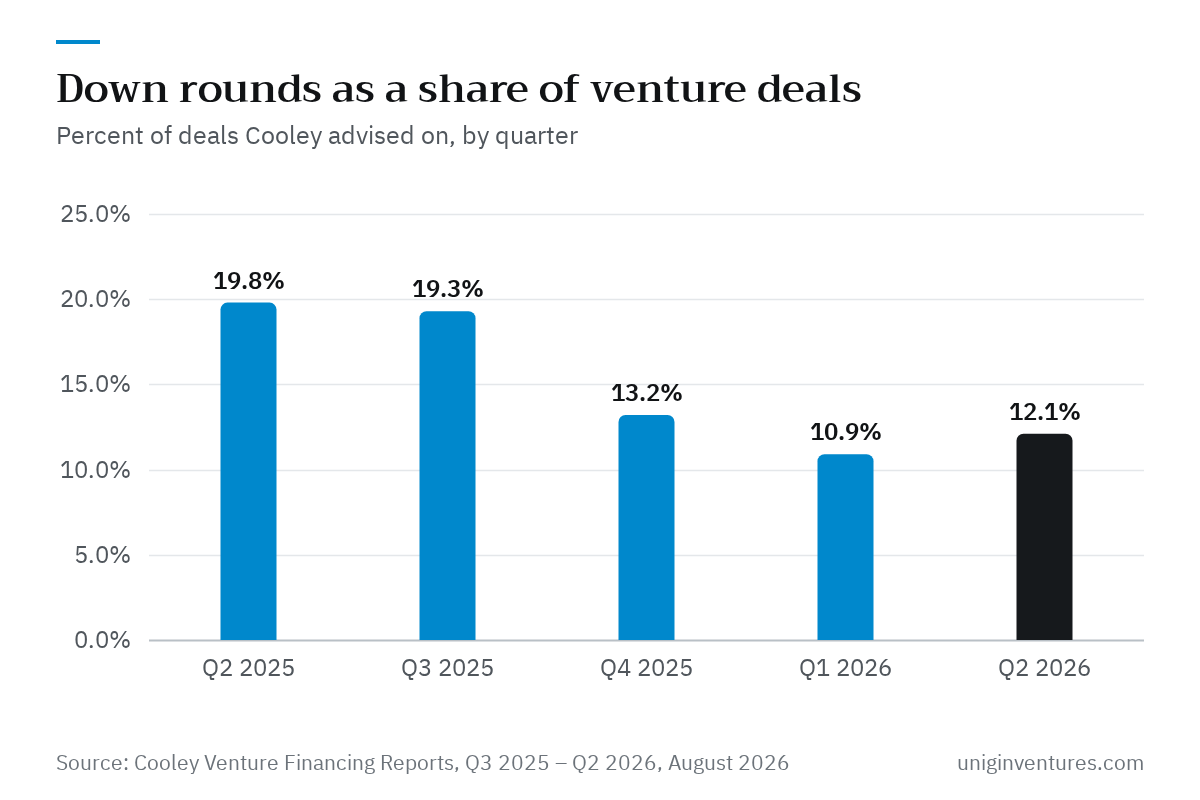
Down rounds happen even in good markets. Law firm Cooley's report on the venture deals it advised on shows down rounds at 12.1% of 166 deals in Q2 2026, down from about 19–20% in Q2 and Q3 2025. These are not Thai market figures, but they show that raising below the last price happens every quarter.
First, work out when you must start raising
The worst decisions tend to happen with less than three months of cash left, because investors know the company has no alternatives. Calculate these two numbers every month (see the full method in Burn Rate and Runway):
Runway (months) = cash on hand ÷ net monthly cash outflow (net burn)
Latest month to start raising = runway − expected fundraising time − buffer
In an illustrative example, a company has 9,000,000 baht in cash and a net burn of 1,500,000 baht a month, so its runway is 6 months. If the founders expect the next round to take 6 months, they must start today with no buffer at all. Cutting net burn to 1,200,000 baht a month extends runway to 7.5 months. Adding a 15,000,000-baht bridge takes it to (9,000,000 + 15,000,000) ÷ 1,200,000 = 20 months.
Your options when cash runs low
| Option | What you get | Main cost | Fits when |
|---|---|---|---|
| Cut spending | More runway with no dilution | Slower growth, possibly layoffs | Always, alongside any other option |
| Bridge from existing investors | More time to reach the next milestone | The discount or price cap given to investors | A clear milestone will improve the next round's price |
| Down round | A large check at a market price | Heavy dilution plus anti-dilution effects | The last price was ahead of results and a bridge cannot reach a better price |
| Sale or merger | Shareholders recover part of their money | Loss of control, possibly less than was invested | No investor will put in more money |
One question separates a good bridge from one that only postpones the problem: what will this money get the company to? If you can answer with a number, such as 3 million baht in monthly recurring revenue or five signed enterprise customers, and that number can really lift the next round's price, the bridge is worth it. If you cannot, the bridge will lead to a down round nine months later, with an extra layer of convertible paper on top.
A worked example: when the next round prices low
In an illustrative example, a Thai limited company has 6,000,000 shares with a par value of 10 baht. Founders hold 4,000,000 (66.7%), the employee option pool (ESOP) holds 500,000, and seed investors hold 1,500,000 bought at 20 baht each. The company takes a 15,000,000-baht bridge from existing investors that converts at the next round at a 20% discount, then raises 45,000,000 baht in that round. The table compares three possible prices for the next round.
| Item | 25 baht a share | 20 baht a share | 12 baht a share |
|---|---|---|---|
| Bridge conversion price (20% off) | 20.00 | 16.00 | 9.60 → 10.00 used |
| Shares to bridge investors | 750,000 | 937,500 | 1,500,000 |
| Shares to new investors | 1,800,000 | 2,250,000 | 3,750,000 |
| Total shares after the round | 8,550,000 | 9,187,500 | 11,250,000 |
| Founders' ownership | 46.8% | 43.5% | 35.6% |
| Bridge investors' ownership | 8.8% | 10.2% | 13.3% |
Three things stand out:
- The discount applies to the next round's price. The lower that price, the more shares the bridge investors get, so founders are diluted twice, by the new round and by the bridge. At 12 baht, founders fall from 66.7% to 35.6%.
- The conversion price cannot go below par. A 20% discount on 12 baht is 9.60 baht, below the 10-baht par value. Section 1105 of the Civil and Commercial Code prohibits issuing shares below par, so the example uses 10 baht instead. The agreement should say in advance what happens in this case.
- The seed investors' anti-dilution is not yet counted. Both the 12-baht new round and the 16-baht conversion price in the middle case are below the 20 baht the seed investors paid. Unless the earlier agreement excludes the bridge conversion, the seed investors may receive extra shares, and founders will end up with less than the table shows. See the formulas in Anti-Dilution and Pro-Rata Rights.
Limits in a Thai limited company
Bridge and down-round templates from abroad are written for those countries' corporate law. Thai limited companies have provisions you need to plan around.
- Debt cannot be set off against the share price. Section 1119 requires shares to be paid in full in money and prohibits shareholders from setting off debts against the company. A plain loan that you intend to turn into share payment later therefore does not work directly. Issuing shares paid for with something other than money requires a special resolution under Section 1221.
- A limited company cannot issue debentures (Section 1229). A convertible note structure has to use a route under SEC Thailand rules, such as the private placement of convertible debentures by SMEs (PP-SME), which first requires registering with the SEC–OSMEP program. See the details in SAFEs and Convertible Notes for Thai Startups.
- The simplest bridge is a small capital increase. Issue new shares to existing shareholders at the last round's price using the normal process: a special resolution (Section 1220) and an offer to existing shareholders in proportion to their holdings (Section 1222). There is no future conversion to calculate. See the steps in Issuing New Shares to an Investor.
- A down round below par needs a capital restructuring first. One route is to reduce capital by lowering the par value of each share by special resolution (Section 1224). This requires a newspaper notice, written notice to known creditors and a 30-day objection period (Section 1226), and capital cannot fall below one quarter of the total (Section 1225). Par value cannot be less than 5 baht a share (Section 1117). Count those 30 days in your runway.
If you take a down round, what to negotiate
- Earlier investors' anti-dilution. Calculate what the adjustment leaves founders with, then ask earlier investors to waive part of it, especially a full ratchet. New investors usually want to see this number before they price the round anyway.
- Pay-to-play terms. Existing investors who do not invest in this round may lose certain special rights, for example by having their preferred shares converted to common. The NVCA model documents support this mechanism, and Cooley found it in about 8.4% of deals in Q2 2026. In a Thai limited company, where preference share rights cannot be changed after issue (Section 1142), have a lawyer design a method that actually works.
- Employee options. If the option exercise price is above the new round's price, employees will see little value in their options. Plan to top up the pool or grant new options at the new price, and include the dilution from that top-up in your model.
- Liquidation preference. New investors in a lower-priced round often ask to be paid back first. Check the combined effect of every round's preference with a waterfall table to see what founders receive at several sale prices.
- Communication. Give the team and shareholders the same numbers: why the price changed, what the money is for, and what the next milestone is.
Where to start
- Calculate your runway and the latest month to start raising today. For example, if you expect fundraising to take 6 months plus a 3-month buffer and your runway is under 9 months, start talking to existing investors now.
- Write down, as a number, the milestone the bridge money will reach, and how that number improves the next round's price.
- Put three next-round prices into your cap table as in the example, including every round's anti-dilution, and compare each conversion price with your shares' par value.
- Have a lawyer experienced in Thai venture deals choose a bridge structure that works, and check that any conversion or new share price does not breach Sections 1105, 1119 and 1229.
The company, share counts, prices and milestones in this article are an illustrative example. Cooley's data covers deals that firm advised on and is not Thai market data. This article is general information, not legal or investment advice for any particular deal. Legal provisions were checked in November 2026.
Sources
- Q2 2026 Venture Financing Report (August 2026) — Cooley
- Q1 2026 Venture Financing Report (April 2026) — Cooley
- Q4 2025 Venture Financing Report (February 2026) — Cooley
- Q3 2025 Venture Financing Report (November 2025) — Cooley
- Ask a MoFo: NVCA — Pay-to-Play Provisions — Morrison Foerster
- Model Legal Documents — National Venture Capital Association
- Private placement (PP) by SMEs and large enterprises — SEC Thailand (in Thai)
- Civil and Commercial Code, Section 1105 (no issue below par) — Thai Law Online
- Civil and Commercial Code, Section 1119 (payment for shares in money) — Thai Law Online
- Civil and Commercial Code, Section 1221 (payment other than money) — Thai Law Online
- Civil and Commercial Code, Section 1220 (capital increase) — Thai Law Online
- Civil and Commercial Code, Section 1222 (offering new shares to existing shareholders) — Thai Law Online
- Civil and Commercial Code, Section 1229 (no debentures) — Thai Law Online
- Civil and Commercial Code, Section 1142 (preference rights cannot be amended) — Thai Law Online
- Civil and Commercial Code, Section 1224 (capital reduction) — Thai Law Online
- Civil and Commercial Code, Section 1225 (floor on capital reduction) — Thai Law Online
- Civil and Commercial Code, Section 1226 (creditor notice on capital reduction) — Thai Law Online
- Civil and Commercial Code, Section 1117 (minimum par value) — Thai Law Online