
The Board After Funding: Seats, Observers and Reserved Matters
Owning most of the shares does not mean controlling the board. Thai rules on directors, a round-by-round seat plan, observer rights, and a reserved-matters list with points to negotiate.

In this article
After a funding round closes, most founders still hold more than half of the shares, so they assume control has not changed. What actually decides who makes which call sits in three places: the number of seats on the board of directors, the rights of any board observer, and the list of reserved matters the company cannot act on without investor approval. All three are negotiated at the term sheet stage, and all three are hard to change later.
This article summarizes the rules of the Thai Civil and Commercial Code on directors of a limited company that founders should know before negotiating, shows an example of how board seats change from round to round, and lays out a reserved-matters list with the points worth pushing back on.
Directors of a Thai limited company
Before agreeing on seats, know what the law sets by default and which rules the company's articles of association can change.
- The general meeting appoints and removes directors. A limited company is managed by one or more directors under its articles, under the control of the general meeting of shareholders (Section 1144), and only the general meeting can appoint or remove a director (Section 1151).
- One third of the board retires each year. At the first ordinary meeting after registration and the first ordinary meeting of every following year, one third of the directors must retire (Section 1152). In the first two years they draw lots unless the directors agree otherwise; after that, the longest-serving retire, and retiring directors may be re-elected (Section 1153).
- Director changes must be registered within 14 days of the change (Section 1157).
- Quorum and voting. Directors may set their own quorum; if they have not and there are more than three directors, three must attend to form a quorum (Section 1160). Decisions pass by majority, and the chair casts the deciding vote on a tie (Section 1161). Any director may call a board meeting at any time (Section 1162). These rules apply unless the articles provide otherwise (Section 1158).
- Directors' duties. Directors must act with the care of a prudent businessperson and may not run a business of the same nature that competes with the company, for themselves or for others, without the consent of the general meeting (Section 1168).
- Changing the articles takes a special resolution. Once the company is registered, new or amended articles require a special resolution (Section 1145), which needs at least three quarters of the votes of shareholders present and entitled to vote (Section 1194).
Two practical consequences follow. First, the "right to appoint a director" an investor gets in a shareholders' agreement does not let the investor appoint anyone directly, because the law gives that power to the general meeting. The agreement has to commit every shareholder to vote for the investor's nominee, including when that director retires by rotation. Second, the quorum and the chair's casting vote can be changed in the articles. If you want rules that differ from the default, amend the articles at the same time as the capital increase.
Board seats: design them round by round
A lead investor typically asks for one board seat, so the board grows with each round. The table shows a hypothetical company through two rounds.
| Stage | Founders | Investors | Independent | Total |
|---|---|---|---|---|
| Before funding | 2 | — | — | 2 |
| After seed | 2 | 1 | — | 3 |
| After Series A | 2 | 2 | 1 | 5 |
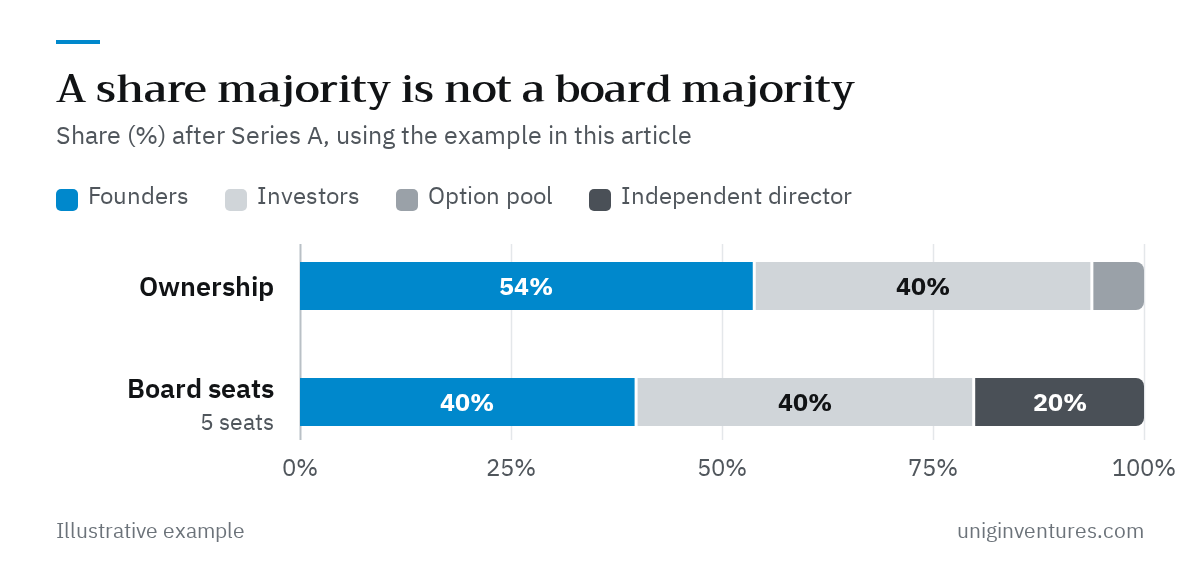
Suppose that after Series A the founders own 54% of the company, investors from both rounds own 40%, and the option pool holds 6%. The founders still hold a majority of the shares, yet they have 2 of 5 board seats, or 40%, the same as the investors. The swing vote on the board belongs to one independent director, so founders should have a say in who that person is, for example by nominating the candidate subject to investor approval.
Two more points need to be written down in this example.
- Quorum. If the articles say nothing, a five-person board has a quorum with three directors present. The two investor directors and the independent can meet without the founders, and the reverse is also true. One common approach requires at least one director from each side for a quorum, and drops that requirement at the adjourned meeting if the first one fails, so neither side can block business by staying away.
- The chair. Directors elect their own chair (Section 1163), and the chair breaks ties (Section 1161). If the independent director is absent, the vote can split two to two, so who chairs the board matters. If you do not want the chair to have a casting vote, the articles must say so.
Board observers
Investors without a board seat, such as co-investors or earlier-round investors, often ask to attend board meetings as observers instead. An observer is not a director under the law, so every observer right comes from contract.
- An observer can attend, ask questions and comment, but has no vote and should not count toward the quorum.
- An observer receives board materials only to the extent the agreement allows. Good agreements carve out matters where the observer's fund has a conflict, matters the company is negotiating with that investor, and legal advice.
- An observer has none of the directors' duties under Section 1168, so confidentiality must be written into the agreement or a separate NDA.
- An observer is not registered with the Department of Business Development, because an observer is not a director.
Observers do not vote, but they add people to the room and send more information outside the company. Founders should limit their number, for example one per major investor, and end the right when the investor's holding falls below an agreed threshold.
Reserved matters
Reserved matters are the actions the company may take only with investor approval. US-style documents call them protective provisions. The items requested most often are issuing shares senior to or on par with the investor's shares, amending the articles in a way that affects investor rights, selling, merging or dissolving the company, paying dividends or buying back shares, taking on significant debt, increasing the size of the board, and expanding the option pool.
Thai agreements often split them into two levels. Shareholder-level matters need consent from investors holding an agreed share. Board-level matters need a yes vote from the investor directors. The table is a starting point for negotiation.
| Matter | Approved by | What to negotiate |
|---|---|---|
| Amending the articles or memorandum | Shareholders | Only amendments that affect investor rights |
| Capital increase, new share classes | Shareholders | Carve out option-pool shares already approved |
| Sale, merger or dissolution | Shareholders | Majority of investors as a group, not each one |
| Dividends, share buybacks | Shareholders | Carve out buybacks from departing employees under the option plan |
| Borrowing or guarantees | Board | A set limit, and no approval for items in the approved budget |
| Annual budget | Board | If not approved by a deadline, last year's budget applies |
| Hiring or pay of senior executives | Board | A clear job level or pay threshold |
| Related-party transactions | Board | A minimum amount, so small items need no approval |
Four principles help in the negotiation. First, use numbers instead of broad words, such as "borrowing above THB 2 million per transaction" instead of "material borrowing." Second, anything already in a board-approved budget needs no second approval. Third, use a majority of investors as a group rather than giving each investor its own veto. Fourth, end the rights when an investor's holding drops below a threshold, so an investor left with a small stake cannot still block major decisions. (The figure in the first point is illustrative.)
If you want reserved matters to bind the company itself, not only the shareholders who signed the agreement, lawyers often recommend writing them into the articles as well, which takes a special resolution under Section 1145. Have a lawyer check that the agreement and the articles say the same thing.
Make board meetings work
- Set the frequency in the agreement, for example quarterly, with board materials sent an agreed number of days ahead.
- Use the same board pack every time: financials against budget, cash and runway, core metrics, and items for approval. Reuse the data from your monthly investor update.
- Record resolutions in writing, noting which items were reserved matters and how each director voted, and keep them in your data room for the next round.
- Hold online meetings lawfully. The Emergency Decree on Electronic Meetings B.E. 2563 (2020) covers meetings held under law by both public bodies and private organizations. The Electronic Transactions Development Agency (ETDA) summarizes what the organizer must do: have attendees identify themselves before the meeting, provide a way to vote, record audio or video throughout, and keep attendance data as evidence.
Where to start
- Open your articles of association and check whether they set the quorum, the chair's casting vote and director rotation, or leave them to the default rules.
- Draw the board seats for this round and the next, and compare them with your cap table to see who holds the deciding vote on each matter.
- Settle how the independent director and the chair are chosen in the term sheet.
- Draft your own reserved-matters list with amounts, carve-outs and a sunset before the investor sends theirs.
- Have a lawyer align the shareholders' agreement with the articles, then register the new directors within 14 days.
This article is general information, not legal advice for any particular company. The statutory provisions were checked in October 2026. The company and figures in the examples are hypothetical. Each company's articles and agreements may provide differently; have a lawyer review them before signing.
Sources
- Civil and Commercial Code Section 1144 (directors manage under the articles) — Thai Law Online
- Civil and Commercial Code Section 1145 (amending the articles by special resolution) — Thai Law Online
- Civil and Commercial Code Section 1151 (general meeting appoints and removes directors) — Thai Law Online
- Civil and Commercial Code Section 1152 (one third of directors retire) — Thai Law Online
- Civil and Commercial Code Section 1153 (order of retirement) — Thai Law Online
- Civil and Commercial Code Section 1157 (register director changes within 14 days) — Thai Law Online
- Civil and Commercial Code Section 1158 (articles may provide otherwise) — Thai Law Online
- Civil and Commercial Code Section 1160 (board quorum) — Thai Law Online
- Civil and Commercial Code Section 1161 (majority and chair's casting vote) — Thai Law Online
- Civil and Commercial Code Section 1162 (calling board meetings) — Thai Law Online
- Civil and Commercial Code Section 1163 (chair of board meetings) — Thai Law Online
- Civil and Commercial Code Section 1168 (directors' duties and non-competition) — Thai Law Online
- Civil and Commercial Code Section 1194 (special resolution) — Thai Law Online
- Using e-Meetings Securely and Lawfully (in Thai) — Electronic Transactions Development Agency
- Cashing In: Getting Ready for Your Series A Round — Faegre Drinker
- What are protective provisions? — Startup Company Lawyer
- The Board Observer: Considerations and Limitations — Harvard Law School Forum on Corporate Governance