Anti-Dilution and Pro-Rata Rights: How They Shape Your Next Round
Full ratchet versus broad-based weighted average in a worked down-round example, the NVCA formula, pro-rata rights, the limits in a Thai limited company, and what to negotiate before signing.
In this article
Two terms in a term sheet often get a quick read from founders because they seem to have no effect on the round being closed: anti-dilution protection and pro-rata rights. Neither changes the numbers of this round. Together they decide who gets how many shares in the next one, and how much ownership founders lose if the next round is priced below this one.
This article walks through the formulas with a numerical example, the limits of using these terms in a Thai limited company, and the points worth negotiating before you sign.
What anti-dilution actually protects against
Dilution from issuing new shares is a normal part of every round, and anti-dilution does not prevent it. What it protects against is the company issuing new shares at a lower price per share than an earlier investor paid, a down round. When that happens, the earlier investor is compensated with extra shares. Those shares come out of everyone else's ownership, mostly founders and employees.
In the model documents of the US National Venture Capital Association (NVCA), the protection works by adjusting the conversion price of preferred stock. The lower the conversion price, the more common shares each preferred share converts into. There are two main forms.
Full ratchet
The earlier investor's conversion price drops straight to the new round's price, however large or small the new round is. Even if the company sells only a handful of shares at the lower price, the earlier investor gets the full adjustment.
Broad-based weighted average
The conversion price drops in proportion to how much money comes in at the lower price relative to the company's total shares. The formula in the NVCA model certificate of incorporation is:
CP2 = CP1 × (A + B) ÷ (A + C)
- CP1 is the conversion price before the new issue, and CP2 the new conversion price.
- A is the number of shares before the new issue. In the broad-based form it counts all common shares, the shares issuable on conversion of preferred stock and the shares under outstanding options.
- B is the number of shares the new money would have bought at CP1: money received ÷ CP1.
- C is the number of shares actually issued in the new round.
If A counts only some of these, for example excluding options, the provision is called narrow-based. A smaller A makes the adjustment larger, so always read the definition of A rather than relying on the label.
A worked example: a down round
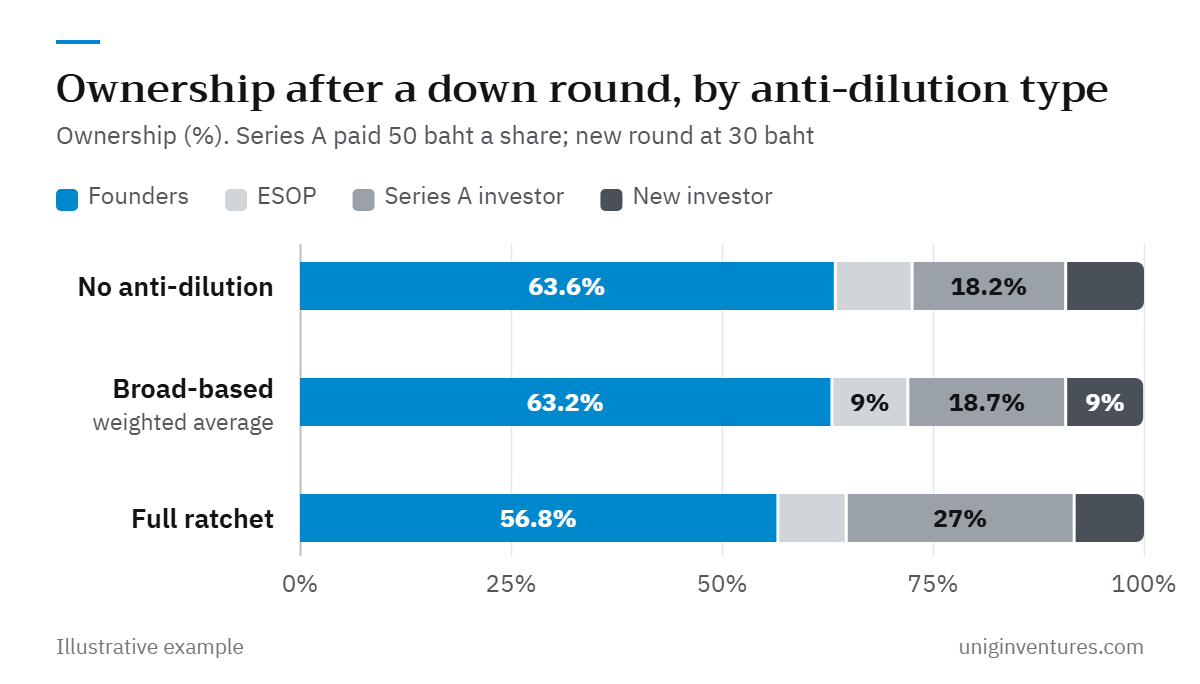
In an illustrative example, a company has 10,000,000 shares on a fully diluted basis. Founders hold 7,000,000, the employee option pool (ESOP) holds 1,000,000, and the Series A investor holds 2,000,000, bought at 50 baht each for 100 million baht. The company later raises 30 million baht at 30 baht per share, issuing 1,000,000 new shares.
- Broad-based weighted average: B = 30,000,000 ÷ 50 = 600,000 shares. The new conversion price = 50 × (10,000,000 + 600,000) ÷ (10,000,000 + 1,000,000) = 48.18 baht. The 100 million baht now converts into 2,075,472 shares, so the earlier investor gains 75,472 shares.
- Full ratchet: the new conversion price is 30 baht. The 100 million baht converts into 3,333,333 shares, a gain of 1,333,333 shares, more than the new investor receives in the entire round.
| Shareholder | No anti-dilution | Broad-based weighted average | Full ratchet |
|---|---|---|---|
| Founders | 63.6% | 63.2% | 56.8% |
| ESOP | 9.1% | 9.0% | 8.1% |
| Series A investor | 18.2% | 18.7% | 27.0% |
| New investor | 9.1% | 9.0% | 8.1% |
| Total shares | 11,000,000 | 11,075,472 | 12,333,333 |
With weighted average, founders lose about 0.4 points more than with no protection. With full ratchet they lose about 6.9 points more. The new investor is diluted too, and may ask to price the adjustment into its offer, which makes a down round with a full ratchet in place even harder to negotiate.
Pro-rata rights: the right to keep your percentage
Pro-rata rights let an investor buy shares in later rounds in proportion to its current holding so it is not diluted. The simple formula: shares the investor may buy = new shares issued × ownership before the round. In an illustrative example, an investor holds 2,000,000 of 10,000,000 shares, or 20%. If the next round issues 1,000,000 new shares, it may buy 200,000. After the round it holds 2,200,000 of 11,000,000 shares, still 20%.
The points to pin down are:
- Who gets the right. Some deals limit it to investors above a holding threshold so the next round is not crowded with small allocations that leave no room for the lead investor.
- How ownership is measured. Issued shares only, or fully diluted. The numbers differ when the option pool is large.
- Super pro-rata. A right to buy more than your current share is not a standard term, and it leaves less of the next round for new investors.
- Response time. How many days the investor has to respond before the right lapses, so the round is not held up.
Limits in a Thai limited company
The NVCA documents are written for US corporate law. Thai limited companies have rules that change how both terms must be drafted.
- Every shareholder already has a statutory pro-rata right. Section 1222 of the Civil and Commercial Code requires new shares to be offered to all shareholders in proportion to their holdings, by written notice stating the number of shares and a response deadline. What the shareholders' agreement must cover is who agrees to waive that right when a new investor comes in, and how unsubscribed shares are allocated. See the steps in Issuing New Shares to an Investor.
- Preference share rights cannot be amended later. Section 1142 prohibits changing the preferential rights once set, so any future mechanism has to be thought through when the shares are issued.
- Shares cannot be issued below par value (Section 1105). If the investor is compensated with new shares, they must be priced at or above par, and the issue needs a special resolution and the Section 1222 offer process, so other shareholders also have to waive.
Because there is no ready-made conversion price mechanism, the agreement has to state how compensation is delivered, for example by the company issuing additional shares to the earlier investor or by founders transferring their own shares. The second approach puts the entire cost on the founders instead of spreading it across all shareholders. Have a lawyer confirm that the chosen method works under the law and the company's articles.
What to negotiate
- Ask for broad-based weighted average, not full ratchet, and check that A really is fully diluted.
- List issues that do not trigger an adjustment, such as shares under an approved ESOP, shares from stock splits or stock dividends, and shares issued to banks or lessors in board-approved debt or leasing deals. The NVCA model calls these Exempted Securities.
- Require investors to take part in the down round to keep the adjustment (a pay-to-play condition), if investors want the protection.
- Allow a waiver by a majority of investors, rather than every investor's consent, so a rescue round can close quickly.
- Limit pro-rata rights to major investors, with no super pro-rata and a clear response deadline.
Where to start
- Put the term sheet's anti-dilution formula into your cap table and model hypothetical down rounds, for example prices 20% and 40% lower, to see what founders would keep. See how to structure the table in Cap Table Basics Before You Raise.
- Read this term together with liquidation preference, because both come into play at the same time when a company is in trouble.
- Have a lawyer experienced in Thai venture deals check that the shareholders' agreement and the company's articles are consistent and workable in a capital increase.
The company, share counts and prices in this article are an illustrative example. This article is general information, not legal advice for any particular deal.
Sources
- NVCA Model Certificate of Incorporation (updated October 2025), Section 4.4.4 Adjustment of Conversion Price — National Venture Capital Association
- Model Legal Documents — National Venture Capital Association
- Civil and Commercial Code, Section 1222 (offering new shares to existing shareholders) — Thai Law Online
- Civil and Commercial Code, Section 1142 — Thai Law Online
- Civil and Commercial Code, Section 1105 — Thai Law Online