Liquidation Preference Explained: Who Gets Paid First When You Sell
Multiple, participation and seniority decide what founders receive in a sale. Run the waterfall through a two-round example, and see what changes with preference shares in a Thai company.

In this article
The company sells for 60 million baht. The founders own 60%, but they receive 20 million baht, not 36 million. The difference didn't disappear. It went to investors under the liquidation preference the founders signed when they raised money, and many founders only work out the numbers when an acquisition offer lands.
Our article on reading your first term sheet covers the basics. This one goes deeper on three things: the three variables that decide who gets what, how to run the payout waterfall when several rounds of investors are involved, with worked numbers, and what changes when the company is incorporated in Thailand.
When the preference applies
The name says "liquidation," but in practice the preference matters most when the company is sold. The model certificate of incorporation published by the U.S. National Venture Capital Association (NVCA) applies it both to an actual liquidation and to a "Deemed Liquidation Event," such as a merger after which the existing shareholders no longer hold a majority of the surviving company, or a sale of all or substantially all of the company's assets, unless a specified share of the preferred holders elects otherwise.
If the company sells for a high price, a typical investor converts to common stock and takes its ownership share. The preference only bites at low and moderate exit values, which happen more often than founders tend to expect.
Three variables
1. Multiple
How many times their investment the investors receive before common shareholders. The NVCA model leaves a blank for "[__ times] the applicable Original Issue Price." A 1x preference returns the money invested; a 2x preference returns double before founders see a baht.
2. Participation
- Non-participating. The investor receives the greater of its preference amount or what it would get by converting to common. This is the form in the NVCA model.
- Participating. The investor receives its preference first, then also shares in what remains according to its ownership.
- Capped participation. The investor participates until its total reaches a cap, such as 3x its investment. Above that, it chooses between taking the cap and converting to common.
3. Seniority between rounds
- Pari passu. All rounds are paid at the same time, in proportion to the amounts they are owed. The NVCA model is written this way.
- Stacked (standard) seniority. Later rounds are paid before earlier ones. For example, Series A is paid in full before seed investors receive anything.
Each variable is negotiated separately. An offer with a higher valuation can leave founders with less if it comes with a 2x participating preference.
Worked example: who gets what in a sale
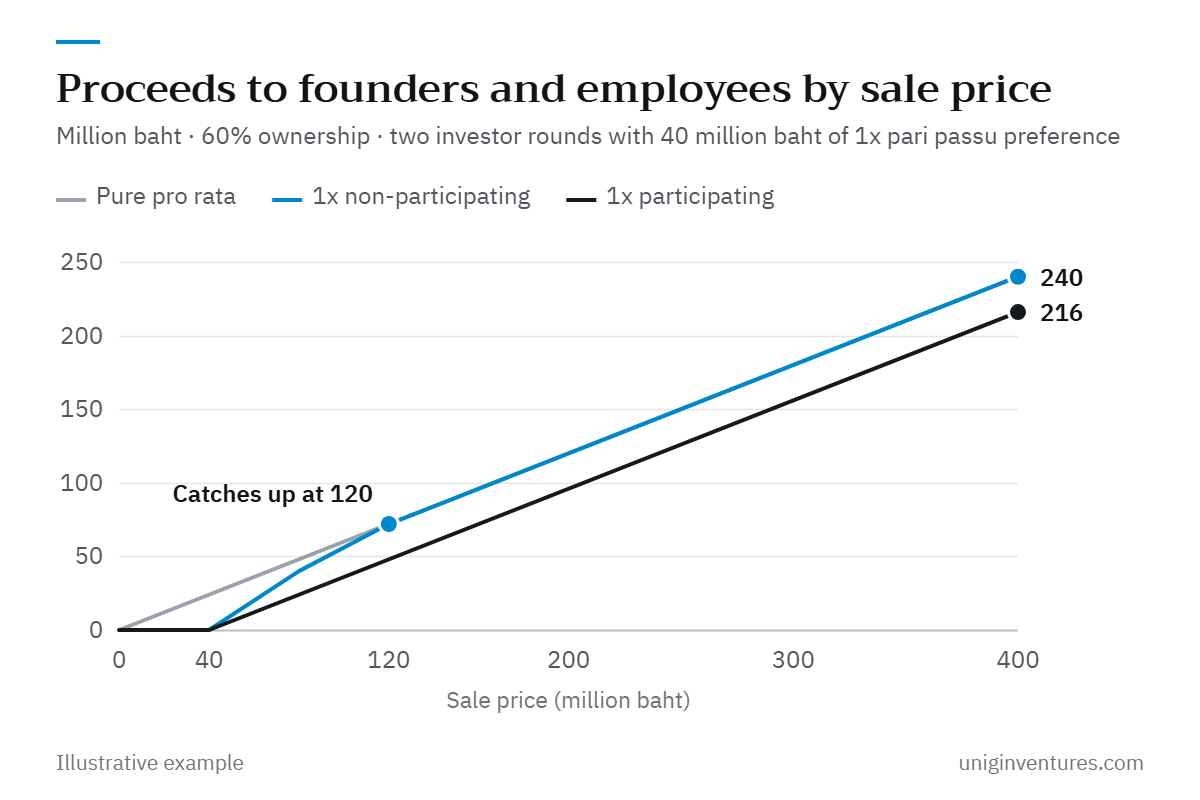
Illustrative example: a company has raised two rounds, each with a 1x preference.
- Seed: 10 million baht for 20% (50 million baht post-money)
- Series A: 30 million baht for 25% (120 million baht post-money), diluting the seed investor to 15%
- Founders and employees together hold 60%
- Total preference owed to investors: 40 million baht
| Sale price | Pure pro rata (60%) | 1x non-participating | 1x participating |
|---|---|---|---|
| 30 | 18 | 0 | 0 |
| 60 | 36 | 20 | 12 |
| 160 | 96 | 96 | 72 |
| 400 | 240 | 240 | 216 |
Walk through the non-participating, pari passu case row by row:
- Sale at 30 million baht. This is below the 40 million total preference, so investors split it in proportion to their preferences. Seed receives 10/40 × 30 = 7.5 million, Series A receives 22.5 million, and founders and employees receive nothing.
- Sale at 60 million baht. If Series A converted, it would get 25% × 60 = 15 million, less than its 30 million preference, so it takes the preference. So does the seed investor. Founders and employees receive 60 − 40 = 20 million.
- Sale at 160 million baht. On conversion, seed gets 15% × 160 = 24 million, more than 10 million, and Series A gets 25% × 160 = 40 million, more than 30 million. Everyone converts, and founders and employees receive 60% × 160 = 96 million.
With participation, investors always take their 40 million first and then share the rest by ownership. At a 160 million baht sale, founders and employees receive 60% × 120 = 72 million, 24 million less than with non-participating preferred. At 400 million baht, the gap is still 24 million. Participating investors never have to choose, so the gap never closes.
If seniority is stacked
Use the same example, but with Series A senior to seed. At a 30 million baht sale, Series A takes all 30 million and seed gets nothing instead of 7.5 million. In this case seniority doesn't change what founders receive, but it hits the earliest investors, often angels or people close to the company who backed it first, and can make the next round harder to agree.
Effects the table doesn't show
- Preference overhang. Every round adds to the amount paid out first. A company that has raised 40 million baht must sell for more than 40 million before founders and employees receive anything. Raising at a valuation well ahead of performance makes this overhang heavier.
- Employee equity. Employees holding common shares through an ESOP sit at the back of the line. If the overhang exceeds what the company can realistically sell for, their equity is worth less than they think. See ESOP design for Thai companies.
- Misaligned incentives. With an offer slightly below the overhang, investors get their money back but the team gets zero, leaving the team little reason to see the deal through. Some deals therefore set aside a carve-out for management outside the normal waterfall.
When the company is incorporated in Thailand
Thai startups organized as private limited companies usually grant these rights through preference shares together with a shareholders' agreement. Three points to know:
- Preference share rights cannot be changed later. Section 1142 of the Civil and Commercial Code prohibits amending the preferential rights of preference shares once they have been issued and their rights set. Get the terms complete the first time and think ahead about how the next round will fit.
- Creditors always come first. In an actual liquidation, Section 1269 allows assets to be distributed to shareholders only after setting aside what is needed to pay the company's debts. A liquidation preference only orders payments among shareholders.
- Selling all the shares is not a liquidation. When a buyer pays shareholders directly, the waterfall needs a contract behind it, such as a clause in the shareholders' agreement on how sale proceeds are split. Have a lawyer check that the articles of association and the shareholders' agreement say the same thing.
How to negotiate
- Start from 1x non-participating. It is the form used in the NVCA model documents.
- If you must accept participation, ask for a cap, and calculate the sale price at which the cap takes effect.
- Compare offers by what founders receive, not by valuation. Build a table like the one above at several sale prices, especially the ones most likely to happen.
- Watch for terms that quietly add to the preference, such as cumulative dividends added to the amount paid first.
- Think about the next round. Whatever you concede now, the next investor will usually ask for the same or more.
Where to start
- Collect the terms of every existing round: multiple, participation, seniority and any cumulative dividends, from the articles and the shareholders' agreement.
- Build a waterfall in Excel from a fully diluted cap table. Calculate what each group receives at sale prices of 0.5x, 1x, 2x and 5x the total amount raised.
- Find the price at which each investor converts to common, so you know how far up the preference bites.
- Use the model for every new term sheet or acquisition offer, and have a lawyer check the actual wording before you sign.
Valuation is the number everyone remembers. What founders and the team actually receive in a sale is set by three lines in the term sheet that many people skim. Run the numbers before you sign, not when an offer arrives.
Sources
- NVCA Model Certificate of Incorporation (updated October 2025): Liquidation, Dissolution or Winding Up; Certain Mergers, Consolidations and Asset Sales, National Venture Capital Association
- Model Legal Documents, National Venture Capital Association
- Civil and Commercial Code, Section 1142, Thai Law Online (in Thai)
- Civil and Commercial Code, Section 1269, Thai Law Online (in Thai)