Corporate Venture Capital vs. VC: Goals, Terms and What to Ask First
CVC can bring customers, distribution and technology, but also conflicts of interest and rights over a future sale. Structures, terms to read, and Thailand's Royal Decree 750 tax exemption.

In this article
Sooner or later, a startup raising money meets an investor that is not a fund at all, but the investment arm of a large company: a bank, a retailer, an energy group or a telecom operator. Corporate venture capital (CVC) can bring things a financial VC cannot, such as a first big customer, a distribution channel or access to technology. It also brings questions a financial VC never raises, because the investor is also a potential partner, competitor or buyer.
This article explains how CVC differs from a conventional VC, the common structures, the deal terms to read carefully, how Thailand's startup capital-gains exemption applies to corporate investors, and the questions to ask before you accept the money.
What Makes CVC Different
A conventional VC firm raises a fund from outside investors, called limited partners, and has one job: return more money than it received within the life of the fund. A CVC invests money from a parent company, and usually has two jobs: a financial return and a strategic benefit to the parent.
| Topic | Conventional VC | Corporate VC |
|---|---|---|
| Source of money | Limited partners in a fund | The parent company's balance sheet, or a fund it sponsors |
| Main goal | Financial return | Strategic benefit plus financial return |
| Time horizon | Set by the fund's life | Set by the parent's strategy and budget, which can change |
| Decision makers | Partners of the fund | Investment team, often with business units and senior management |
| What it adds | Network, follow-on funding, fundraising experience | Customers, distribution, technology, industry knowledge |
| Typical risks | Pressure to exit within the fund's life | Conflicts of interest, slow decisions, a program closed after a strategy change |
None of this makes CVC money better or worse. It makes it different, and the right choice depends on what your company needs most in the next two or three years.
Common Structures
- Direct investment from the balance sheet: the parent company itself buys shares. This is simple, but decisions often run through the parent's normal approval process.
- A dedicated investment company or fund: the parent sets up a subsidiary, or a fund with its own team and budget. Decisions are usually faster, and the team tends to behave more like a financial VC.
- A limited partner in an outside VC fund: the parent puts money into a fund managed by others, often to learn about a sector before investing directly.
Ask which structure you are dealing with. It tells you who approves the deal, how long approval takes, and who will sit in your board meetings.
Strategic or Financial: Four Kinds of Investment
Henry Chesbrough's widely cited framework in the Harvard Business Review sorts corporate investments along two questions: is the main objective strategic or financial, and how closely is the startup linked to the parent's current operations? That gives four kinds of investment:
- Driving: strategic and tightly linked. The startup advances the parent's current strategy, so the parent will care a lot about how you work with it.
- Enabling: strategic but loosely linked. The startup's success helps the parent's own business, for example by growing demand for its products.
- Emergent: strategic intent but loosely linked today. The parent is exploring a market or technology it may enter later.
- Passive: mainly financial. The parent behaves much like any other investor.
Knowing which kind of deal you are in helps you predict what the investor will ask for and how it will behave if your plans change direction.
Terms to Read Carefully
- Right of first refusal or first negotiation on a sale: a right for the corporate to match or be first to bid if someone wants to buy your company. Other buyers may not bother to bid if they know the corporate can match.
- Exclusivity and commercial agreements tied to the investment: if the term sheet bundles the investment with a supply, distribution or partnership deal, check whether it stops you from working with the corporate's competitors, and for how long.
- Information rights: a corporate investor may also compete with you or with your customers. Agree on what information it receives, who inside the company sees it, and what is excluded from board materials.
- Board seat or observer: an observer seat is common for CVC. Decide in advance how the board handles agenda items where the corporate has a conflict of interest.
- Signaling: if a well-known corporate invests and then does not follow on, other investors may read it as a bad sign. Ask about its follow-on policy up front.
Thailand's Capital-Gains Exemption for Startup Shares
Royal Decree No. 750 (2022) exempts personal and corporate income tax on gains from selling shares in a "target company". The exemption runs from the day after publication to 30 June 2032. The main conditions in the decree:
- The target company is incorporated in Thailand, operates in a targeted industry announced by the national competitiveness committee, develops or applies technology or innovation as a key part of its business, and is certified by an agency the Director-General of the Revenue Department designates.
- The investor can be an individual, or a company or juristic partnership incorporated in Thailand or abroad. A corporation investing directly from its balance sheet is therefore covered.
- Holding period: the shares were held for at least 24 months before the sale, and only the gain above the amount invested is exempt.
- Revenue test: the target company's supported business produced at least 80% of its total revenue in each of the two consecutive accounting periods before the sale.
The decree also exempts gains on shares of a venture capital company that invests in target companies, and on its liquidation, under formulas tied to its qualifying investments. That company must be incorporated in Thailand, have paid-up capital of at least 20 million baht at the end of each accounting period, register as a venture capital business with the Securities and Exchange Commission, and not use the earlier VC exemptions under Royal Decrees No. 10 (as amended by No. 481), No. 597 or No. 636.
As an illustrative example, a corporate investor puts 10,000,000 baht into a qualifying startup and later sells its shares for 40,000,000 baht, assuming a 20% corporate income tax rate.
Gain = 40,000,000 − 10,000,000 = 30,000,000 baht
Sold after 20 months: tax at 20% = 6,000,000 baht, gain after tax = 24,000,000 baht
Sold after 36 months, with all conditions met: exempt, gain after tax = 30,000,000 baht
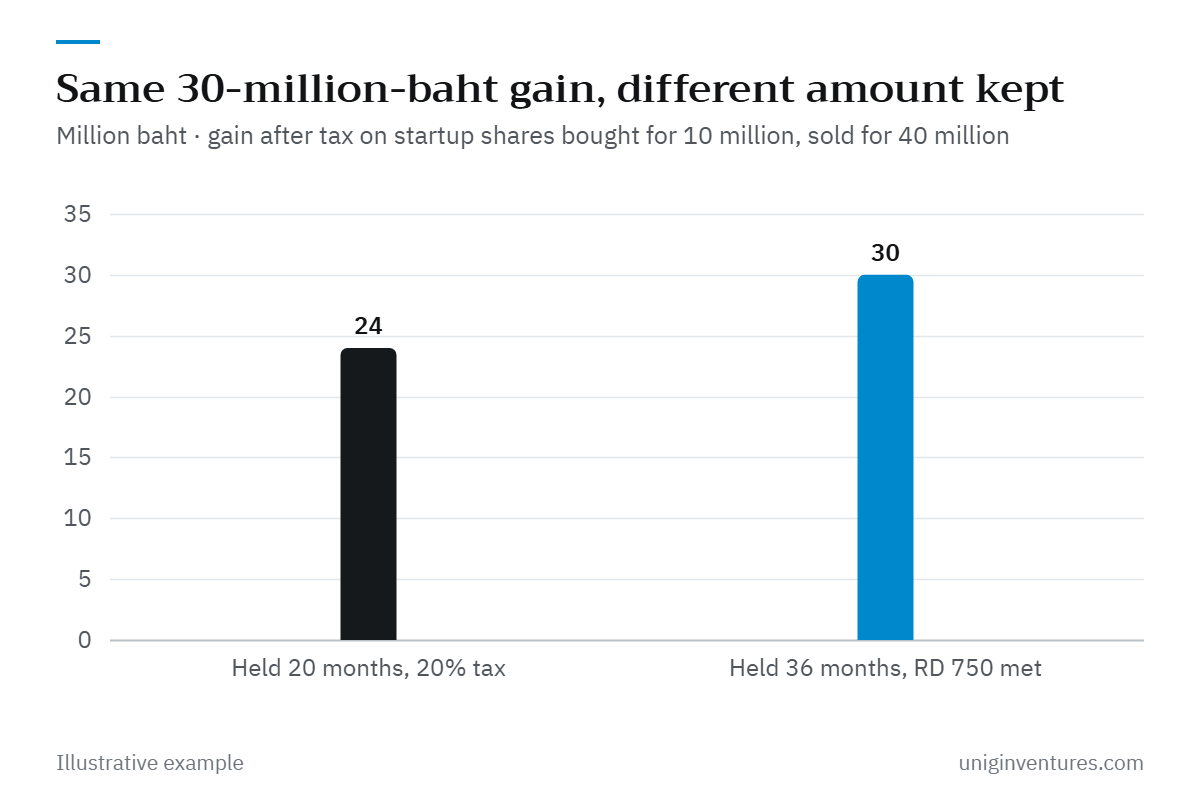
For founders, this matters in two ways. A corporate investor may ask you to keep the company qualified, for example by staying in a targeted industry and keeping the certification. And an investor that wants to sell within 24 months gets no exemption, which can affect how it thinks about a secondary sale.
Questions to Ask a CVC Before You Accept
- Is this investment strategic or financial for you, and which business unit sponsors it?
- Who approves the investment and any follow-on, and how long does approval usually take?
- Is the investment tied to a commercial agreement? Can we still work with your competitors?
- What happens to your stake and your board seat if the parent changes strategy or closes the program?
- Do you want any right over a future sale of the company?
- Who inside your company will see our information?
- Can we speak to founders of startups you have invested in, including ones where things did not go to plan?
Where to Start
- Write down what you need besides money: a first customer, distribution, technology or credibility. If the answer is "nothing", a financial VC may be the simpler choice.
- Classify the deal: driving, enabling, emergent or passive, and which structure the corporate uses.
- Separate the investment from the commercial deal: negotiate each on its own merits, and avoid exclusivity that outlasts the business case.
- Keep sale rights out, or narrow: if you must give one, prefer a right to be notified or to negotiate over a right to match.
- Check Royal Decree 750 eligibility early: certification and the 80% revenue test take planning, and your investors will ask.
This article is general information, not legal, tax or investment advice. Laws are as of October 2026.