Venture Debt or Equity: When to Borrow, When to Raise, and the Real Cost
Compare the cost of venture debt and selling equity with a worked example, learn the signs for and against borrowing, the contract terms to check, and the warrant and tax issues for Thai companies.
In this article
Startups that have just closed a round often face the same question again a few months later: if the cash on hand will not reach the next milestone, should you sell more shares or borrow to buy time? Loans designed for venture-backed companies are called venture debt. Their best-known selling point is that you keep your ownership. That advantage comes with an obligation to repay, whatever happens to the business.
This article explains how venture debt works, compares its real cost with selling equity using a worked example, lists the signs that you should or should not borrow, covers the contract terms to read closely, and flags the legal and tax points specific to Thai limited companies.
What venture debt is
Venture debt is a loan to an early-stage company that does not yet generate enough cash flow for a conventional bank loan but has already raised money from venture investors. The European Investment Bank (EIB), a major lender of this kind, describes it as a loan that bridges the period between funding rounds, rarely a long-term source of finance, and an addition to venture capital rather than a replacement.
How it differs from an ordinary bank loan, as summarized by the Corporate Finance Institute:
- Lenders look at investors more than assets. Borrowers have usually completed one or more venture rounds. Lenders expect most repayment to come from the next round, not from profits.
- The amount is tied to the last round. A common rule of thumb is up to about 30% of the amount raised in the most recent equity round.
- The term is short to medium. Usually 1 to 3 years, and many deals start with an interest-only period.
- Warrants come attached. The lender gets the right to buy shares at a preset price, often worth about 5% to 20% of the loan principal, to compensate for limited collateral. If the company does not grow, the warrants expire worthless.
- Covenants apply. Their number and strictness depend on the lender. Banks tend to impose more than non-bank lenders.
In short, venture debt is a tool to buy time to reach a milestone that lets you raise the next round at a higher valuation. It is not a rescue tool for a company that cannot raise its next round.
Comparing costs: borrow 15 million baht or sell 10%
Illustrative example: a startup valued at 135 million baht in its last round needs another 15 million baht to extend its runway by 12 months and reach a sales target. It has two options.
- Sell more equity at a pre-money valuation of 135 million baht. The new investor gets 15 ÷ 150 = 10%.
- Take venture debt of 15 million baht at 12% a year over 36 months: interest-only for the first 12 months, then 24 equal principal payments of 625,000 baht a month, a 1% fee, and warrants worth 10% of the principal (1.5 million baht) at the last-round price, about 1.1% of the company.
The cash cost of the loan
Interest in the first 12 months = 15,000,000 × 12% = 1,800,000 baht
Interest during the 24-month repayment period = 1,875,000 baht (the balance falls every month)
1% fee = 150,000 baht
Total 3,825,000 baht
Selling equity costs no cash. You pay with a share of the company's future value. The warrants work the same way: their cost is the value of 1.1% of the company minus the 1.5 million baht the lender pays in when it exercises. If the shares are worth less than the exercise price, the lender will not exercise.
| Company value at exit | Cost of selling 10% | Cost of venture debt |
|---|---|---|
| 50 million baht | 5,000,000 | 3,825,000 (warrants not exercised) |
| 150 million baht | 15,000,000 | 3,975,000 |
| 500 million baht | 50,000,000 | 7,825,000 |
| Next round fails | Nothing to repay | Principal and interest still due under the contract |
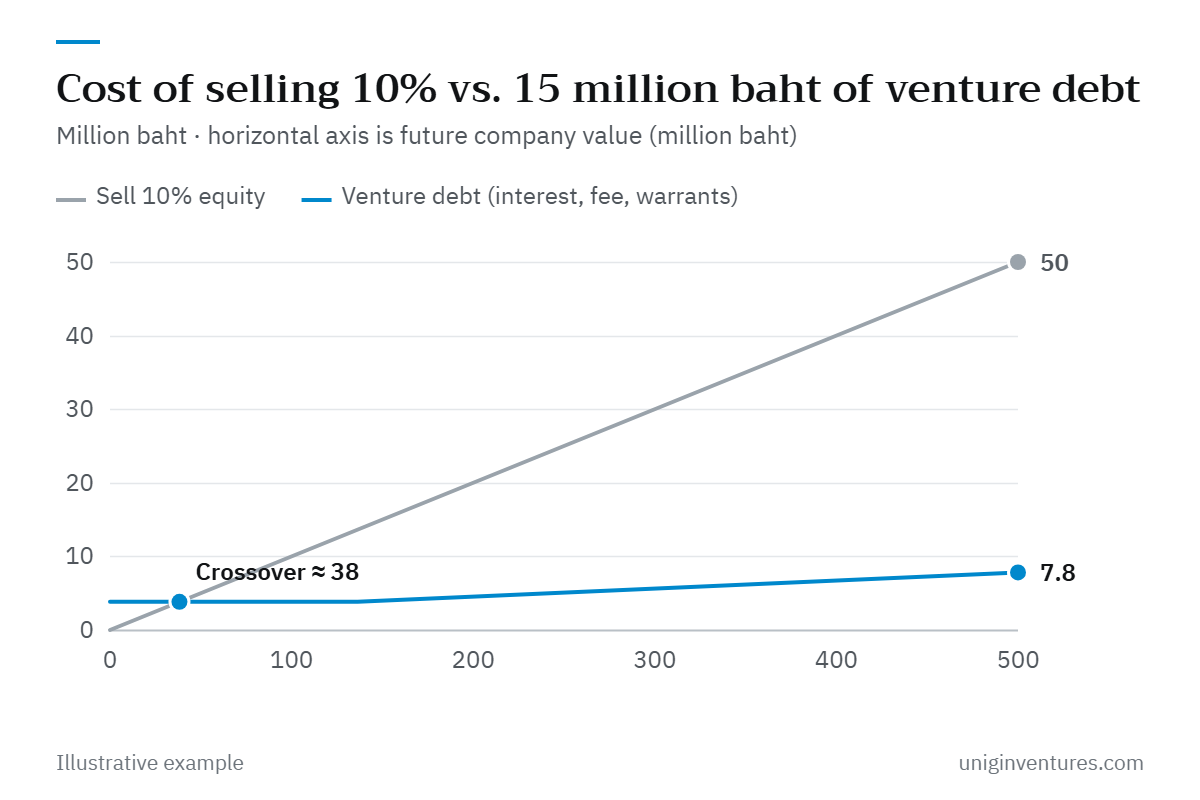
These numbers explain why confident founders like debt. But the last row of the table matters most. If sales miss the target and investors do not fund the next round, the company that sold equity still has time to adjust. The company that borrowed must pay 625,000 baht a month plus interest, and may breach a covenant that lets the lender demand the full balance at once.
When to borrow, and when not to
Consider debt when
- You have just closed a round, and your current investors confirm they will support the next one.
- You know exactly what the money is for, and that milestone will genuinely raise your next valuation, such as monthly recurring revenue reaching the level investors have set.
- Your revenue is predictable, or you hold enough cash to cover interest and principal even if the next round arrives six months late.
- You use it as a reserve alongside equity, not as your main source of funds.
Do not borrow when
- The loan would only postpone a hard decision, such as cutting costs or changing the business plan.
- Your current investors will not commit more money or will not give a clear answer. Lenders will read the same signal, and your terms will get worse.
- The repayment period is shorter than the time the business needs to reach the milestone.
- Sales are too volatile to be confident you can make every monthly payment.
Contract terms to read closely
The interest rate is only part of the cost. Before you sign, build a table comparing every lender's offer on these points.
| Term | Questions to answer |
|---|---|
| Amount and drawdown | Single draw or tranches? What conditions apply before the next tranche? Is there a fee on undrawn amounts? |
| Interest-only period | How many months, and what is the monthly payment afterward? |
| Interest and fees | Fixed or floating rate? Any upfront fee, final fee or prepayment penalty? |
| Warrants | What percentage of principal? What exercise price? When do they expire? |
| Collateral | Which assets does the lender have rights over, including intellectual property or bank accounts? |
| Covenants | Is there a minimum cash or revenue requirement? Restrictions on further borrowing, asset sales or dividends? |
| Events of default | Besides missed payments, what lets the lender demand the full balance? |
Covenants and events of default can do the most damage when the business falls behind plan. Have a lawyer read every clause, and model which ones you would breach if sales came in 30% below plan.
Extra points for Thai limited companies
Lender warrants
The Civil and Commercial Code, which governs Thai limited companies, has no provisions on warrants as such. Granting a lender the right to buy shares must therefore be structured as an agreement among the company, existing shareholders and the lender, taking these rules into account:
- Increasing capital to issue new shares requires a special resolution of a shareholders' meeting (Section 1220).
- New shares must first be offered to existing shareholders in proportion to their holdings (Section 1222), so existing shareholders must agree to waive their rights to the portion intended for the lender.
- A limited company cannot issue debentures (Section 1229). A convertible debenture must go through the private placement route under SEC rules.
Foreign lenders are often used to documents under other countries' laws. Have a Thai lawyer review the deal from the term sheet stage.
Tax on interest
- Interest on business borrowing is deductible for corporate income tax, unlike equity, which has no deductible cost. Startups still making losses will not benefit from this right away.
- Interest paid to a Thai juristic person other than the banks and financial institutions named in the order is subject to 1% withholding tax under clause 4 of Revenue Department Order Tor.Por.4/2528.
- Interest paid to a foreign company not doing business in Thailand is subject to 15% withholding tax under Section 70, filed on form P.N.D.54, unless a double tax treaty with the lender's country sets a lower rate. If the contract makes the company bear that tax for the lender (a gross-up), the real cost exceeds the contract rate.
Where to start
- Build a monthly cash forecast up to the next funding round, with both a plan case and a case where sales fall short.
- Name the milestone this money must reach, and ask your current investors directly whether they will fund the next round if you hit it.
- Calculate the cost of both options with your own numbers, as in the example, and check that you can still make the payments in the worst case.
- If you choose debt, get offers from more than one lender and compare every term in the table, not just the interest rate.
- Have your lawyer and accountant review the warrants, covenants and withholding tax before you sign.
Sources
- What is venture debt? All the answers from a market pioneer (May 2022) — European Investment Bank
- Venture Debt — Corporate Finance Institute
- Civil and Commercial Code Section 1220 — Thai Law Online (Thai)
- Civil and Commercial Code Section 1222 — Thai Law Online (Thai)
- Civil and Commercial Code, Book III, Title XXII, Partnerships and Companies (Section 1229) — Department of Business Development (Thai)
- Private placements by SMEs and large enterprises — Securities and Exchange Commission, Thailand (Thai)
- Revenue Department Order Tor.Por.4/2528 (clause 4, interest paid to juristic persons) — Revenue Department (Thai)
- Corporate income tax on income paid from or in Thailand (Section 70) — Revenue Department (Thai)