The Monthly Investor Update: A Short, Honest Report That Builds Trust
A monthly investor update structure you can reuse, the numbers every issue needs, how to calculate runway honestly, how to share bad news, and how to ask for help investors can act on.

In this article
Once the money from a funding round is in the bank, many founders go quiet until they need to raise again. Investors then hear about the company only when it is short of cash. The next conversation starts with doubt instead of trust. A short monthly report to your investors, the investor update, fixes this at almost no cost. It also forces you to look at your own numbers on the same day every month.
This article covers what the law and your investment agreement require compared with what a monthly update adds, a structure you can reuse every month, the numbers every issue needs and how to calculate runway honestly, how to share bad news, how to ask for help that investors can actually give, and what to watch out for.
What you must send, and what an update adds
A Thai limited company has formal reporting duties to shareholders under the Civil and Commercial Code. They are annual, not monthly:
- A general meeting of shareholders must be held within six months of registration and at least once every 12 months after that (Section 1171).
- The balance sheet must be audited by an auditor and submitted for approval at a general meeting within four months of its date. A copy must be sent to every shareholder on the register at least three days before the meeting (Section 1197).
Investors who come in through a funding round usually negotiate additional information rights. According to a summary by law firm Morrison Foerster, typical terms include annual financial statements within 90 to 180 days after year-end, unaudited quarterly statements within 45 days after quarter-end, a quarterly capitalization table, and a board-approved annual budget. Monthly statements are sometimes requested but are often dropped for early-stage companies to reduce the workload. These rights usually go only to major investors above an ownership threshold.
So legally and contractually, many companies could report to investors only a few times a year. A monthly update fills the gap. It is not a formal financial statement. It is a short letter that tells every investor, big or small, how the company is doing, what has changed, and where you need help. Your current investors are also the first people the next round's investors will call to ask about you.
A structure you can reuse every month
Use the same order every month so readers know where to look. Put the numbers and requests at the top, because many investors read only the first screen.
| Section | What goes in it | Length |
|---|---|---|
| 1. Summary | The most important things this month, good and bad | 3 lines |
| 2. Key numbers | Cash, net burn, runway, revenue and 2 to 3 KPIs, compared with last month | One small table |
| 3. Asks | Specific help you need, one line each | 1 to 3 items |
| 4. Wins | Progress against the goals you set | 3 to 5 bullets |
| 5. Challenges | What went wrong or missed plan, and what you are doing about it | 2 to 4 bullets |
| 6. Team | New hires, departures, open roles | 1 to 3 lines |
| 7. Next month | The 2 to 3 goals you will report on next time | 3 lines |
Keep the whole thing in the body of the email so it can be read on a phone. Attach the detailed financials separately if investors want them. Send it on the same date every month, for example by the 10th, after you have closed the previous month's books. A reliable schedule tells investors as much as the content does.
Section 7 matters more than it looks. Next month's update should report against the goals you wrote this month. Over a year, investors will see 12 issues showing whether this team does what it says it will do. That record is what investors look for before writing their next check.
The numbers every issue needs
Revenue alone is not enough. Investors want to know how long the company can survive. The three numbers that must appear every month are cash, net burn and runway.
Net burn = total cash paid out in the month − total cash received in the month
Runway (months) = cash at month-end ÷ average net burn over the last 3 months
Illustrative example: a startup's numbers from April to September 2026.
| Month | Revenue | Expenses | Net burn | Cash at month-end |
|---|---|---|---|---|
| April | 620,000 | 2,400,000 | 1,780,000 | 27,240,000 |
| May | 700,000 | 2,450,000 | 1,750,000 | 25,490,000 |
| June | 780,000 | 2,500,000 | 1,720,000 | 23,770,000 |
| July | 880,000 | 2,600,000 | 1,720,000 | 22,050,000 |
| August | 1,000,000 | 2,650,000 | 1,650,000 | 20,400,000 |
| September | 1,150,000 | 2,750,000 | 1,600,000 | 18,800,000 |
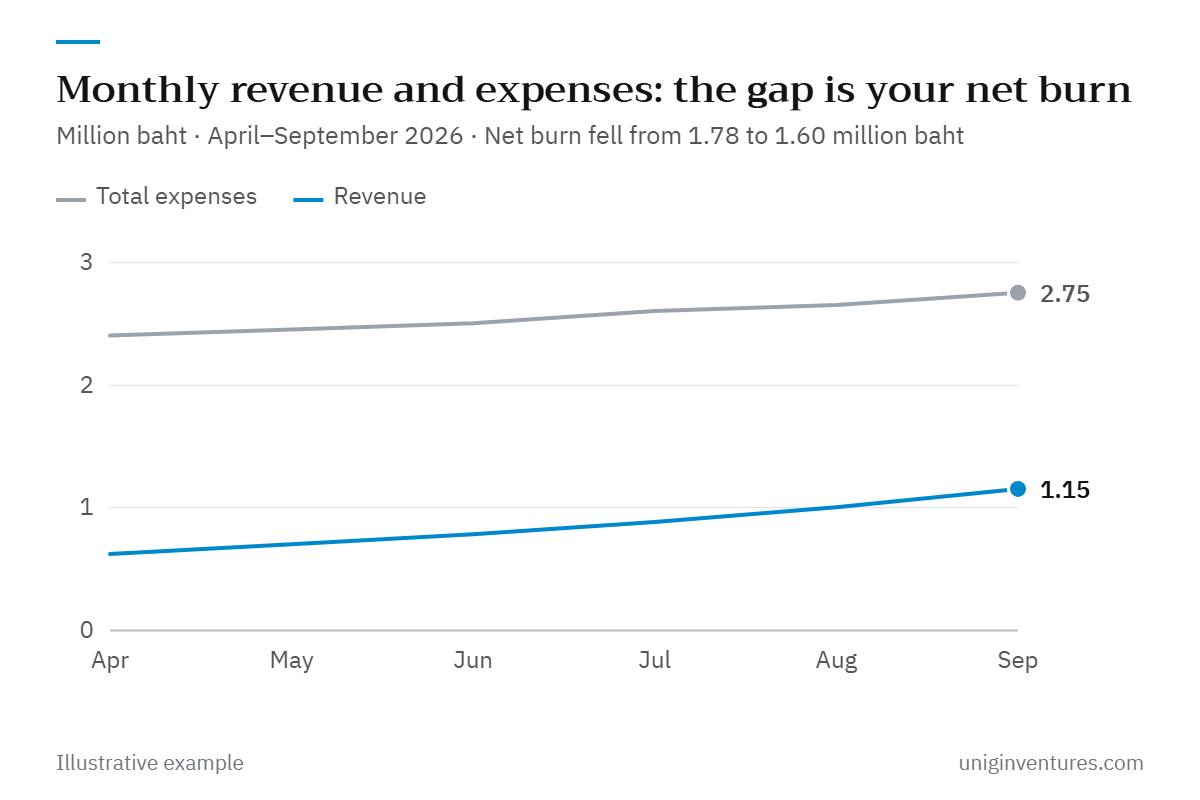
Using September alone, runway is 18,800,000 ÷ 1,600,000 = 11.75 months. Using the three-month average, net burn is (1,720,000 + 1,650,000 + 1,600,000) ÷ 3 = about 1,656,667 baht, and runway is 18,800,000 ÷ 1,656,667 = about 11.3 months. The average is more conservative and smooths out one unusually good month. Pick one method, state it in the update, and do not switch methods when the numbers look bad.
Besides these three, add 2 to 3 KPIs that fit your business model, such as monthly recurring revenue, customer churn, or gross margin. Define each one clearly the first time and keep the definition fixed. If you must change a definition, say so and restate the previous months on the new basis.
Share bad news early
The hardest update to write is the one with bad news, and that is the one that matters most. Investors who learn about a problem from someone else, or only when you ask for more money, will question everything you said before.
- Put it in the summary. Do not bury it at the bottom of a long email.
- State the facts and the numbers. For example: "We lost our second-largest customer, which accounted for 18% of monthly revenue."
- Say what you are doing. State the decision you have made, or the options you are weighing and when you will decide.
- Show the effect on runway. If runway falls to the point where you must raise or cut costs, say so plainly and name the date by which you must act.
- Ask for specific help. Bad news is when experienced investors can help the most.
Do not tone down bad news to the point that it is no longer true, and do not overstate good news. Investors read many updates. They notice when a company always "beats plan" without the cash to show for it.
Make asks investors can act on
The asks section is the most useful part for the company. Investors want to help but do not know what you need. A vague ask usually gets no reply. A specific ask gets an introduction within days.
| Vague ask | Specific ask |
|---|---|
| Introductions to large customers | An introduction to the procurement manager of a hospital group with 5 or more branches, to pilot our appointment system |
| Help with hiring | Looking for a senior backend engineer with payments experience. Job description attached. Introductions appreciated |
| Advice on fundraising | We plan to raise our next round in Q2 2027. We would like 30 minutes with someone who has invested in B2B SaaS in Southeast Asia |
Limit yourself to 1 to 3 asks per issue. In the next update, thank the people who helped by name and report what happened. That makes others more willing to help next time.
What to watch out for
- Confidentiality. Updates are easy to forward. Do not include personal data about customers or employees, unsigned contract terms, or trade secrets. If you need to share sensitive information, do it in a board meeting or with investors who have signed a confidentiality agreement.
- Numbers that match the books. Monthly figures are unaudited management accounts. At year-end, they should reconcile with the audited financial statements. If they differ materially, explain why.
- The same story to everyone. Every investor should receive the same core numbers. Telling different investors different things causes problems when they compare notes.
- Not a substitute for legal duties. An update does not replace the shareholders' meeting, the audited financial statements, or the reports your investment agreement requires.
Where to start this month
- Check your shareholders' agreement or investors' rights agreement to see what you must deliver and by when.
- Pick 3 to 5 KPIs, define them in writing, and pull 6 months of history.
- Fix a sending date, such as the 10th of each month, and block time on your calendar to close the books before it.
- Write the first issue using the 7-section structure above, and keep it to one screen without the attachment.
- Next month, report against the goals you wrote in section 7 before adding anything new.