Issuing New Shares to an Investor: Legal Steps for a Thai Limited Company
A three-quarters special resolution, a first offer to existing shareholders, no direct sale to outsiders, premium only if the memorandum allows it, and registration within 14 days.
In this article
A signed term sheet gets you halfway. The money reaches the company, and the investor becomes a legal shareholder, only after the company issues new shares under the Civil and Commercial Code and registers the increase with the Department of Business Development (DBD) on time. Several steps surprise founders. New shares in a Thai private limited company cannot be sold directly to an outsider, and selling shares above par value requires permission in the memorandum of association.
This article walks through a capital increase in a private limited company (not a public company), from the meeting notice to the updated shareholder register. It includes a worked example of share price and share premium, and the deadlines to plan backward from the day you want the money.
The Rules to Know First
- A special resolution is required. A limited company increases capital by issuing new shares under a special resolution of the shareholders' meeting (Section 1220). A special resolution needs at least three-quarters of the votes of shareholders present and entitled to vote (Section 1194). Founders who together hold less than 75% need other shareholders on board.
- Existing shareholders get the first offer. New shares must be offered to all shareholders in proportion to their holdings, in writing, stating how many shares each may buy and the deadline to respond. Anyone who has not accepted by the deadline is treated as declining (Section 1222).
- Remaining shares go to other shareholders or the directors. The DBD's own manual states plainly that newly issued shares cannot be sold to outside persons.
- New shares use the existing par value. A different par value requires amending clause 5 of the memorandum (a share split or consolidation) first, which can happen in the same meeting. Par value cannot be below 5 baht a share (Section 1117).
- No issuance below par. Issuing above par is allowed only if the memorandum of association permits it, and the premium must be paid with the first installment, which must be at least 25% of par (Section 1105).
- Non-cash payment needs a special resolution. Paying for shares with assets or services requires a special resolution that describes what is contributed (Section 1221).
- No public offering. A private company may not invite the public to subscribe for shares (Section 1102), so a raise happens through individually negotiated investors.
How a New Investor Gets In
Because new shares can only go to shareholders, an investor who holds no shares must become a shareholder before the directors allocate the declined shares. One route that works within the law is a transfer of existing shares. A transfer of registered shares must be in writing, signed by the transferor and transferee, witnessed by at least one person, and recorded in the shareholder register (Section 1129). If the company's articles require director approval for transfers, follow that as well.
Existing shareholders who do not want their allocation then decline in writing, and the directors can sell those shares to the investor, who is now a shareholder. Put this sequence in the term sheet and investment agreement from the start, and have a lawyer check it against your articles. Some companies have transfer restrictions or meeting rules that go beyond the Code.
Worked Example: Share Price and Premium
An illustrative example. A company has registered capital of 1,000,000 baht: 100,000 shares with a par value of 10 baht, fully paid. An investor agrees to put in 5,000,000 baht for 20% of the company after the raise.
New shares = existing shares × investor stake ÷ (1 − investor stake) = 100,000 × 0.20 ÷ 0.80 = 25,000 shares
Price per share = investment ÷ new shares = 5,000,000 ÷ 25,000 = 200 baht
Share premium = (200 − 10) × 25,000 = 4,750,000 baht
| Item | Before | After |
|---|---|---|
| Shares | 100,000 | 125,000 |
| Registered capital (10 baht par) | 1,000,000 baht | 1,250,000 baht |
| Share premium | — | 4,750,000 baht |
| Total paid by investor | — | 5,000,000 baht |
| Founders combined | 100% | 80% |
| Investor | — | 20% |
Three things stand out. First, registered capital rises by only 250,000 baht; the other 4,750,000 baht is share premium. The company can sell at 200 baht a share only if its memorandum permits issuing above par, so check that clause before the meeting. Second, the premium is due with the first installment; in practice an investor pays the full amount at once anyway. Third, the example ignores the small number of shares the investor may receive by transfer beforehand. If there are any, include them when you compute final ownership.
Steps and Deadlines
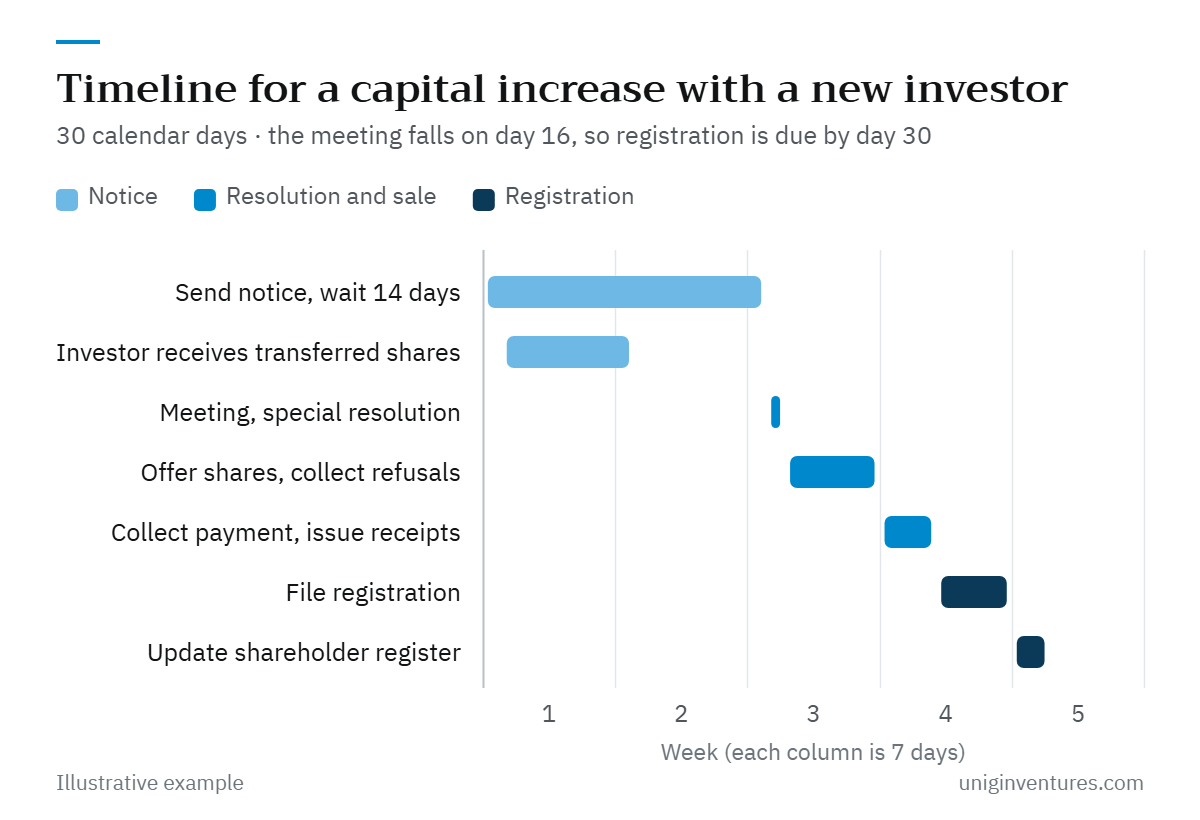
- Send the meeting notice by registered mail with return receipt, or deliver it by hand, to every shareholder in the register. A meeting for a special resolution needs at least 14 days' notice, and the notice must state the proposed resolution (Section 1175). Newspaper or electronic publication is needed only if the company has bearer shares or its articles require it. The period starts the day after the notice is sent, and the meeting can be held the day after the period ends.
- Hold the meeting and pass the special resolution approving the increase, the number of new shares and the amendment to clause 5 of the memorandum. If you issue preference shares, define the rights clearly in the same resolution: once preference shares are issued, their rights cannot be changed (Section 1142).
- Offer the new shares to existing shareholders in a notice dated and signed by a director (Section 1223). Keep every acceptance and written refusal.
- Collect payment and issue receipts. Have the investor transfer to the company's bank account, not a director's, and issue a receipt for the share payment. You need it to register.
- Register within 14 days of the resolution (Section 1228). If all new shares are sold at once, file the special resolution, the capital increase and the memorandum amendment together. If shares are sold in batches, register the resolution within 14 days, then register each increase as shares are sold. You can file at a DBD office, a provincial commerce office or online through DBD Biz Regist.
- Update the shareholder register and the cap table to match the registration, and use the same data in the next annual shareholder list (Bor Or Jor 5).
Registration Documents and Fees
According to the DBD's manual on registering a capital increase, the main documents are:
- The limited company registration application (form Bor Or Jor 1) and the registration certification form
- The amendment and special resolution particulars (form Bor Or Jor 4)
- The amended memorandum of association, with 50 baht of stamp duty
- Copies of the receipts the company issued for payment of the new shares
- A letter describing the rights of preference shares, only if you issue them and the articles do not define share classes
- ID copies of the directors signing the application, and a power of attorney if used
- If the increase takes registered capital above 5 million baht, the extra evidence required by Central Partnership and Company Registration Office Order 1/2567. For cash payment, the DBD's sample is a letter from the directors confirming that the amount shown in the attached bank evidence is payment for shares.
The DBD manual lists a fee of 500 baht to register a capital increase for a limited company, 40 baht per item for a company certificate, and 50 baht per page for certified copies.
Mistakes That Stall a Closing
- Taking the money before the resolution. Cash arrives with no shares to issue against it. The books must carry it as an advance for shares, and if the process stalls, you have to return it.
- A memorandum that does not allow issuance above par. Discovered on the meeting day, it adds an agenda item and may force a new meeting.
- Counting days wrong. Counting the sending day as day one, or filing more than 14 days after the resolution.
- No written refusals from existing shareholders. Investors ask for them in due diligence to confirm that nobody can challenge their shares.
- Forgetting the shareholder register. The company certificate changes, but the internal register still shows the old holdings, so the cap table and legal records disagree.
Where to Start
- Read your memorandum and articles. Check whether they allow issuance above par, restrict share transfers, or set meeting notice periods different from the Code.
- Calculate the new shares, price per share and post-raise ownership from the term sheet, using your registered par value (see our term sheet guide).
- Count backward from the day you want the money. Set the notice date, meeting date and filing date so every step fits inside both 14-day windows.
- Agree in advance which existing shareholders will take up new shares and which will decline, and prepare the letters for signature.
- After registration, update the shareholder register and cap table on the same day. File the resolution, offer letters, refusals and payment receipts in your data room for the next round.
This article is general information, not legal advice for any specific company. Laws, forms and fees were checked in October 2026. The company and figures above are illustrative. Your articles of association may add requirements beyond those described here; have a lawyer set out the steps before you accept investment.
Sources
- Registering a special resolution to increase capital and amend clause 5 of the memorandum (Thai) — Department of Business Development
- Sample letters under Central Registration Office Order 1/2567 (Thai) — Department of Business Development
- Civil and Commercial Code Section 1220 (capital increase) — Thai Law Online
- Civil and Commercial Code Section 1222 (offer to existing shareholders) — Thai Law Online
- Civil and Commercial Code Section 1228 (registration within 14 days) — Thai Law Online
- Civil and Commercial Code Section 1105 (issuance above par) — Thai Law Online
- Civil and Commercial Code Section 1175 (meeting notice) — Thai Law Online
- Civil and Commercial Code Section 1194 (special resolution) — Thai Law Online
- Civil and Commercial Code Section 1129 (share transfers) — compiled by Legardy