How Much to Raise: Size Your Round From Milestones, Burn and the Next Raise
A formula for the round size from the burn needed to reach your milestones, the time to raise again and a buffer, with a worked example and a table of round size against runway and dilution.
In this article
Many founders set the size of a round from what other companies raised or from a number an investor suggests. A round size you can defend comes from your own plan: the cash you need to reach the milestones that make the next round possible, the time it takes to raise that round, and a buffer in case the plan runs late.
Raise too little and you go back to investors before you have proven what you said you would. Raise too much and existing shareholders give up more of the company than they need to. This article gives a formula, a worked example, a table of round size against runway and dilution, and how to explain the number to investors.
Start from milestones, not from a number
A milestone here is the evidence the next round's investors need to see before they decide, such as monthly recurring revenue reaching a set level, churn below a threshold, or customer acquisition cost paying back within a set time. Write down two or three milestones, each with a number and a target month. A milestone you cannot measure cannot anchor a funding plan.
Two questions help set them: "What do the next investors need to see to value us higher than this round?" and "Where do we need to get so that we do not have to raise again?" See the common metrics in unit economics and MRR, churn and cohorts.
The formula
Amount to raise = net burn until the milestones + net burn while raising the next round + buffer − cash on hand
- Net burn is cash out minus cash in each month. Plan it month by month from your hiring and marketing plans rather than using last year's average, because if the plan after the raise includes new hires, monthly spending rises with them. See burn rate and runway and headcount planning.
- Time to raise the next round. The company keeps spending while you find investors, negotiate and wait for the money, and other work slows down. In "How to Raise Money," Paul Graham writes that when you start fundraising, everything else grinds to a halt, because fundraising becomes the top idea in the founders' minds.
- A buffer for milestones that slip or a next round that takes longer than expected. Set it as a number of months of the monthly burn at the end of the plan.
A worked example
In an illustrative example, a startup has 2,800,000 baht in cash and sets its milestones for month 12. Net burn is 800,000 baht a month for the first six months, then rises to 1,200,000 baht a month after new hires. The plan allows six months to raise the next round and a three-month buffer.
| Period | Months | Net burn per month | Total |
|---|---|---|---|
| Before new hires | 1–6 | 800,000 | 4,800,000 |
| After new hires, to the milestones | 7–12 | 1,200,000 | 7,200,000 |
| While raising the next round | 13–18 | 1,200,000 | 7,200,000 |
| Buffer | 19–21 | 1,200,000 | 3,600,000 |
| Total cash needed | 1–21 | – | 22,800,000 |
| Less cash on hand | – | – | −2,800,000 |
| Amount to raise | – | – | 20,000,000 |
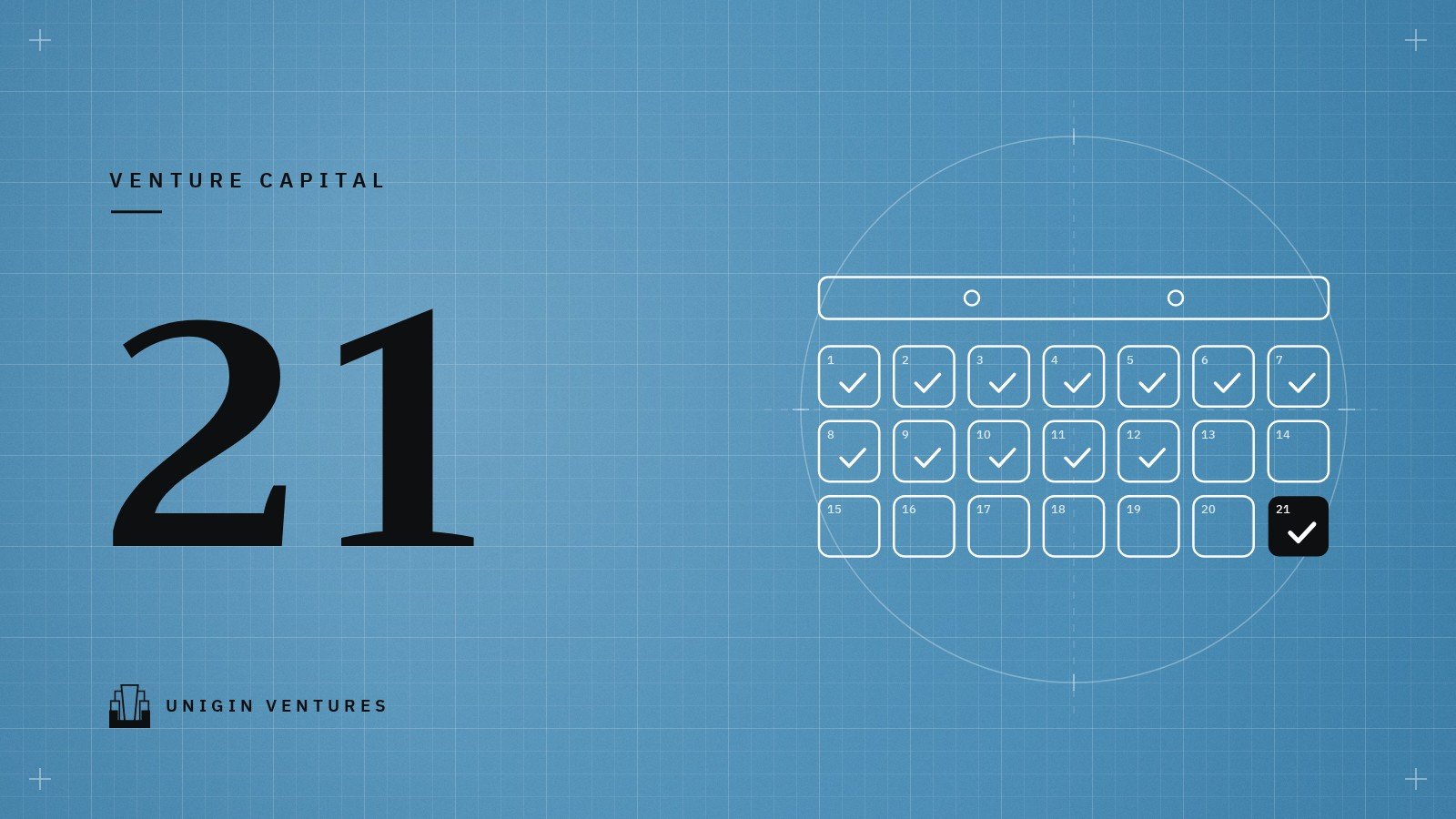
Together with the existing cash, 20,000,000 baht lasts 21 months: 12 months to the milestones, six months to raise the next round and a three-month buffer. If the milestones land on time, the company starts its next raise with nine months of cash left.
Round size against dilution
The money you raise is paid for in shares. The new investor's stake depends on the post-money valuation:
New investor's stake = amount raised ÷ (pre-money valuation + amount raised)
Continuing the example, assume the company agrees a pre-money valuation of 80,000,000 baht and that the valuation does not change with the size of the round.
| Amount raised (baht) | Post-money valuation (baht) | New investor's stake | Existing shareholders keep | Runway |
|---|---|---|---|---|
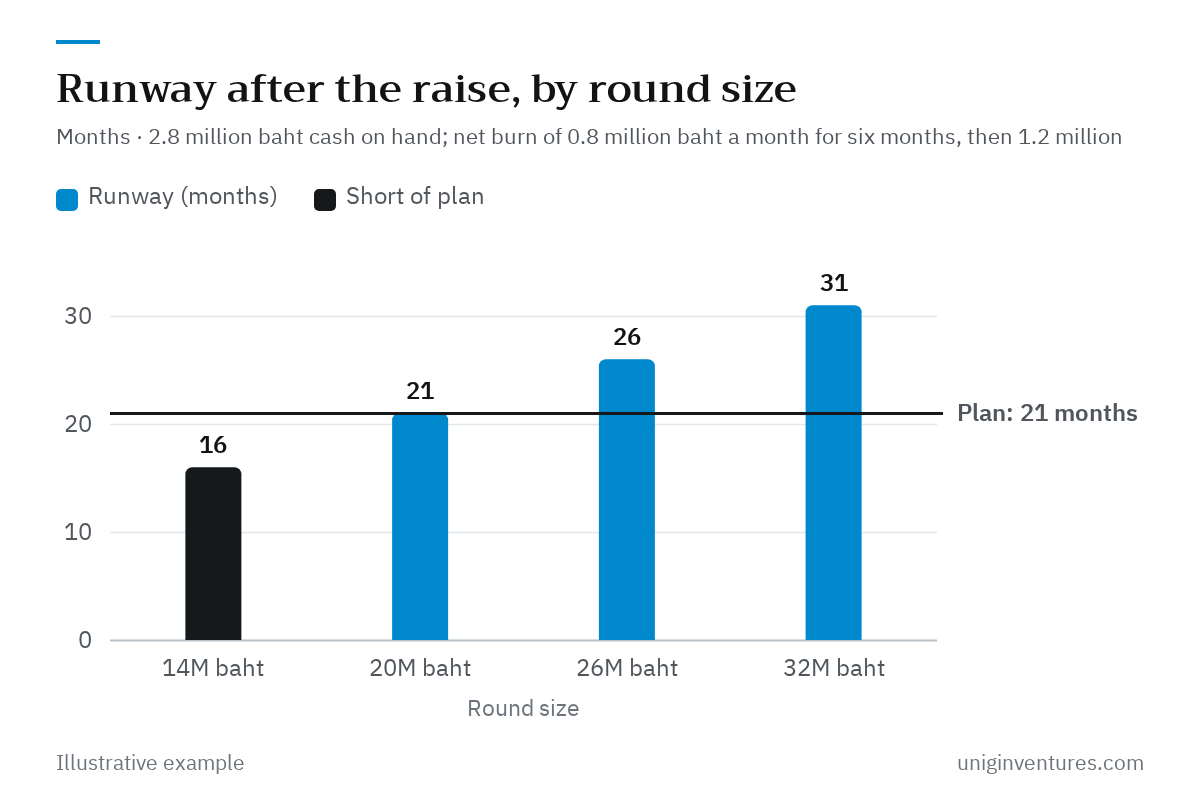
| 14,000,000 | 94,000,000 | 14.9% | 85.1% | 16 months |
| 20,000,000 | 100,000,000 | 20.0% | 80.0% | 21 months |
| 26,000,000 | 106,000,000 | 24.5% | 75.5% | 26 months |
| 32,000,000 | 112,000,000 | 28.6% | 71.4% | 31 months |
A 14 million baht round lasts 16 months. It reaches the milestones but leaves only four months to raise the next round and no buffer. Each additional 6 million baht buys five more months for about 4–5 percentage points of ownership. That extra money is sold at today's valuation. If the plan works, the next round will be priced higher, so selling the extra shares today costs more than it appears.
Holding the valuation constant across round sizes is a simplification. In a real negotiation, investors may not accept a larger round at the same valuation. Use the table to see the price of the extra time.
What too little or too much costs
- Too little. The company has to start raising again before it has enough results, negotiates as the side that needs the money, and founders spend more of their time fundraising.
- Too much. Existing shareholders give up more of the company. If the valuation of this round rises with its size, the next round needs results strong enough to justify an even higher valuation. Otherwise it becomes a down round, which can trigger existing investors' anti-dilution protection. See anti-dilution and pro-rata rights.
- A rough ceiling. Paul Graham offers a rule of thumb for the upper limit on what to raise: the number of people you want to hire × the total monthly cost per person × 18 months. His reasoning is that in most startups nearly all costs are a function of headcount. His per-person figure reflects US costs in 2013, so use your own costs instead, and add other expenses that do not depend on people, such as manufacturing.
Explaining the number to investors
Explain the round size by what the money buys, not just by the amount. In your pitch deck and in meetings, be ready to answer five things:
- The round size and the milestones it reaches, with numbers and target months.
- How many months of runway it gives, split into the period to the milestones, the next raise and the buffer.
- Use of funds by category, such as people, marketing and product, matching the monthly cash plan.
- The minimum round that still works, and which milestones you would cut or delay if you raise less.
- Ownership after the round, from an up-to-date cap table.
Where to start
- Write two or three milestones the next round's investors need to see, with numbers and target months.
- Build a monthly cash plan to those milestones, including hiring.
- Add the months needed to raise the next round and a buffer, then use the formula to size the round.
- Make a table of three or four round sizes, comparing runway and dilution at the valuation you expect to agree.
- Prepare a minimum plan for what you would cut if you raise less than the target, and prepare the legal steps for the capital increase. See issuing new shares to an investor.
The company and figures in this article are an illustrative example. Actual round size, valuation and fundraising time depend on the business, its results and the negotiation with each investor.