Burn Rate and Runway: How Long Your Cash Lasts and When to Raise
How to calculate gross burn, net burn and a realistic runway, the costs founders forget including severance, and three scenarios that show how monthly growth changes the whole answer.

In this article
Every founder should be able to answer one question without opening a spreadsheet: how many months will the cash we have today last? Many companies only know roughly, until there is too little left to fix anything. The number is simple to calculate, and it is one of the first things investors ask about in a first meeting.
This article explains the difference between gross burn and net burn, how to calculate a runway that matches reality, the costs people forget to count, and how to plan when to start fundraising or cutting costs. It includes an example with three scenarios that differ only in growth rate.
Gross burn, net burn and runway
- Gross burn is all the cash paid out in a month: salaries, rent, software, marketing, before any revenue.
- Net burn is how much cash actually falls in a month: cash paid out minus cash received.
- Runway is the number of months your remaining cash lasts at the current net burn.
Net burn = monthly cash out − monthly cash in
Runway (months) = cash balance ÷ net burn
Gross burn tells you how long the company survives if revenue disappears. Net burn tells you where you stand today. Watch both, because early revenue is rarely stable: one large customer paying late can make net burn jump.
An example
Take an illustrative startup with 6 million baht in cash. It collects 400,000 baht a month from customers and pays out 1,000,000 baht a month.
| Monthly item | Baht |
|---|---|
| Salaries and benefits for 8 staff | 600,000 |
| Office rent and software | 150,000 |
| Sales and marketing | 250,000 |
| Gross burn | 1,000,000 |
| Cash collected from customers | −400,000 |
| Net burn | 600,000 |
| Runway | 6,000,000 ÷ 600,000 = 10 months |
Make the number match reality
Runway calculated from the income statement usually looks longer than it really is, because profit and cash are not the same. Use figures from the bank account or the cash flow statement, and watch for these items:
- Use a three-month average. A single month's net burn can be low because a customer paid a big invoice, or high because of an annual bill.
- Annual and quarterly payments, such as insurance, annual software licenses and audit fees.
- Taxes and amounts you hold for others, such as VAT, withholding tax and social security contributions. The money sits in your account but is not yours.
- Loan principal. It does not appear in the income statement, but it is real cash going out.
- Planned hiring. If three hires are already approved for next month, calculate runway on the cost after they join, not today's.
Set aside severance pay
If you ever have to cut staff or close the company, Thailand's Labour Protection Act requires severance based on length of service, paid on the day employment ends.
| Length of service | Severance (days of final wage) |
|---|---|
| Under 120 days | None |
| 120 days to under 1 year | 30 days |
| 1 year to under 3 years | 90 days |
| 3 years to under 6 years | 180 days |
| 6 years to under 10 years | 240 days |
| 10 years to under 20 years | 300 days |
| 20 years or more | 400 days |
If you terminate without the legally required notice, you also owe pay in lieu of notice. In the example, if all 8 staff have worked 1–3 years and wages total 600,000 baht a month, 90 days of severance comes to about 1.8 million baht. The cash truly available to run the business is 4.2 million baht, and the safe runway is 7 months, not 10.
Growth changes the whole answer
The runway formula assumes revenue stays flat, which is not true for a company that is growing. A better question is what Paul Graham of Y Combinator calls default alive or default dead: if expenses stay constant and revenue keeps growing at its recent rate, will the company become profitable before the money runs out (default alive), or run out first (default dead)?
Using the same example, with expenses fixed at 1 million baht a month, compare three cases:
- Revenue flat at 400,000 baht: cash runs out in month 10.
- Revenue growing 5% a month: cash runs out about halfway through month 16, when revenue has reached about 850,000 baht. Close to break-even, but not close enough.
- Revenue growing 8% a month: revenue overtakes expenses in month 12. Cash bottoms out at about 2.19 million baht in month 11 and then climbs.
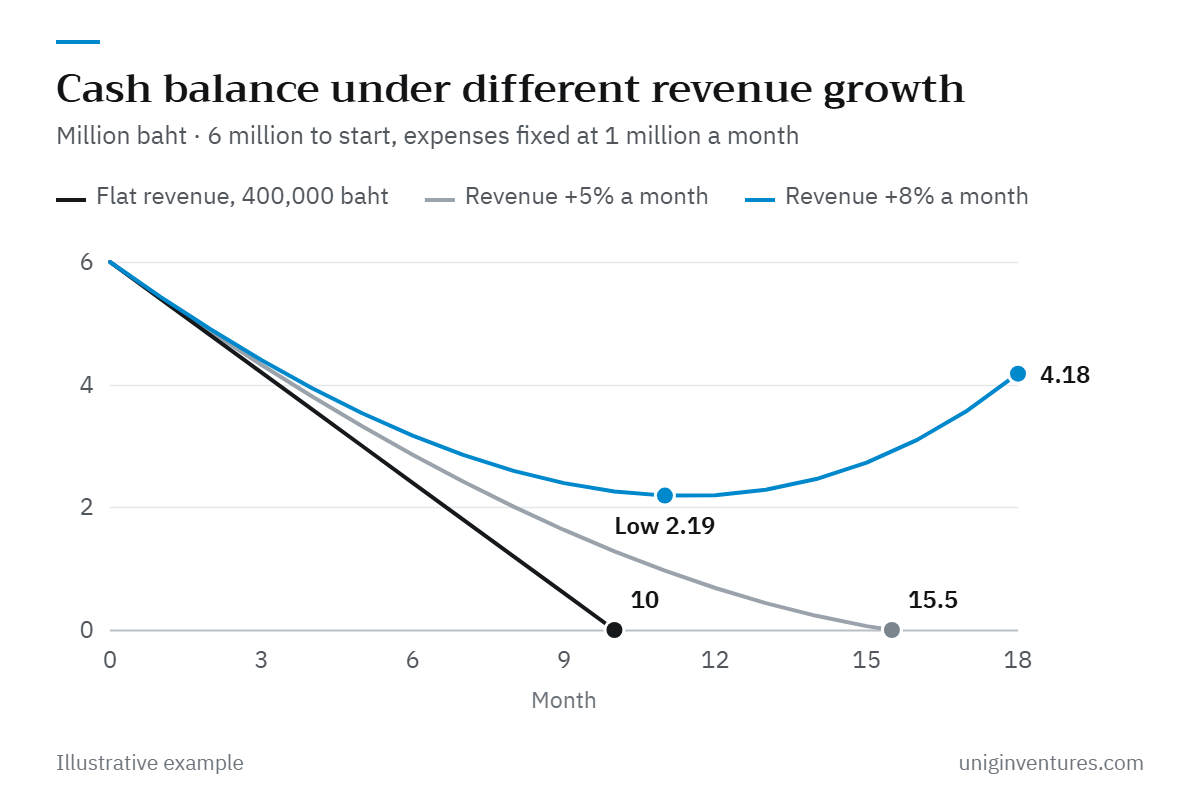
If you also set aside the 1.8 million baht of severance, usable cash in the 5% case drops below the reserve from month 9. Even in the 8% case, where cash bottoms out at 2.19 million baht, the margin above the reserve is less than 400,000 baht. Monthly growth matters as much as the balance in the bank.
When to start fundraising
Work backward from the day the cash runs out. Every round takes time from the first meeting to money in the bank: meetings, due diligence and legal agreements. How long depends on the market and on how prepared the company is. Plan like this:
Month to start fundraising = runway − expected time to raise − buffer
As an illustration, if you expect raising to take 6 months and want a 3-month buffer in case the round slips, a company with 10 months of runway must start within the next month. A company whose safe runway is 7 months after the severance reserve is already late.
There is another reason to start early. A company raising with little cash left has little bargaining power. Investors can read a runway too, and they know you cannot wait.
Prepare a cost-cutting plan in advance
Paul Graham warns that funded startups are most often killed by hiring too fast, and that survival should not depend on the next round alone. A practical approach is to set decision points while things are still calm, for example:
- Runway under 12 months: start the fundraising process and review marketing spend you cannot measure.
- Under 9 months: freeze hiring, except for roles that bring in revenue directly.
- Under 6 months: execute the prepared cost-cutting plan that makes the company default alive without new money.
These thresholds are examples. Adjust them to how long fundraising really takes in your business. What matters is making the decision while you still have time to think, and making sure the cost-cutting plan includes severance and lease terms.
Start this week
- Pull the last three months of cash in and cash out from your bank statements and calculate average gross and net burn.
- Add annual costs, taxes due, loan principal and approved hiring, then recalculate runway.
- Calculate severance for every employee by length of service, and subtract it from cash to find your safe runway.
- Apply your last three months' revenue growth rate and see whether the company is default alive or default dead.
- Write down your own 12-, 9- and 6-month decision points, and update runway every month in the management report.