Read Your Three Financial Statements in 15 Minutes: How They Connect
The income statement, balance sheet and cash flow statement answer different questions but form one set. See a company that made 1.76 million baht of profit and lost cash, plus a 15-minute reading routine.
In this article
Many business owners get their financial statements from the accounting firm once a year, sign them, and file them away. The only numbers they look at are revenue and profit. Yet the same set of statements shows where the cash went, whether customers are paying more slowly, and whether the business is growing on its own money or on borrowed money. Investors and banks always read those things in your accounts.
This article explains the question each of the three main statements answers, how they connect, and a 15-minute reading routine you can use on your own statements or a partner's right away, with a full set of example numbers.
Three statements, three questions
- Income statement: over the past year, how much did the business earn and spend, and what was left as profit or loss? It covers a period.
- Statement of financial position (the balance sheet): on the last day of the period, what does the business own, whom does it owe, and how much belongs to the owners? It is a snapshot.
- Statement of cash flows: over the year, where did cash come from and where did it go, split into operating, investing and financing activities?
Assets = liabilities + equity
This equation sits at the heart of the balance sheet, and it must always balance.
One point matters for Thai SMEs. Most companies that are not listed on the stock exchange use the Thai Financial Reporting Standard for Non-Publicly Accountable Entities (TFRS for NPAEs), revised 2022. It defines a complete set of financial statements as the statement of financial position, the income statement, the statement of changes in owners' equity and the notes. It does not require a statement of cash flows. A company may choose to prepare one under Thai Accounting Standard 7. So the accounts you receive each year may not include the third statement at all, and that is the one investors most want to see.
Example: a profitable year that drained cash
Take an illustrative distributor with revenue of 20 million baht this year, up 25% from 16 million baht last year. Figures in the tables are in thousands of baht.
Income statement
| Item | Thousand baht |
|---|---|
| Revenue | 20,000 |
| Cost of sales | −13,000 |
| Gross profit (35%) | 7,000 |
| Selling and administrative expenses (including 600 depreciation) | −4,600 |
| Interest expense | −200 |
| Corporate income tax | −440 |
| Net profit | 1,760 |
Statement of financial position
| Item | Opening | Closing |
|---|---|---|
| Cash | 1,500 | 360 |
| Trade receivables | 2,500 | 4,000 |
| Inventory | 2,000 | 2,900 |
| Equipment and vehicles (net) | 3,000 | 4,400 |
| Total assets | 9,000 | 11,660 |
| Trade payables | 1,800 | 2,200 |
| Long-term bank loan | 2,000 | 2,500 |
| Share capital | 2,000 | 2,000 |
| Retained earnings | 3,200 | 4,960 |
| Total liabilities and equity | 9,000 | 11,660 |
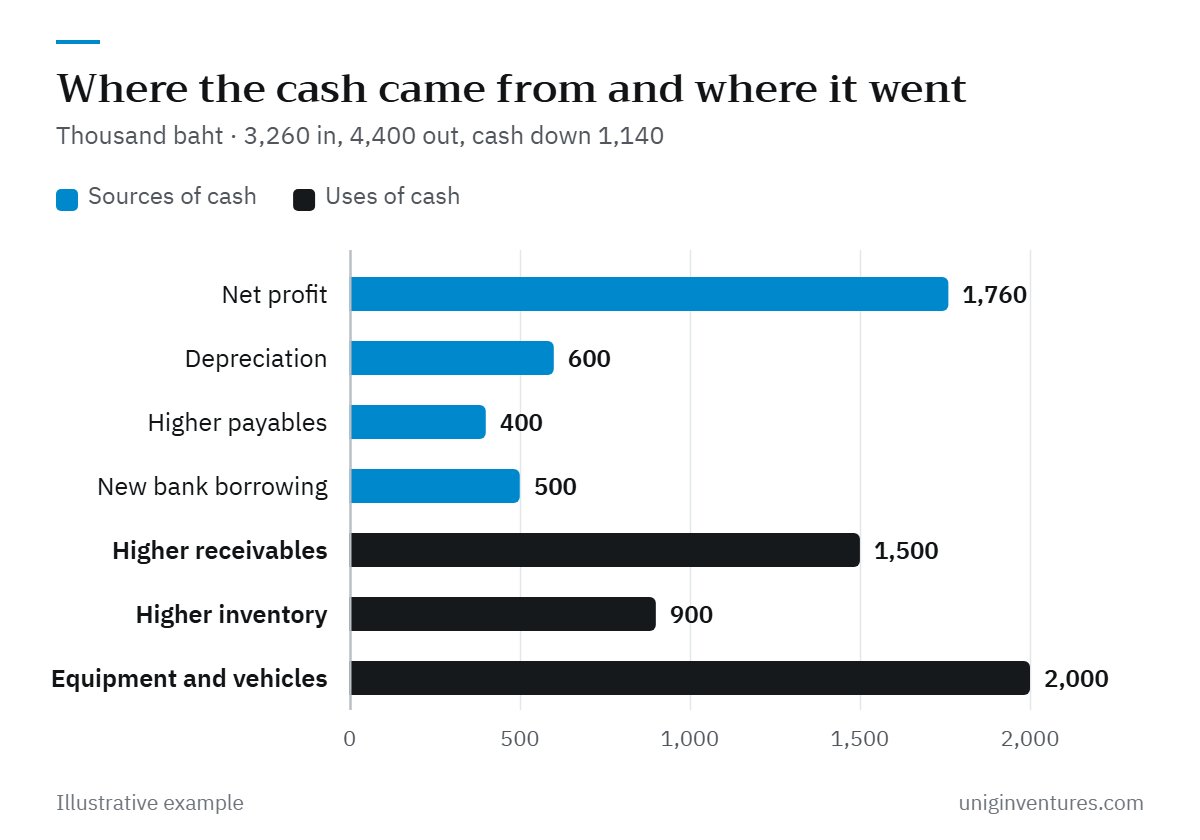
The company made 1.76 million baht of profit, yet cash fell from 1.5 million baht to 360,000 baht, a drop of 1.14 million baht, or 76%. Reading only the income statement, you would never see it.
How the three statements connect
There are three links worth remembering.
- Net profit flows into retained earnings. Opening retained earnings of 3,200 plus profit of 1,760 gives exactly 4,960, because no dividend was paid this year. If a dividend is paid, retained earnings rise by less than profit, and the statement of changes in equity explains the gap.
- The cash flow statement explains the change in cash. Its total must equal closing cash minus opening cash on the balance sheet: −1,140.
- The cash flow statement starts from profit. The indirect method takes net profit, adds back non-cash items such as depreciation, and then adjusts for changes in receivables, inventory and payables.
| Statement of cash flows (indirect method) | Thousand baht |
|---|---|
| Net profit | 1,760 |
| Add back depreciation | 600 |
| Increase in trade receivables | −1,500 |
| Increase in inventory | −900 |
| Increase in trade payables | 400 |
| Net cash from operating activities | 360 |
| Purchase of equipment and vehicles | −2,000 |
| Net cash used in investing activities | −2,000 |
| New bank borrowing | 500 |
| Net cash from financing activities | 500 |
| Net decrease in cash | −1,140 |
You can check the equipment line too. Net equipment rose from 3,000 to 4,400: 2,000 of new purchases less 600 of depreciation. If the three statements do not tie together like this, something has not been explained, and you should ask whoever keeps the books.
The 15-minute routine
Minutes 0–3: the income statement
- How fast did revenue grow compared with last year?
- Is the gross margin (gross profit ÷ revenue) steady, rising or falling? A falling margin during strong growth can mean sales were bought with discounts.
- Are selling and administrative costs growing faster than revenue?
Minutes 3–7: the balance sheet
- Compare the growth of receivables and inventory with revenue. In the example, revenue grew 25% but receivables grew 60% and inventory 45%, a sign that customers are paying more slowly or stock is piling up.
- Look at cash against monthly expenses.
- Look at interest-bearing debt against equity.
A caution: the example's current ratio is about 3.3 at both the start and the end of the year (6,000 ÷ 1,800 and 7,260 ÷ 2,200). Nothing seems to have changed, yet almost all the cash is gone, because nearly all current assets are now receivables and stock. One ratio is never enough.
Minutes 7–12: the cash flow statement
- Compare operating cash flow with net profit. In the example, 1,760 of profit produced only 360 of operating cash, about 20%.
- Was spending on fixed assets funded by cash the business generated, or by borrowing and new equity?
- If there is no cash flow statement, build a rough one yourself using the table above. With two years of balance sheets side by side, it takes less than 10 minutes.
Minutes 12–15: the notes
- Significant accounting policies, such as how revenue is recognized and how inventory is valued.
- Related-party transactions, such as loans to directors or loans from directors.
- Commitments and contingent liabilities, such as guarantees and lawsuits.
- If there is an auditor's report, read the opinion paragraph: is it unqualified, or does it raise points you need to follow up?
Warning signs worth a follow-up question
- Operating cash flow below profit for several years running. One year can be explained by growth. Several years in a row means profit is not turning into cash.
- Receivables or inventory consistently growing faster than revenue. Check the receivables aging report and slow-moving stock.
- Short-term debt funding long-term assets, such as buying machinery with an overdraft. If the bank pulls the facility, the business is squeezed at once.
- Large loans to directors. They usually mean company money and personal money are still mixed, and investors ask about it almost every time.
- Negative equity. Accumulated losses exceed the capital put in, so the company needs a plan to raise capital or return to profit.
Where to start
- Ask your accounting firm for the last two years of financial statements and read them with the 15-minute routine above.
- If there is no cash flow statement, ask your accountant to prepare one, or build it yourself from the two years, and use it in conversations with banks and investors.
- Write down questions from any warning signs you find, and discuss them with your accountant or auditor before next year's books close.
- Look up the financial statements other limited companies have filed through the Department of Business Development's DBD DataWarehouse+ service, to compare margins and debt levels with competitors or partners in the same industry.
Once you read the three statements together, the question shifts from "how much profit did we make?" to "has the profit turned into cash, and where is the money now?" That is the same question anyone funding your business will ask.
Sources
- Thai Financial Reporting Standard for Non-Publicly Accountable Entities (revised 2022), chapter 4, presentation of financial statements (in Thai), Federation of Accounting Professions
- IAS 7 Statement of Cash Flows, IFRS Foundation
- DBD DataWarehouse+, company and financial statement search (in Thai), Department of Business Development