When to Hire: True Cost, Payback Month and the Cash You Need
The fully loaded cost of one employee under Thailand's new 17,500 baht social security ceiling, the signals that it is time to hire, how to find the payback month, and alternatives.

In this article
Adding one full-time employee is among the biggest financial decisions a small company makes. Salary is a fixed cost you pay every month whatever sales do. A new hire needs months to reach full output. And if the hire does not work out, letting someone go has a legal cost. So many companies hire too late and burn out the team, or hire too early and run out of cash before the new person delivers.
This article offers a numbers-based way to decide: what one employee really costs, the signals that it is time to hire, how to work out when a new hire pays back, and the alternatives to consider before adding permanent headcount.
An Employee Costs More Than a Salary
The fully loaded cost to the employer includes several items that often get left out of the budget:
- Employer social security contributions. The standard rate is 5% of wages. From January 1, 2026, the wage base runs from a minimum of 1,650 baht to a maximum of 17,500 baht a month, so the employer's share is at most 875 baht per person per month. The employer remits it, together with the amount withheld from the employee, by the 15th of the following month.
- Workmen's Compensation Fund contributions. Paid by the employer alone, at 0.2–1.0% depending on the risk of the business type, on wages of up to 240,000 baht per person per year.
- Bonuses and benefits, such as group health insurance, travel and meal allowances.
- Equipment and software: a computer and per-user subscriptions.
- Recruiting costs: job ads, agency fees and the management time spent interviewing and training.
| Item | Baht per year |
|---|---|
| Salary, 12 months | 420,000 |
| Employer social security, 875 × 12 | 10,500 |
| Workmen's Compensation Fund, 0.2% × 240,000 | 480 |
| Bonus, one month | 35,000 |
| Group health insurance | 12,000 |
| Computer 30,000 and software 10,000 | 40,000 |
| Recruiting agency fee, one month's salary | 35,000 |
| First-year total | 552,980 |
In this example the first-year cost is about 1.32 times the annual salary. Every company's figure differs with its benefits and hiring channels, but you should know your own before you post the job.
Signals That It Is Time to Hire
"We're busy" is not enough. Look for measurable evidence that repeats for at least two to three months, not a single peak.
- You turn down or delay customer work. Count the sales or gross profit lost each month. That number is the minimum benefit of hiring.
- Turnaround or quality slips: slower replies to customers, more rework, more complaints.
- The team works overtime as a matter of routine. Monthly overtime pay may already be close to the cost of a new hire, and a team that stays exhausted is at risk of quitting.
- Founders spend most of their time on work someone else could do, such as paperwork, collections or routine questions, instead of finding customers or planning.
If the signal comes from one-off work, such as a large project that ends in three months, the temporary options below are usually a better fit.
When Will the New Hire Pay Back?
For revenue roles such as sales, compare the gross profit the person will generate with their cost. For support roles such as accounting or admin, count the work you get back: time freed for others to generate revenue, or overtime and outside fees that go away.
What people often forget is the ramp-up period. New hires do not deliver full output in month one.
Illustrative example: hiring one salesperson
- Upfront cost of 65,000 baht (35,000 agency fee and a 30,000 computer).
- Monthly cost of 40,665 baht (35,000 salary, 875 social security, 40 workmen's compensation, plus 4,750 set aside for bonus, health insurance and software).
- At full productivity, 80,000 baht of gross profit a month.
- No results in months 1–3, then 25% of target in month 4, 50% in month 5, 75% in month 6 and full target from month 7.
Hire payback = the first month in which cumulative gross profit from the hire ≥ cumulative cost of the hire
| End of month | Cumulative cost | Cumulative gross profit | Difference |
|---|---|---|---|
| 3 | 186,995 | 0 | −186,995 |
| 5 | 268,325 | 60,000 | −208,325 |
| 8 | 390,320 | 280,000 | −110,320 |
| 11 | 512,315 | 520,000 | 7,685 |
| 12 | 552,980 | 600,000 | 47,020 |
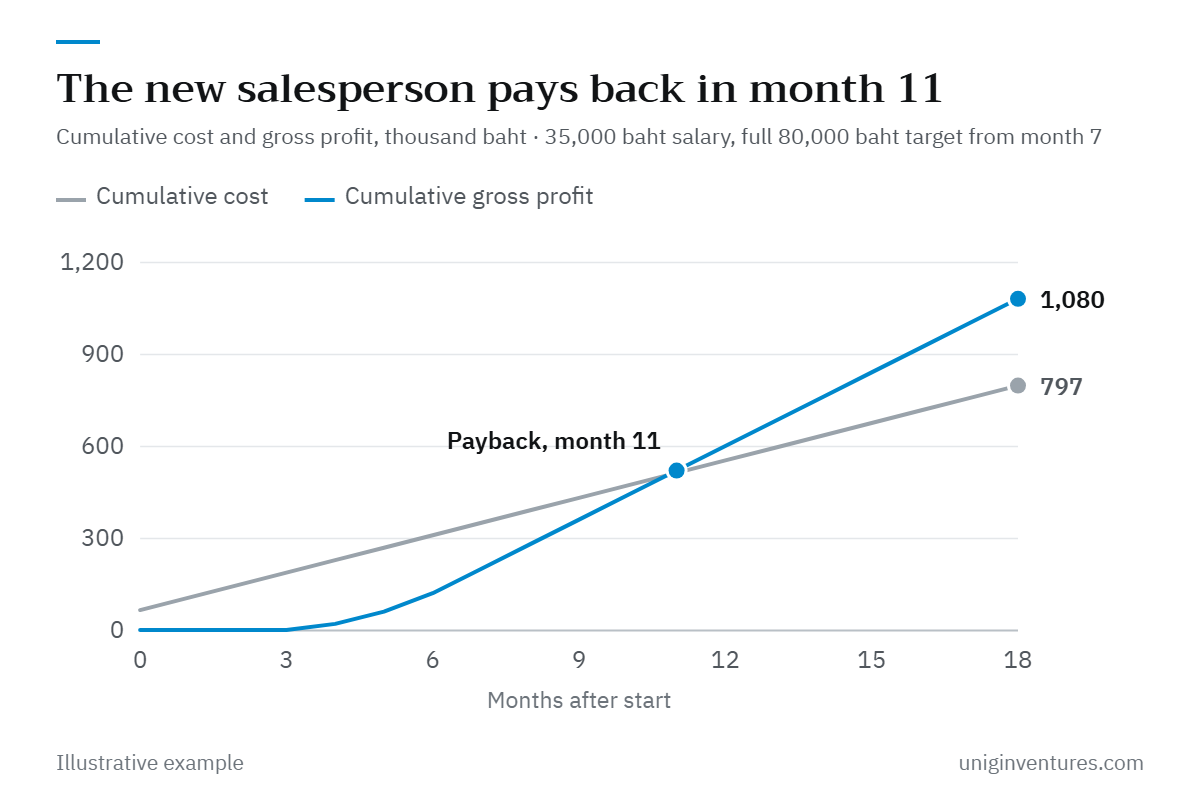
Two numbers from the table drive the decision:
- Payback in month 11. If you are not confident you can keep this person for more than a year, or customer demand could fade before then, a permanent hire does not yet pay.
- About 208,000 baht of cash to set aside. This is the largest shortfall before the hire delivers, and it must come on top of the company's normal cash reserve.
Test how sensitive the result is. If ramp-up takes two months longer, or the person reaches only 70% of target, how far does payback move? If it moves beyond the time your cash can cover, wait or start with an alternative.
Alternatives to a Permanent Hire
- Part-time staff or short fixed-term contracts suit work that has grown for a period or may not last.
- Outsourcing suits work outside the core of the business, such as bookkeeping, payroll or IT. The cost is variable and can stop under the contract terms.
- Freelancers suit project work. Be careful: if a contractor works under your direction like a regular employee, the relationship may be treated as employment. Have a legal adviser review the contract.
- Process changes and tools. Repetitive daily work, such as invoicing or answering common questions, can often shrink with software you already pay for.
The Cost If a Hire Does Not Work Out
Under Section 118 of the Labour Protection Act, an employee dismissed without serious misconduct is entitled to severance pay based on length of service.
| Length of service | Severance (days of final wage) |
|---|---|
| 120 days to under 1 year | 30 days |
| 1 year to under 3 years | 90 days |
| 3 years to under 6 years | 180 days |
| 6 years to under 10 years | 240 days |
| 10 years to under 20 years | 300 days |
| 20 years or more | 400 days |
Severance is separate from pay in lieu of notice. Setting clear goals from day one and reviewing performance seriously at intervals during probation is fair to both the company and the employee. If a dismissal becomes necessary, get advice from a labor lawyer first.
Where to Start
- Work out your fully loaded cost per employee with a table like the one above: social security, workmen's compensation, bonus, benefits, equipment and recruiting.
- Collect two to three months of evidence: work turned down, overtime, turnaround times and founder hours spent on work others could do.
- Write down the expected output of the role in numbers, along with ramp-up assumptions, then calculate payback and the cash you need to set aside.
- Put the hire into your cash flow forecast and see how long your cash lasts afterward. If it is not enough, start with a temporary option.
- Review at three and six months. Compare actual results with your assumptions. If they beat the plan, it may be time to plan the next hire. If they lag, find out why before hiring more.
This article is general information, not legal or tax advice for a specific case. Rates and thresholds are as of October 2026. Follow the Social Security Office for the latest announcements.
Sources
- Wage base of 1,650 to 17,500 baht from January 1, 2026 — Social Security Office, Phrae (Thai)
- Section 33 contribution wage ceiling raised from 2026 — Social Security Office, Nonthaburi (Thai)
- Contributions and payment, including the Workmen's Compensation Fund — Social Security Office (Thai)
- Severance pay rates on dismissal — Department of Labour Protection and Welfare, Bangkok Area 3 (Thai)