Customer Concentration: Measure the Risk Before Investors Ask
How risky is it when one customer brings in nearly half your revenue? Measure it with three numbers, test your profit if that customer leaves, and close the gaps in contracts and receivables.
In this article
Many Thai SMEs grow on the back of one large customer: a retail chain, a big manufacturer, or an agency that renews its order every year. At first that customer feels like luck. Sales are predictable and you rarely need to chase new business. But once nearly half your revenue comes from one place, a single decision by someone else, such as switching suppliers, cutting orders or stretching payment terms, is enough to push you into a loss or a cash squeeze.
This article shows how to measure customer concentration with three numbers, how to test what happens to profit and cash if your largest customer cuts back or leaves, what investors and lenders will ask, and what you can change starting with your next contract.
The risk is more than lost revenue
When one customer accounts for a large share of sales, four risks arrive together.
- Revenue disappears in one block. If the customer leaves, the whole amount goes at once, while rent, salaries and equipment payments stay.
- Bargaining power shifts to the customer. The customer knows you cannot afford to lose them, so asking for lower prices, longer credit terms or for you to absorb some costs becomes easy. Unit margins erode without anyone deciding they should.
- Receivables are concentrated. If this customer pays late or runs into financial trouble, the amount they owe you may equal a year of your profit.
- Valuation and deal terms suffer. A buyer or investor will see that revenue as uncertain and may value the business lower or ask for extra protection, such as paying part of the price based on future performance.
Measure it with three numbers
Take the last 12 months of revenue by customer. Treat companies in the same group, or those whose purchasing is decided by the same person, as one customer. Then calculate:
Largest-customer share = revenue from the largest customer ÷ total revenue
Top-five share = combined revenue from the five largest customers ÷ total revenue
HHI = sum of (each customer's share of revenue in percent)²
Equivalent number of customers = 10,000 ÷ HHI
The Herfindahl-Hirschman Index (HHI) is a tool competition authorities use to measure market concentration: square each firm's market share and add the results. It works well on a customer list because it gives large customers far more weight than small ones. The equivalent number of customers turns the index into something intuitive: your risk is the same as having that many equally sized customers.
In an illustrative example, a packaging manufacturer earns 60 million baht a year from 45 customers.
| Customer | Revenue (million baht) | Share | Share squared |
|---|---|---|---|
| Customer A | 27.0 | 45% | 2,025 |
| Customer B | 9.0 | 15% | 225 |
| Customer C | 6.0 | 10% | 100 |
| Customer D | 3.0 | 5% | 25 |
| Customer E | 3.0 | 5% | 25 |
| 40 other customers (0.3 million baht each) | 12.0 | 20% | 10 |
| Total | 60.0 | 100% | 2,410 |
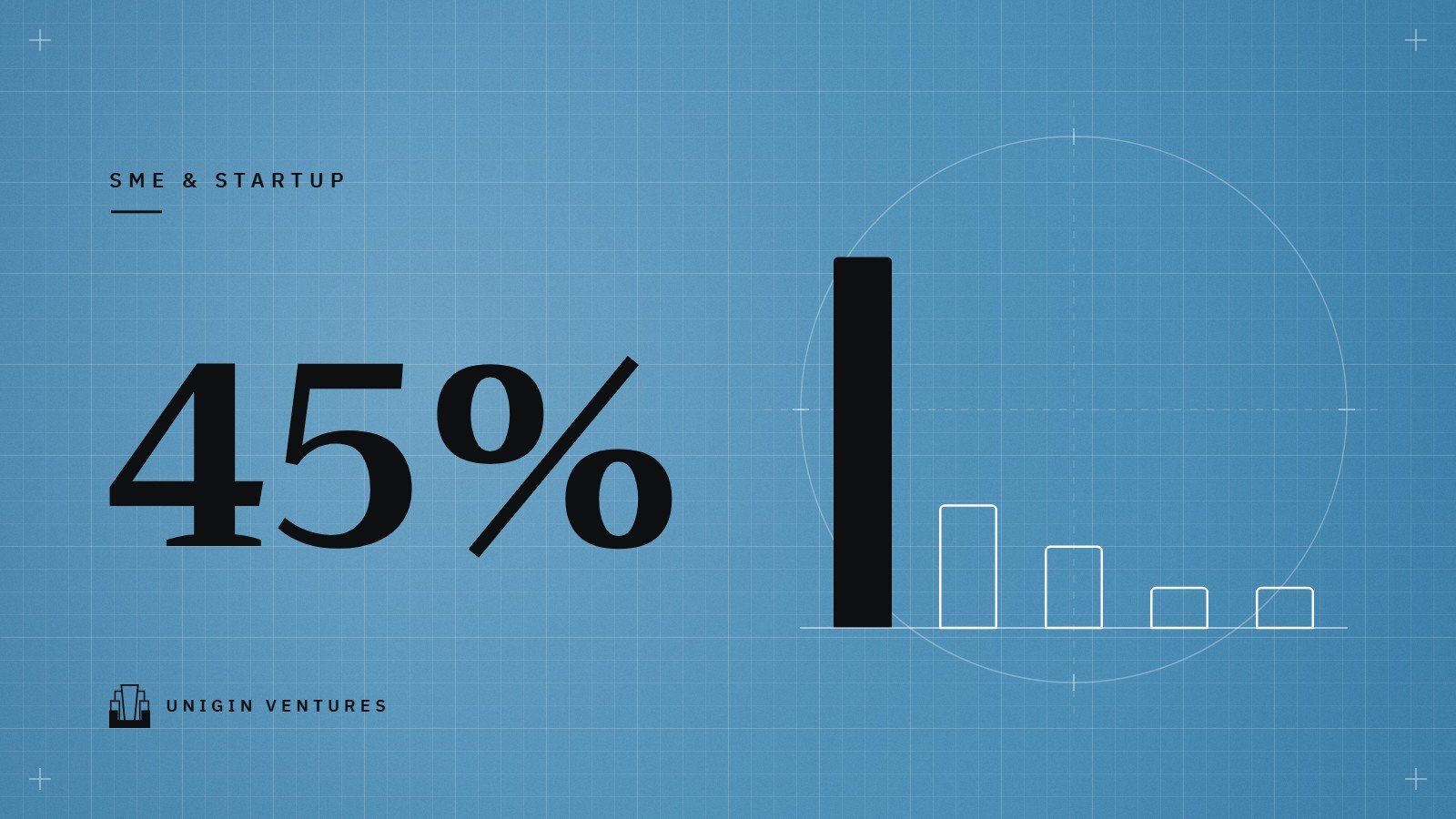
The largest customer holds 45%, the top five together hold 80%, and the HHI is 2,410, which works out to 10,000 ÷ 2,410 ≈ 4.1 equivalent customers. The company has 45 customers in its system, but its risk is the same as having only about four of equal size.
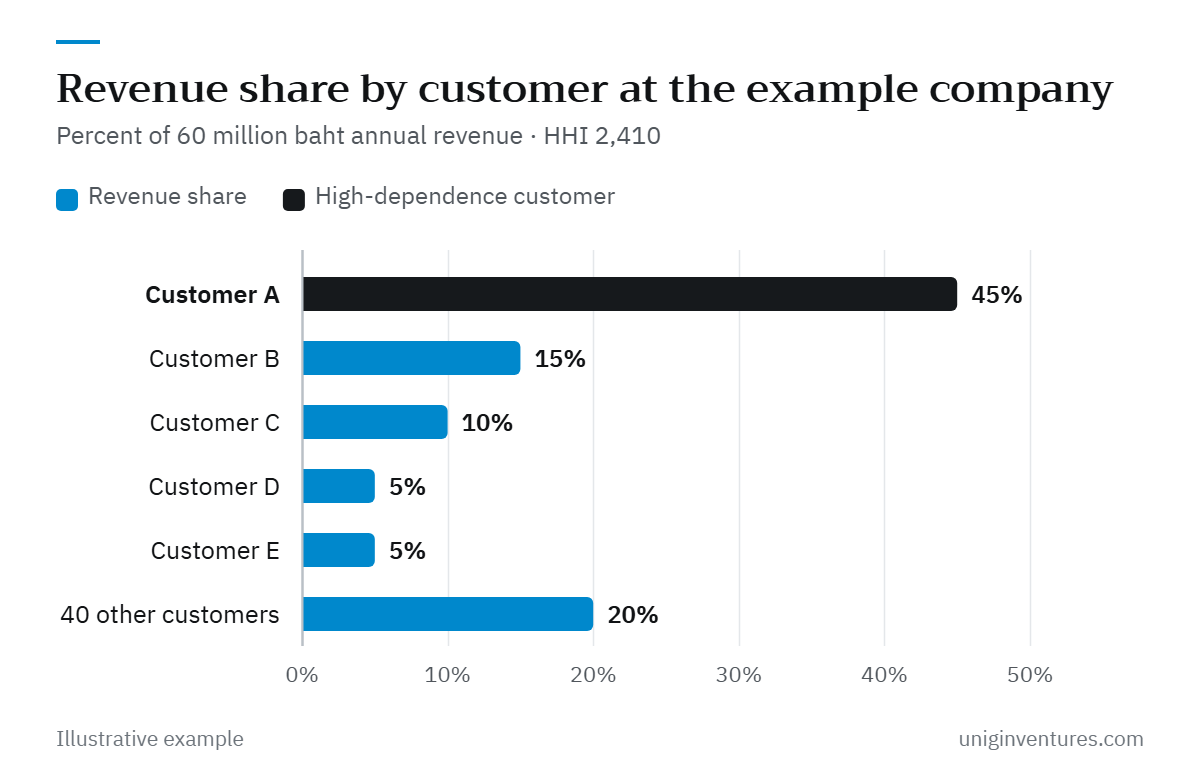
There is no official threshold for how high is too high, because it depends on the industry. Contract manufacturers serving big brands normally have few customers. One useful reference point is Thai Financial Reporting Standard 8 (TFRS 8), Operating Segments, the Thai equivalent of IFRS 8. It requires entities whose shares or debt trade in a public market, or that are filing financial statements to issue securities, to disclose when revenue from a single external customer amounts to 10% or more of the entity's revenue. Most SMEs do not apply this standard, but if you plan to list, this figure will appear in your financial statements.
Test what happens if your largest customer leaves
The share tells you how dependent you are. The more important question is how much damage you would take if the risk actually happened. Continuing the example, assume every customer earns the same contribution margin of 35% of revenue and fixed costs are 15 million baht a year.
| Scenario | Revenue (million baht) | Contribution (million baht) | Operating profit (million baht) |
|---|---|---|---|
| Current | 60.0 | 21.00 | 6.00 |
| Customer A cuts orders by 30% | 51.9 | 18.17 | 3.17 |
| Customer A leaves | 33.0 | 11.55 | −3.45 |
A 30% cut by customer A wipes out almost half of the profit. If A leaves, the company loses about 3.5 million baht a year until it can cut fixed costs or replace the revenue.
A useful number for setting a target is the largest share a single customer can have and still leave you at break-even if you lose it.
Maximum share you can lose without a loss = operating profit ÷ total contribution = 6.0 ÷ 21.0 ≈ 29%
At 45%, customer A is well above that ceiling of about 29%. The formula holds when customers earn similar contribution margins. If your largest customer gets special pricing, use that customer's actual contribution instead.
Do not forget cash. If customer A is on 90-day terms, the receivable from that customer alone is about 27 × 90 ÷ 365 ≈ 6.7 million baht, more than a full year of operating profit. If that customer runs into financial trouble, you lose twice: future revenue disappears, and money for goods already delivered may never arrive.
What investors and lenders will ask
A large customer on the list rarely ends the conversation. Investors usually dig in to see how durable that revenue is. Prepare answers, with documents, in advance.
- Contract: How long is left? Does it renew automatically? How much notice is needed to terminate? Is there a minimum volume? Can the customer terminate if your controlling shareholder changes (a change-of-control clause)?
- History: How many years have you worked together, how have volumes moved, and have you ever been forced to cut prices or rebid?
- Relationship: Do you deal with one contact or several departments? If your main contact leaves, does the relationship survive?
- Customer profitability: What contribution margin does the large customer generate compared with others? Large customers often get special pricing, so their margin can be lower than everyone else's.
- Plan to reduce dependence: How many new customers are in the pipeline, and is the largest-customer share falling steadily?
Answers backed by documents let investors price the risk accurately. Companies that cannot answer tend to be judged more harshly than reality warrants.
Reduce the risk without walking away from the big customer
Short term: close the gaps in contracts and receivables
- Negotiate longer protection. Ask for a notice period long enough to find new customers or cut costs, a minimum order volume, and a price adjustment formula linked to material costs.
- Set a credit limit. Cap the receivable from your large customer and review aging every week. Payments slipping later than usual are the first signal to start a conversation.
- Insure against non-payment. If your large customer is overseas, the Export-Import Bank of Thailand (EXIM Bank) offers export insurance that covers commercial and political risks when a buyer fails to pay under the contract. Check the terms and premiums with the bank first.
- Hold a cash reserve large enough to cover fixed costs while you replace lost revenue, at least for the length of the notice period.
Medium term: add other customers step by step
- Set a numeric target, such as bringing the largest-customer share below your calculated ceiling within two to three years, by adding other customers rather than selling less to the large one.
- Use the big account as a reference. Having met a large customer's standards opens doors in adjacent industries, if your contract allows you to mention them.
- Expand within the customer carefully. Selling to several departments or group companies reduces the risk of relying on one contact, but in your calculations it still counts as one customer.
- Watch profit too. If the large customer has the lowest margin, taking more profitable new work when capacity is full may be worth more than taking extra volume from the existing account.
Start this week
- Pull 12 months of revenue by customer, grouping related companies as one, then calculate the largest-customer share, top-five share, HHI and equivalent number of customers.
- Calculate your own ceiling: operating profit ÷ total contribution, and compare it with your largest-customer share.
- List the receivables from your large customers and compare them with your annual profit and the cash you hold.
- Reread the contracts of your top three customers, noting the term, notice period and any change-of-control clause.
- Track the numbers every quarter in your management or investor report so you can show the share is really falling.
A large customer is not the problem. Not knowing how much damage you could absorb if that customer changed its mind is. These numbers answer that question before an investor, or events, ask it for you.