Value-Based Pricing for SMEs: Price on Customer Value, Not Cost-Plus
Why a 1% price change moves profit more than costs or volume, how to calculate value from the customer's side, how much volume a price rise can cost, and Thai price display rules.
In this article
Most small businesses set prices the same way: take the cost, add the margin they want, and check what competitors charge. It is simple and feels safe, but no step in it asks what the customer actually gains from the product or what that gain is worth to them. The result is that products clearly better than the competition often sell for about the same price.
This article explains why price is the number with the strongest effect on profit, how to calculate a product's economic value to the customer step by step, how to check how much volume you can lose after a price increase before profit falls, and the Thai pricing rules every seller has to follow.
A small price change moves profit a lot
In "Managing Price, Gaining Profit," published in Harvard Business Review in 1992, two McKinsey consultants used the average economics of 2,463 companies to compare what a 1% improvement in each lever does to operating profit.
| 1% improvement in | Increase in operating profit |
|---|---|
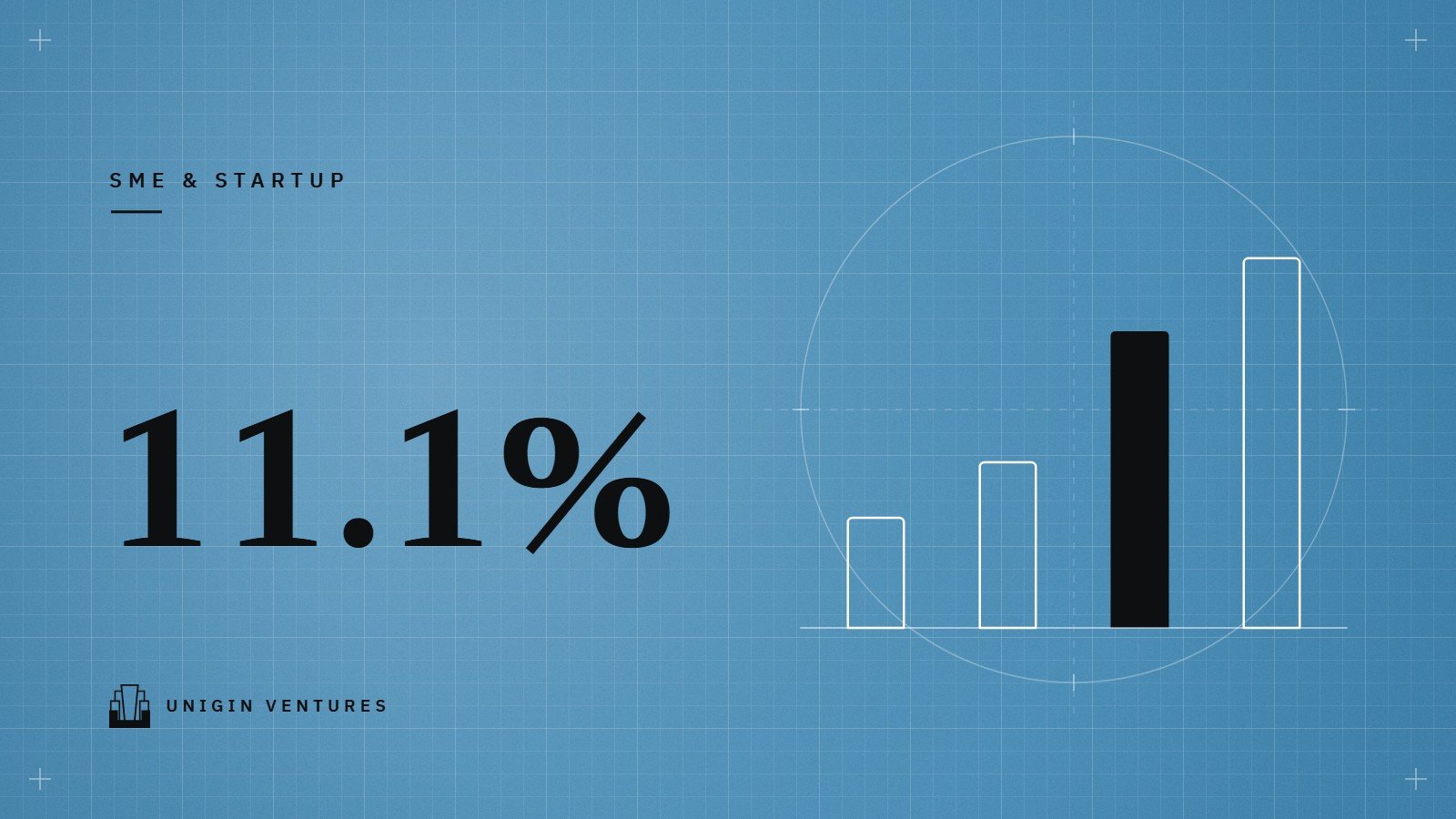
| Price | 11.1% |
| Variable cost | 7.8% |
| Volume | 3.3% |
| Fixed cost | 2.3% |
The reason is that every extra baht of price falls straight to profit, with no extra cost to make or deliver anything. The effect cuts both ways: the same article warns that a 1% price cut at a company with these average economics wipes out 11.1% of operating profit. Your own numbers will differ with your margins, but the direction is the same. The thinner the margin, the harder price hits.
What goes wrong with cost-plus
Cost-plus pricing has three problems.
- Customers do not care about your costs. They compare your price with their other options and with what they get, not with your production cost.
- Price gets tied to your own efficiency. A plant that becomes more efficient automatically cuts its price, while a business with bloated costs raises its price even though customers get nothing more.
- Money gets left on the table. A product that saves customers a lot of money, or earns them a lot, sells at a price that only reflects what it cost to make.
Cost still matters, but as the floor: the lowest price you will accept. The ceiling is the value the customer receives. A good price sits between the two. Value-based pricing means finding the ceiling first, then deciding how much of that value to share with the customer.
Calculate value from the customer's side
A method widely used in pricing textbooks splits economic value into two parts.
Economic value = reference value + differentiation value
Reference value = the price of the customer's next best alternative
Differentiation value = what the customer gains extra from you − what they give up extra by choosing you
The next best alternative is whatever the customer would do if they did not buy from you: a competitor's product, doing it in-house, or doing nothing. Differentiation value has to be stated in money, such as time saved, less waste, or more sales.
An example
In this illustrative example, a small manufacturer sells a concentrated floor cleaner to hotels. A 5-liter gallon dilutes to 150 liters of cleaning solution. The brand the hotel uses now costs 600 baht a gallon and dilutes to 100 liters.
| Item (per gallon of our product) | Baht |
|---|---|
| Reference value: 1.5 gallons of the current brand make the same 150 liters | 900 |
| Plus: floors dry faster, saving housekeeping time (hotel's own estimate) | 200 |
| Less: staff training and the cost of switching to a new supplier | −100 |
| Economic value | 1,000 |
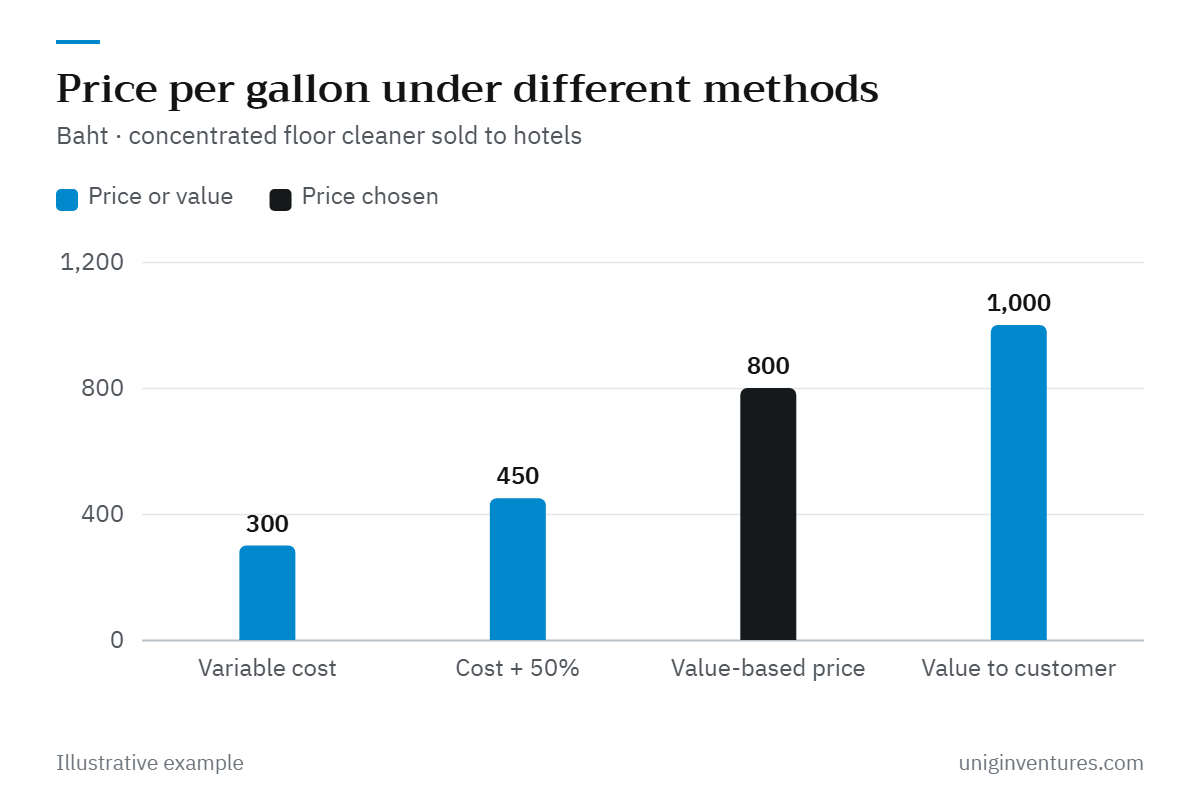
The manufacturer's variable cost is 300 baht a gallon. Cost-plus with a 50% markup gives a price of 450 baht, which is 550 baht below the value the hotel receives. At 800 baht instead, the hotel still saves 200 baht a gallon compared with its current option, so it has a reason to switch, while the manufacturer's gross profit rises from 150 to 500 baht a gallon.
Do not set the price at the full economic value. The customer would have no reason to switch, and the differentiation figures are usually estimates the customer may not fully believe. Sharing part of the value is what makes the sale happen.
How much volume can a price increase cost you?
The biggest fear about raising prices is losing customers. The better question is how many you can lose before profit actually falls. The answer depends on your contribution margin: price minus variable cost, divided by price.
Price increase: maximum volume you can lose = % increase ÷ (contribution margin + % increase)
Price cut: minimum volume you must add = % cut ÷ (contribution margin − % cut)
| Contribution margin | 5% increase: volume can fall up to | 5% cut: volume must rise at least |
|---|---|---|
| 20% | 20.0% | 33.3% |
| 30% | 14.3% | 20.0% |
| 40% | 11.1% | 14.3% |
| 50% | 9.1% | 11.1% |
Read it like this: a business with a 20% contribution margin that cuts its price by 5% has to sell at least a third more just to earn the same total profit. If it raises the price by 5%, it can lose up to 20% of its volume before profit falls. Low-margin businesses should be especially careful about discounting. These figures cover contribution only and leave out long-term effects, such as customers who leave and never come back.
Different customers see different value
Not every customer gets the same value. In the cleaner example, a large hotel with dozens of housekeepers saves far more time than a five-room guesthouse. A single price is too high for one group and too low for the other.
- Offer tiers. For example, three packages: a basic one for price-driven buyers, and higher tiers that add what large customers value, such as scheduled deliveries or staff training.
- Make every discount earn something. A discount should be traded for something that is worth money to you, such as larger orders, faster payment, or a longer contract, not given because a customer negotiates hard.
- Track the price you really get. The same Harvard Business Review article calls the price left after every discount, including cash discounts, promotional allowances and freebies, the pocket price. The quoted price may look healthy while the price that reaches your pocket is much lower.
Value-based pricing under Thai law
Pricing on value does not mean pricing at will. Sellers in Thailand must follow the Price of Goods and Services Act B.E. 2542 (1999), administered by the Department of Internal Trade.
- Display prices clearly, in store and online. Failing to display prices carries a fine of up to 10,000 baht.
- Online sellers cannot tell buyers to send a message to ask the price. Under Central Committee on Prices of Goods and Services Notification No. 70 of 2020, product names, prices and other charges such as shipping must be shown clearly. The fine is up to 10,000 baht.
- Check whether your product is a controlled good or service. In June 2026 the Ministry of Commerce kept 66 goods and services on the controlled list for another year. Some items carry measures such as having to notify or seek approval before changing prices.
- Do not sell at unreasonably high prices or hoard goods. Penalties reach up to seven years in prison, a fine of up to 140,000 baht, or both.
A price based on value you can demonstrate, and displayed openly, is the opposite of opportunistic price gouging. If your product is on the controlled list, though, check the conditions with the Department of Internal Trade (hotline 1569) before you change prices.
Start with one product
- Pick your best-selling product or service and calculate its variable cost and current contribution margin.
- Talk to five to ten customers. Ask what they would use if they did not buy from you, and where your product saves them money or earns them more.
- Calculate economic value with the formula, separately for at least two main customer groups.
- Use the table above to see how much volume a price increase could cost you, then choose a price that still leaves part of the value with the customer.
- Try the new price on new customers first, and track your win rate and the reasons you lose deals for two to three months. If you almost never lose on price, your price may still be too low.
Sources
- Managing Price, Gaining Profit — Michael V. Marn and Robert L. Rosiello, Harvard Business Review (September–October 1992)
- Online shops that ask buyers to message for prices are breaking the law — Government Public Relations Department (in Thai)
- Reporting unfair sales of goods and services — Uttaradit Provincial Public Relations Office (in Thai)
- Central committee keeps 66 controlled goods and services for another year — Ministry of Commerce, June 2026 (in Thai)