Separating Personal and Company Money: Director Loans, Advances and Audits
Money owners withdraw or spend for the company without documents becomes a director loan balance that auditors and tax officers question. The five kinds, how to record them, and how to clean up.
In this article
In a small company, the owner often pays company bills on a personal card, or moves company money out to spend now and sort out later. At first it seems harmless, since the money stays among the same people. But a Thai limited company is a legal person separate from its shareholders. Every baht that crosses the line between owner and company needs a name in the books, and when there are no documents, the name it usually ends up with is "loan to director" or "loan from director," with a balance that grows every year.
Those balances are among the first things auditors, Revenue Department officers, banks and investors ask about. This article explains the kinds of money that move between owners and their companies, how each should be recorded and documented, which tax rules apply, and where to start if balances have already built up.
Why mixing money causes problems
Expenses that are not deductible
Section 65 ter of the Revenue Code lists expenses that may not be deducted when calculating net profit. Three items bear directly on this issue:
- (3) Expenses of a personal nature, gifts or charitable payments (except where the law allows a deduction).
- (13) Expenses that are not incurred specifically for earning profit or for the business.
- (18) Expenses for which the payer cannot prove who the recipient is.
Family meals, personal trips, or money transferred out with no evidence of who received it and why: if these are booked as company expenses, an audit will disallow them, raising the profit on which the company pays tax.
Interest-free loans from the company to a director
Section 65 bis (4) provides that if a company lends money without interest, or at interest below the market rate without reasonable cause, the assessment officer may assess the interest at the market rate on the date of the loan. Money the owner withdraws and books as an interest-free loan to a director can therefore turn into interest income the company never received but still has to include for tax.
The financial statements show it to everyone
The Department of Business Development (DBD) explanatory note on its 2023 notification on required line items in financial statements says the "short-term loans" line includes loans to directors, employees and related parties, and "long-term borrowings" include borrowings from related persons or entities. These balances appear in the statements filed with DBD, which banks and investors can look up. A large loan to a director relative to equity or cash usually draws two questions: where did the money go, and when will it come back?
Five kinds of money between owner and company
| Item | Recorded as | Documents needed |
|---|---|---|
| Director lends to the company | Liability (loan from director) | Loan agreement stating amount, interest and repayment terms; evidence the money reached the company's account |
| Company lends to a director | Asset (loan to director) | Board resolution, loan agreement, an interest rate you can justify, repayment schedule |
| Cash advance for company spending | Temporary asset until cleared | Advance request, receipts in the company's name, and a clearance form within a set deadline |
| Director pays a company expense | Company expense, plus an amount owed back to the director | Tax invoice or receipt in the company's name, reimbursement claim |
| Company pays a director's personal expense | Not a company expense; a receivable from the director to be repaid | Payment record and evidence of repayment |
If you intend the owner to draw money from the company regularly, pay it through a channel with a clear name: salary or director's fees that are recorded and taxed through payroll, or dividends approved by resolution. Do not withdraw as you go and decide what it was later.
An example: a balance that was never cleared
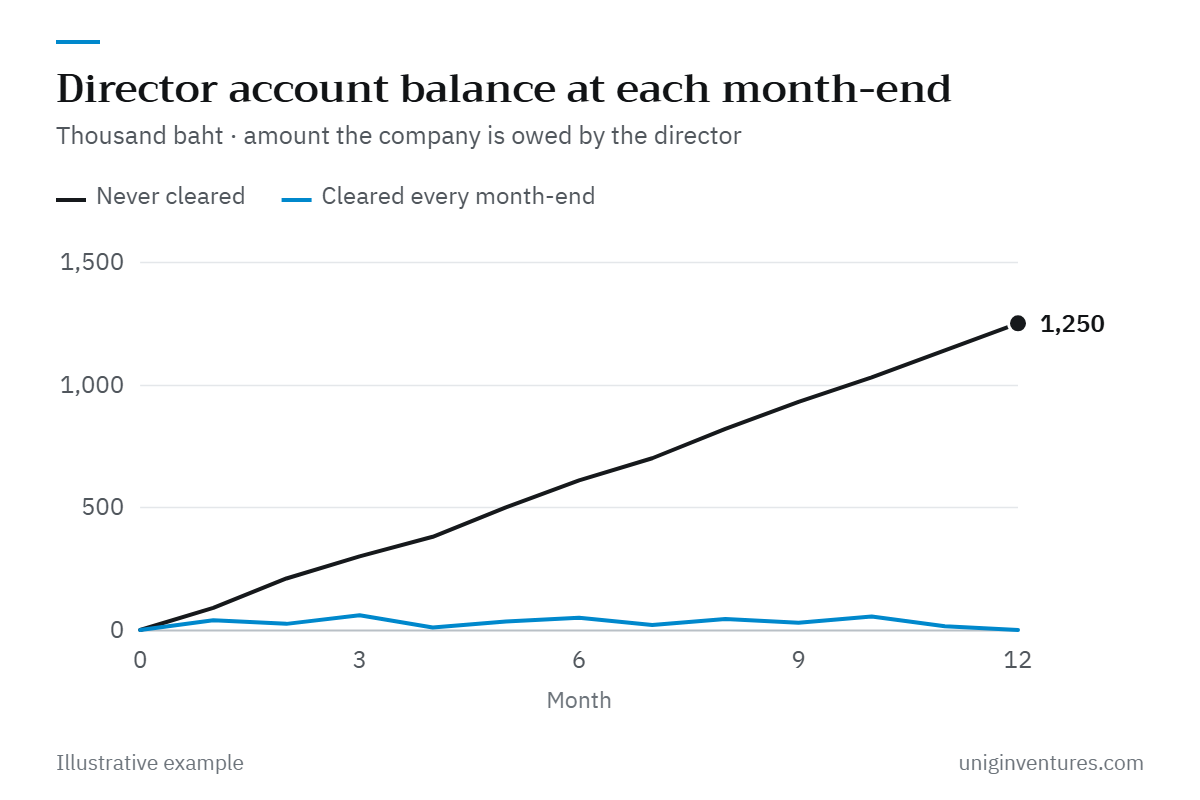
In an illustrative example, a company owner transfers company money out from time to time, sometimes pays company bills with a personal card, and never fills in a clearance form. At year-end, the accountant pieces together the following:
| Items during the year | Baht |
|---|---|
| Transfers to the owner with no supporting documents | 1,200,000 |
| Personal expenses paid by the company | 300,000 |
| Company expenses paid by the owner (receipts in the company's name) | −250,000 |
| Net loan to director outstanding | 1,250,000 |
If the 1,250,000 baht stays outstanding for the whole of the next year with no interest, and we assume the market rate used for assessment is 5% a year, the interest that could be assessed as company income is 1,250,000 × 5% = 62,500 baht a year. And if the 300,000 baht of personal expenses was booked as a company expense, it has to be reversed.
A system that keeps money separate
- Separate bank accounts and cards. Company income goes only into the company account, and company expenses are paid from company accounts or cards.
- Always get documents in the company's name. If you must pay personally first, ask for a tax invoice or receipt with the company's name and tax ID.
- Set a deadline for clearing advances, such as within 7 days of spending or before month-end. Anything that cannot be cleared is repaid in cash.
- Keep a monthly director account schedule that splits items into the five kinds above, and have the owner sign off the balance each month-end.
- Pay owners through salary or dividends, so money the owner receives has a clear accounting and tax status from the start.
- Put every loan in writing, whether the director lends to the company or the other way round, with the amount, interest rate and repayment terms, backed by a board resolution.
If balances have already built up
- Split the balance into the five kinds with your accountant, working back through the bank statements.
- Find documents for items that genuinely belong to the company. Expenses with receipts in the company's name can move to expenses. Accept that anything without documents belongs to the owner.
- Set up an agreement and repayment plan for amounts the company has lent to a director, and discuss a defensible interest rate with a tax adviser.
- Reduce the balance through proper channels, such as the owner repaying in cash. If you plan to offset it against dividends or pay, pass the resolutions and handle the tax properly. Do not simply write it off.
- Brief your auditor before the year-end close. The auditor will ask anyway, and a prepared schedule with documents makes the audit faster.
Separating money does not mean owners can never use company funds. It means every baht that leaves the company has the right name and documents behind it. A company that builds this habit early can answer its auditor, its bank and its investors with a single schedule.
This article is general information, not tax or legal advice. Whether interest or tax is assessed in practice depends on each company's facts. The legal position is as of September 2026.