
Drag-Along and Tag-Along Rights: Who Can Force a Sale, Who Can Join
Who can trigger a drag, why it must be read with the liquidation preference, which sale prices leave founders with zero, and how a tag-along cuts the shares a founder can sell.

In this article
When someone offers to buy your company, the first question is not always price. It is who has to sell and who gets to sell alongside. Most buyers want 100% of the shares, so one small holder who refuses can sink the deal. In the other direction, if a founder sells shares alone, investors worry about being left behind with a new owner.
Two clauses answer these questions: drag-along and tag-along. Both usually appear in the term sheet and the shareholders' agreement. This article explains how each one works, who should be able to trigger a drag, what happens when a drag meets a liquidation preference, a worked example with numbers, and the points founders should negotiate before signing.
What drag-along and tag-along mean
Drag-along forces minority shareholders to sell in a deal that a defined group of holders has approved, at the same price and on the same terms. The Holloway Guide to Raising Venture Capital defines drag-along agreements as provisions that "require certain minority shareholders to comply with a transaction approved by a specified majority percentage of shareholders."
Tag-along, called a co-sale right in the United States, lets a smaller holder sell its shares alongside a larger holder at the same price and on the same terms. In the model documents of the National Venture Capital Association (NVCA), this right sits in the Right of First Refusal and Co-Sale Agreement, while the drag-along sits in the Voting Agreement.
| Question | Drag-along | Tag-along (co-sale) |
|---|---|---|
| Who it protects | Holders who want to sell, and a buyer who needs every share | Smaller holders who do not want to be left behind |
| Who triggers it | Holders meeting the approval threshold in the contract | Holders granted the right, when a bound holder sells |
| Where founders usually sit | On the side that can be forced to sell | On the selling side, sharing the buyer's allocation |
| Effect on founders | May have to sell at a price they oppose | Sell fewer shares than the buyer offered to take |
Who should be able to trigger a drag
The approval threshold is the heart of a drag-along. If it reads "a majority of the preferred stock" and one investor holds more than half the preferred, that investor can force a sale of the whole company alone.
The Holloway guide advises founders to require all three of these: a majority vote of the board, a majority of the preferred, and a majority of the common. It warns that some investors try to drop the common vote, arguing that founders control the board anyway. But founders may lose control of the board at some point, and by then it will be very hard to add the common vote back. For board composition, see The Board After Funding.
Drag-along meets liquidation preference: a worked example
A drag-along decides who must sell. The liquidation preference decides who gets the money. Always read the two together.
Illustrative example: a company has 1,000,000 shares. Founder A holds 450,000, Founder B holds 150,000, and other investors and staff hold 100,000, for 700,000 common shares in total. A VC fund holds 300,000 preferred shares (30%), bought for 30 million baht with a 1x non-participating liquidation preference. The VC takes either its 30 million baht back or 30% of the sale price as converted common, whichever is larger.
| Sale price, whole company | VC receives | All common holders receive | Founder A receives |
|---|---|---|---|
| 20 | 20 | 0 | 0 |
| 30 | 30 | 0 | 0 |
| 60 | 30 | 30 | 19.3 |
| 100 | 30 | 70 | 45.0 |
| 150 | 45 (converts to common) | 105 | 67.5 |
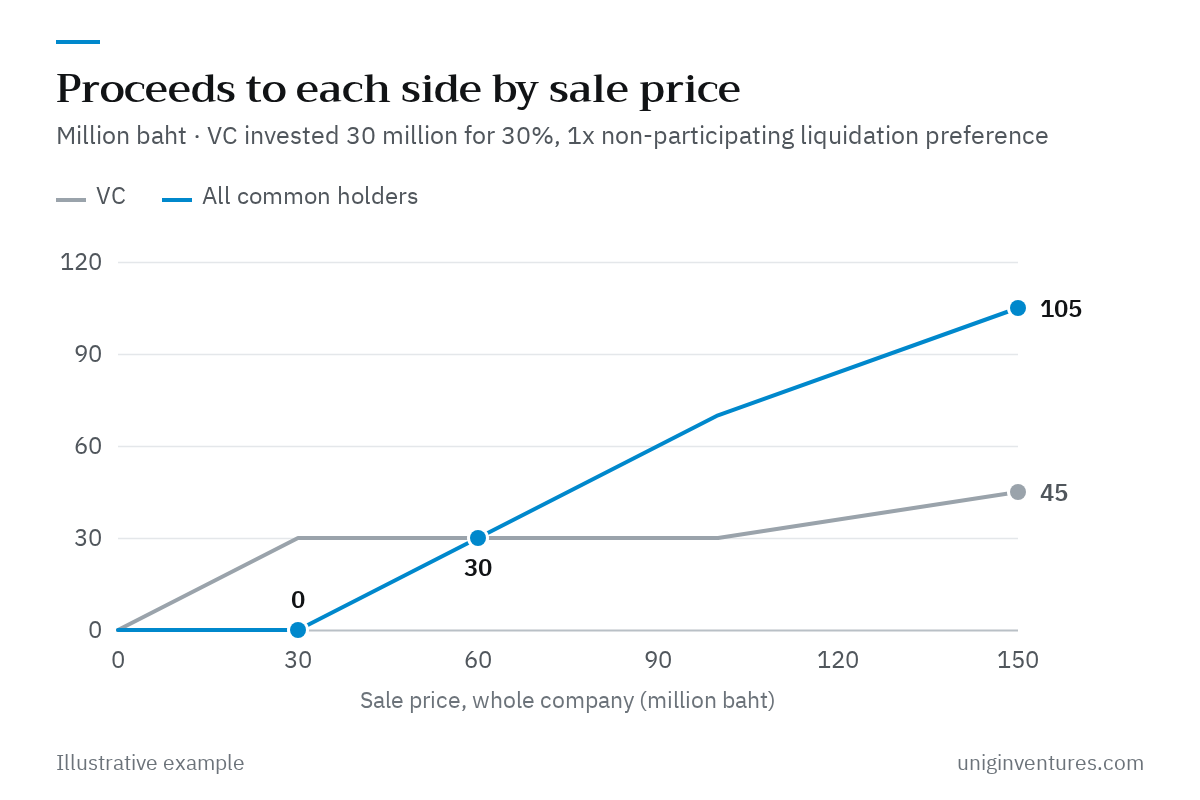
If the VC can trigger the drag alone and a buyer offers 30 million baht, the VC gets its money back in full while the founders transfer every share and receive 0 baht. At 60 million baht, common holders split 30 million baht, about 42.86 baht a share, and Founder A receives about 19.3 million baht. The VC converts to common only above a 100 million baht sale price, where 30% of the price exceeds 30 million baht. For the full mechanics, see Liquidation Preference Explained.
What founders should negotiate in a drag-along
- A three-part approval. Board, preferred and common, as described above.
- A minimum price. For example, no drag below an agreed price, or none during the first years after the investment. A CRV article lists a floor set as a multiple of the investment, an early-year block, and proceeds calculated as if the preferred had converted to common, so founders do not walk away with zero. In the example above, a 60 million baht floor would guarantee common holders at least 30 million baht in a forced sale.
- The same consideration per share. Dragged holders should receive the same form and amount of consideration per share within their class, after the liquidation preference is applied.
- Limited representations and liability. CRV recommends several, not joint, liability, so you answer only for your own breaches; an indemnity capped at the proceeds you receive; and representations limited to your own shares and your authority to sell.
- No forced non-compete. Being dragged into a sale should not commit a founder to a non-compete the founder did not agree to separately.
CRV notes that these protections are achievable asks at seed and Series A, and that the time to negotiate them is the term sheet, before deal pressure at closing leaves nothing to trade. For the term sheet as a whole, see Your First Term Sheet.
Tag-along: founders sell less than the buyer offered
Tag-along sounds fair, but founders often miss its effect: the buyer usually still wants the same number of shares. When an investor tags along, the allocation is split by holdings.
Shares each seller can sell = shares the buyer will purchase × that seller's shares ÷ total shares of everyone selling
Illustrative example, same company: Founder A agrees to sell 100,000 shares to a buyer at 50 baht a share, or 5,000,000 baht. The VC, with 300,000 shares, exercises its tag-along. The two sellers hold 750,000 shares between them, and the buyer still takes only 100,000.
| Seller | Shares held | Share of total | Shares sold | Proceeds (baht) |
|---|---|---|---|---|
| Founder A | 450,000 | 60% | 60,000 | 3,000,000 |
| VC | 300,000 | 40% | 40,000 | 2,000,000 |
| Total | 750,000 | 100% | 100,000 | 5,000,000 |
Founder A receives 3,000,000 baht, not the 5,000,000 baht agreed. If you plan a partial sale to take some money off the table, plan for this.
CRV explains that a founder's proposed transfer usually goes through the right of first refusal first, and co-sale covers only the shares that the ROFR holders decline to buy. Common exemptions cover estate planning transfers to family trusts, small transfers, pledges of shares to a lender and transfers to entities you control. Check that your agreement includes them.
Applying this to a Thai limited company
In a Thai private limited company, these clauses usually live in the shareholders' agreement, and some may also appear in the company's articles of association. Section 1129 of the Civil and Commercial Code says shares may be transferred without the company's consent, unless they are registered shares and the articles provide otherwise. A transfer must be in writing, signed by the transferor and the transferee, and certified by at least one witness, or it is void. It cannot be set up against the company or third parties until it is recorded in the register of shareholders.
So even when a contract obliges a holder to sell, each holder still has to sign the transfer instrument. Have Thai counsel spell out what happens if a holder refuses to sign, and make sure the articles and the shareholders' agreement do not conflict. The NVCA documents are written for U.S. law. Use them for the concepts, not as a translation template.
Where to start
- Find the drag-along and tag-along clauses in your term sheet or signed agreements, and note who can trigger them with what vote.
- Open your cap table and check whether a single investor can meet the threshold alone.
- Build a table of proceeds at several sale prices, including the liquidation preference, and find the prices at which common holders get zero.
- Negotiate the three-part approval, a minimum price, limited liability and tag-along exemptions at the term sheet stage.
- Have Thai counsel confirm that the agreement and the articles line up and that the transfer steps work in practice.
The company, shareholders and figures in this article are illustrative examples to explain the reasoning. This article is not legal advice.
Sources
- Drag-Along Agreements — The Holloway Guide to Raising Venture Capital
- Right of First Refusal and Co-Sale Agreement — The Holloway Guide to Raising Venture Capital
- Drag-Along Rights: What They Mean for Founders and How to Negotiate Them — CRV
- What Are Tag-Along Rights? A Guide for Startup Founders — CRV
- Model Legal Documents (Voting Agreement; Right of First Refusal and Co-Sale Agreement) — National Venture Capital Association
- Civil and Commercial Code Section 1129 (share transfers, in Thai) — Thai Law Online