Reverse Due Diligence: How Founders Should Check an Investor Before Signing
An investor stays with your company for years. Check identity, source of funds, follow-on capacity, behavior in hard times and usual terms, with questions for portfolio founders and a scoring table.

In this article
Before investing, an investor spends weeks examining your company: the financial statements, contracts, customers and the team's track record. Many founders, by contrast, sign after only a few meetings with the investor. Yet once the money arrives, that investor holds shares, has contractual rights and may sit on your board for years. If the relationship turns out to be a poor fit, there is no easy way out.
Reverse due diligence is the same homework done in the other direction. This article sets out five things to check, the questions to ask founders in the investor's portfolio, and a scoring table that lets you compare two offers with numbers.
Why check your investor
The U.S. Securities and Exchange Commission (SEC) explains that VC funds are typically structured to last at least ten years: the first few years go to investing, followed by monitoring the portfolio, and then exiting. VC funds also tend to take an active role, often with a seat on the board of directors or an advisory board. The investor you pick today will be in your boardroom for most of the years in which your company grows fastest.
That influence is real. The survey How Do Venture Capitalists Make Decisions? by Gompers, Gornall, Kaplan and Strebulaev cites research by Baker and Gompers (2003) finding that only about one-third of U.S. VC-backed companies still have a founder as chief executive officer (CEO) at the time of their IPO. These are U.S. figures, not Thai ones, but they show that once investors come in, the big decisions no longer rest with the founders alone.
Five things to check before you sign
1. Identity and source of funds
This is a gate, not a score. If an investor fails it, there is nothing else to discuss.
- A Thai company investing. Look it up in DBD DataWarehouse+, the Department of Business Development's service for information on juristic persons and the financial statements they file. Check that it is still active, who its directors are, and whether its finances are consistent with the amount it plans to invest.
- Anyone claiming an SEC license in Thailand, such as a securities company, an asset management company or a crowdfunding portal. Search the name in the Thai SEC's SEC Check First system, and check the SEC's Investor Alert list, which records people and firms that led the public to believe they were SEC-supervised but turned out not to be licensed.
- Ask directly where the money comes from. Is it a fund that has already raised its money from its own investors (limited partners), or will it raise money only once it finds a deal? If it is an individual angel investor, is it their own money or pooled from others?
2. How ready the money is, and whether there is more for the next round
A fund near the end of its investment period may be able to write the first check but have nothing left for the next round, or may want to sell earlier than your company is ready. Ask when the fund started, how many years of its investment period remain, and how much it reserves for follow-on investments in existing companies. If the investor asks for pro-rata rights to invest in later rounds, ask whether it will actually have the money to use them (see Anti-Dilution and Pro-Rata Rights). Also ask when the money will reach the company's account, in one payment or in tranches, and what conditions apply to later tranches.
3. Behavior when things go wrong
Almost every investor looks good while the company grows to plan. The difference shows when sales miss target, cash runs low or the next round has to be priced lower. Ask what the investor has done in those situations: helped arrange a bridge round, or used contractual rights to pressure the founders (see Bridge Rounds and Down Rounds). The best answer will not come from the investor. It comes from founders who went through that period with them.
4. Help you will actually get
The same survey asked almost 900 VCs what they do for companies after investing. The answers range from strategic guidance to introductions to other investors and to customers.
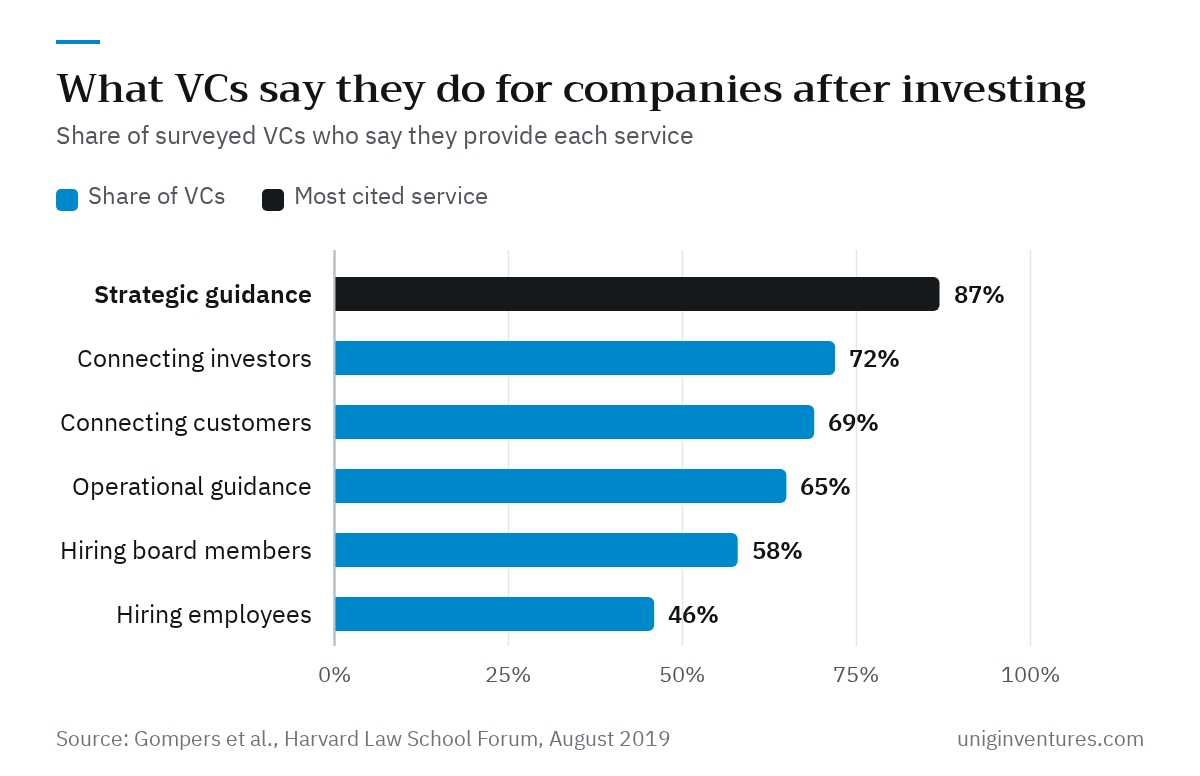
Because these are the VCs' own answers, treat them as a list of things to ask about, not proof that every investor delivers. Ask for named examples: which customer did they introduce last year, and did the deal close? Which investor did they bring in who actually invested? Then ask the founder of that company.
5. The terms this investor usually asks for
The survey found that VCs are relatively inflexible on pro-rata rights, liquidation preferences, anti-dilution protection, vesting, valuation and board control. They are more flexible on the option pool, participation rights, investment amount, redemption rights and, particularly, dividends.
That tells you two things. First, the terms in the first group that you accept in this round will follow the company through every later round, so understand them before you sign (see Reading Your First Term Sheet and Liquidation Preference). Second, ask portfolio founders which terms this investor asked for in earlier deals, and whether it changed terms after agreeing in principle.
Talking to portfolio founders: whom to call and what to ask
Ask the investor for a list of founders, then add names yourself from the investor's portfolio page and investment news. The list an investor hands you usually features companies that did well, so find at least one founder whose company missed its plan, shut down or raised at a lower price. Ask everyone the same questions so you can compare the answers.
- After the money came in, what concrete help did the investor give? Give me one example.
- When the company missed targets or ran low on cash, what did the investor do?
- Did the investor put in more money in the next round? If not, why not?
- Did the final contract differ from the agreed term sheet?
- How easy is the investor to reach, and how fast do they respond when something is urgent?
- In board meetings, do their questions help you think, or do they give orders?
- If you could go back, would you take money from this investor again?
The last question usually gets the most honest answer. If a founder pauses for a long time or answers around it, that is information too.
Example: scoring two offers
An illustrative example: a startup receives two offers. Investor A offers a higher valuation; Investor B offers a lower one. Both pass the identity and source-of-funds gate. The founders weight the remaining four areas to total 100 and score each from 1 to 5 based on their calls with portfolio founders.
Total score (out of 100) = sum of (weight × score) ÷ 5
| Area | Weight | Investor A | Investor B |
|---|---|---|---|
| Money ready and follow-on capacity | 30 | 2 | 4 |
| Behavior when things go wrong | 30 | 2 | 5 |
| Help actually delivered | 20 | 3 | 4 |
| Terms of the offer, including valuation | 20 | 5 | 3 |
| Total | 100 | 56 | 82 |
Investor A scores (2 × 30 + 2 × 30 + 3 × 20 + 5 × 20) ÷ 5 = 56. Investor B scores (4 × 30 + 5 × 30 + 4 × 20 + 3 × 20) ÷ 5 = 82. The higher valuation loses, because founders in Investor A's portfolio said it did not invest again when their companies missed targets.
The table does not decide for you, but it forces you to put your reasoning into numbers and keeps valuation alone from drowning out everything else. Set the weights before you see the offers, not afterward to make your favorite win.
Signals to stop and think
- An upfront fee before investing, or a request to pay for "introductions to funds"
- Refusal to let you talk to portfolio founders, or access only to hand-picked ones
- A deadline to sign within a few days, with no reason given
- Identity, directors or source of funds that cannot be verified, or a name on the Investor Alert list
- Key terms that change after the term sheet is agreed, especially once you have turned other investors away
Where to start
- Set the weights for the four areas in the table to fit your company before you start talking to investors. A company that must raise several more rounds should weight follow-on capacity heavily.
- Run the gate check on every investor who makes an offer, using DBD DataWarehouse+ and SEC Check First.
- Talk to at least three portfolio founders per investor, including at least one whose company did not go to plan.
- Score the table and use the result in negotiation, for example by asking the high-scoring investor with the lower valuation for better terms.
- Prepare your own documents in parallel, as in The Data Room Before Due Diligence.
The company, investors and scores in this article are illustrative examples. Figures from the survey are the answers of the VCs who responded, not data on the Thai market. This article is general information, not legal or investment advice for any particular business.
Sources
- Early-Stage Investors — U.S. Securities and Exchange Commission
- How Do Venture Capitalists Make Decisions? (Gompers, Gornall, Kaplan, Strebulaev) — Harvard Law School Forum on Corporate Governance
- SEC Check First: search licensed business operators — Securities and Exchange Commission, Thailand
- Investor Alert: list of persons not licensed by the SEC — Securities and Exchange Commission, Thailand
- DBD DataWarehouse+: juristic person and financial statement data — Department of Business Development