Use of Funds: A Spending Plan Tied to Next-Round Milestones
Investors want more than a pie chart. Split your round into base costs, milestone budgets and a reserve, prepare a minimum plan if you raise less, and track spend against results monthly.
In this article
Most use-of-funds slides are a single pie chart: product 40%, marketing 30%, team 20%, other 10%. An investor who reads it learns which buckets the money will land in, but not what each amount is supposed to buy, or how the company will know whether the plan is on track.
This article shows how to write a spending plan tied to the milestones of your next round. It covers splitting the budget into base costs and milestone budgets, a table you can drop straight into a slide, a minimum plan for when the round comes in short, and a monthly tracking table for after the money arrives.
A pie chart cannot answer an investor's questions
Investors read a use-of-funds plan to answer three questions. Where will this money take the company? Will that point let it raise the next round at a higher valuation? And if things run late, how will the founders adjust? A chart split by expense category only shows where the money goes out. It says nothing about what comes back.
In Y Combinator's guide to seed fundraising, Geoff Ralston writes that companies that will need to raise again should raise enough to reach their next "fundable" milestone, which will usually be 12 to 18 months later. A good spending plan therefore works backward from the milestone to the money, not forward from expense categories. If you have not sized your round yet, start with How much to raise.
Split the money into three parts
- Base costs are what you must pay to keep the company running even if you do nothing new: the existing team's salaries, rent, accounting and software. This part is not tied to any one milestone, but show it separately, because it sets how fast the cash runs out if every other activity stops.
- Milestone budgets are the extra spending needed to reach each target, such as hiring salespeople to grow revenue or engineers to build a feature that large customers require. Every line must say what work it buys and which number, in which month, will show the result.
- A reserve covers a plan that runs late or a next round that takes longer than expected. Show it as an amount and as months of spending, not hidden inside another category.
A usable milestone is measurable and dated: monthly recurring revenue (MRR), customer churn, or how many months it takes to recover the cost of acquiring a customer. For definitions, see MRR, Churn and Cohorts and Unit Economics.
Example: a 15 million baht plan tied to three milestones
Take an illustrative B2B subscription software startup with recurring revenue of 300,000 baht a month. It raises 15,000,000 baht on an 18-month plan, aiming to hit its milestones by month 12 and use the rest of the time to raise the next round. The plan counts spending only and does not net off the revenue it expects to add, so it stays on the cautious side.
| Part of plan | What the money buys | Measure and target month | 18-month budget | Share |
|---|---|---|---|---|
| Base costs | Existing team, office, accounting, software | 300,000 baht a month | 5,400,000 | 36% |
| Milestone 1: revenue | Two salespeople and a marketing budget | MRR of 1,000,000 baht by month 12 | 4,200,000 | 28% |
| Milestone 2: retention | One customer success hire, onboarding tools and guides | Churn of 2% a month or less, three-month average at month 12 | 1,200,000 | 8% |
| Milestone 3: large customers | Two engineers building an integration with customers' accounting systems | Live with 5 customers by month 9 | 2,700,000 | 18% |
| Reserve | About two months of average spending | Used if the plan or the next round runs late | 1,500,000 | 10% |
| Total | – | – | 15,000,000 | 100% |
Planned spending before the reserve is 13,500,000 baht, or 750,000 baht a month on average, so the 1,500,000 baht reserve equals two months of average spending. A table like this fits on one slide and answers the investor's first question by itself: what each amount buys, and when the result will show.
In the supporting material, add two things to each milestone. The first is a leading indicator that shows progress before the target month, such as the number of deals in the sales pipeline, or the date the first customer starts testing the feature. The second is a decision point, for example: "If MRR is below 550,000 baht at month 6, we cut the marketing budget by half and move that money to the reserve." Founders who write their decision points in advance show investors they have already thought about the risks.
Prepare a minimum plan in case the round comes in short
The same Y Combinator guide suggests creating multiple plans for different amounts raised and explaining why the company will succeed whether it raises the full amount or less. A minimum plan has to say clearly which milestones are dropped, which have lower targets and which move to the next round.
Continuing the example, suppose the company raises only 10,000,000 baht. Base costs stay at 5,400,000 baht. Milestone 1 keeps one salesperson and a smaller marketing budget, 3,000,000 baht in total, with the MRR target cut to 700,000 baht. Milestone 2 hires no one; the founders handle customer success themselves and spend 600,000 baht on tools and guides only. Milestone 3 moves to the next round, and the reserve drops to 1,000,000 baht.
| Part of plan | Full plan, 15 million baht | Minimum plan, 10 million baht | What changes |
|---|---|---|---|
| Base costs | 5,400,000 | 5,400,000 | Unchanged |
| Milestone 1: revenue | 4,200,000 | 3,000,000 | MRR target cut from 1,000,000 to 700,000 baht |
| Milestone 2: retention | 1,200,000 | 600,000 | Same target; founders handle customer success |
| Milestone 3: large customers | 2,700,000 | 0 | Moved to the next round |
| Reserve | 1,500,000 | 1,000,000 | – |
| Total | 15,000,000 | 10,000,000 | – |
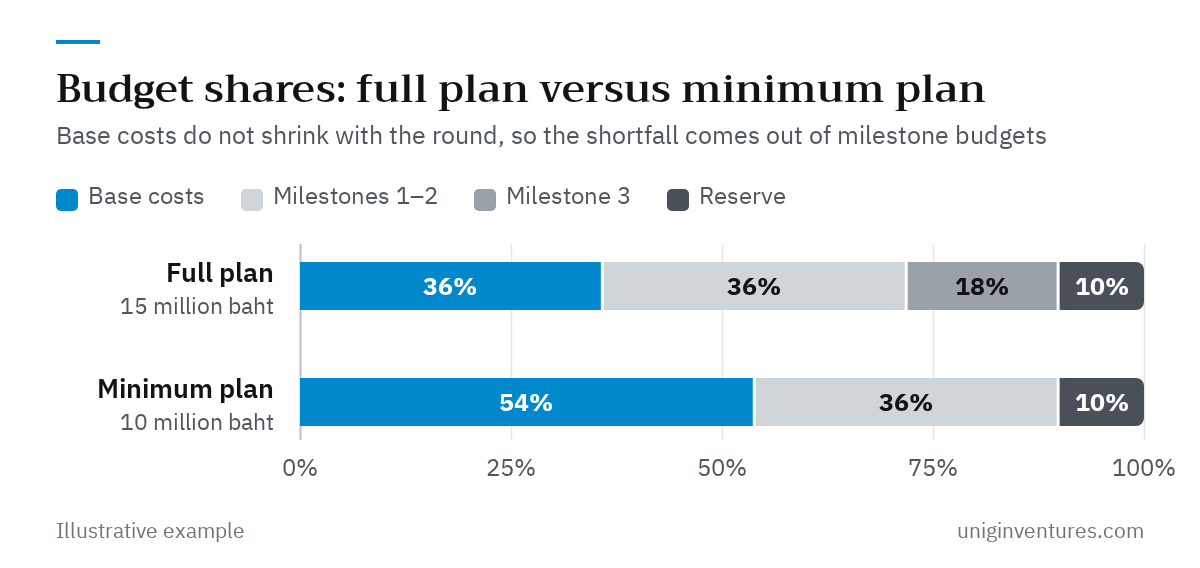
The message for investors is that base costs do not shrink with the round, so every baht missing from the target comes straight out of the milestone budgets. If the minimum plan still reaches a milestone that can support the next round, the founders can close below target with confidence. If it cannot, they need to know that before the first investor meeting.
After the money arrives: track budget and milestones every month
A spending plan is only useful if you compare it with reality every month. Use one table that holds both money and results, because spending exactly to plan while the results fail to arrive is a worse signal than overspending while hitting the target.
| Part of plan | Planned spend to date | Actual | Variance | Planned measure | Actual measure |
|---|---|---|---|---|---|
| Base costs | 1,800,000 | 1,790,000 | −10,000 | – | – |
| Milestone 1: revenue | 1,320,000 | 1,450,000 | +130,000 | MRR 550,000 | MRR 480,000 |
| Milestone 2: retention | 350,000 | 340,000 | −10,000 | Churn 3% or less | Churn 2.6% |
| Milestone 3: large customers | 900,000 | 780,000 | −120,000 | Testing with 2 customers | Testing with 1 |
In this example, milestone 1 has spent 130,000 baht more than planned, yet MRR is 70,000 baht behind plan, which triggers the decision point written in advance. Before putting more money in, the founders need to find out whether the problem is the marketing channel, the price or how quickly deals close. Milestone 3 has spent less than planned because the second engineer was hired late, so the work is late too. The unspent money is not a saving.
Report this table in your monthly investor update and in board papers. If you may need to move money between milestones, agree on a threshold in advance, for example that moving more than 10% of the round requires telling the board first. Check the shareholders' agreement as well, since some make the annual budget a matter the board must approve; see Board seats, observers and reserved matters. (The 10% threshold is illustrative.)
Where to start
- Write two or three milestones the next round's investors will need to see, each with a number and a target month.
- Work out your monthly base costs first, then go milestone by milestone: who you need to hire and what else you need to pay for.
- Add a reserve expressed in months of spending, and make the total match your round size and the monthly cash plan from Burn Rate and Runway.
- Write a leading indicator and a decision point for each milestone.
- Build a minimum plan that says what you will drop, shrink or postpone if you raise less than the target.
- Put the full-plan table on the use-of-funds slide of your pitch deck, and have the monthly tracking table ready from the first month the money is in.
The company and every number in this article are illustrative, not market averages. This article is general information, not investment or legal advice for any particular company. Sources were checked in November 2026.