Preparing an SME Loan Application: DSCR, Collateral and TCG Guarantees
What Thai banks check before approving a business loan, how to calculate your own DSCR, how loan size and term change the result, the documents to prepare, and TCG's PGS 11 guarantee terms.
In this article
Most SME owners walk into a bank with one question in mind: how much will they lend me? The loan officer is asking a different one: will this business generate enough cash to make the payments, and if it doesn't, how does the bank get its money back? Applications that answer that question clearly from the first page tend to move faster and get better terms.
This article covers what Thai banks weigh, how to calculate your own debt service coverage ratio (DSCR) before you apply, how to adjust loan size and term so the numbers work, the documents to prepare, and the role of the Thai Credit Guarantee Corporation (TCG) when collateral falls short.
What banks check before they approve
Details vary by bank and product, but the core questions are always the same five.
- Capacity to repay. Does operating cash flow cover principal and interest on every loan? This carries the most weight.
- Repayment history of both the company and its directors, from the credit bureau and from existing bank accounts.
- Owner's capital. How much of their own money the owners have put into the business relative to total debt.
- Collateral. The bank's fallback if cash flow doesn't go to plan.
- Business conditions. The industry, customers, competition, and what the money will actually be used for.
A common misconception is that collateral comes first. It is the last line of defense. Banks don't want to seize and sell assets. They want to be repaid on time out of the business's own revenue.
DSCR: the one number to know before you apply
The debt service coverage ratio shows how many times a company's annual cash flow covers the debt payments due in the same year.
DSCR = (EBITDA − cash taxes) ÷ (principal + interest due in the year)
EBITDA, earnings before interest, taxes, depreciation and amortization, stands in for operating cash flow because depreciation is not a cash outflow. The denominator must include every obligation: existing loans, hire-purchase contracts, and the new loan you are requesting.
- A DSCR below 1.0x means the business does not generate enough cash to service its debt and must top up from elsewhere.
- A DSCR of exactly 1.0x covers payments with no room for a drop in sales.
- The Corporate Finance Institute notes that many commercial lenders set a minimum covenant of 1.25x.
Each Thai bank uses its own formula and threshold. Some start from net profit plus depreciation and interest; some work from bank statements. Before applying, ask the loan officer which formula and threshold they use, then run the numbers their way.
A worked example
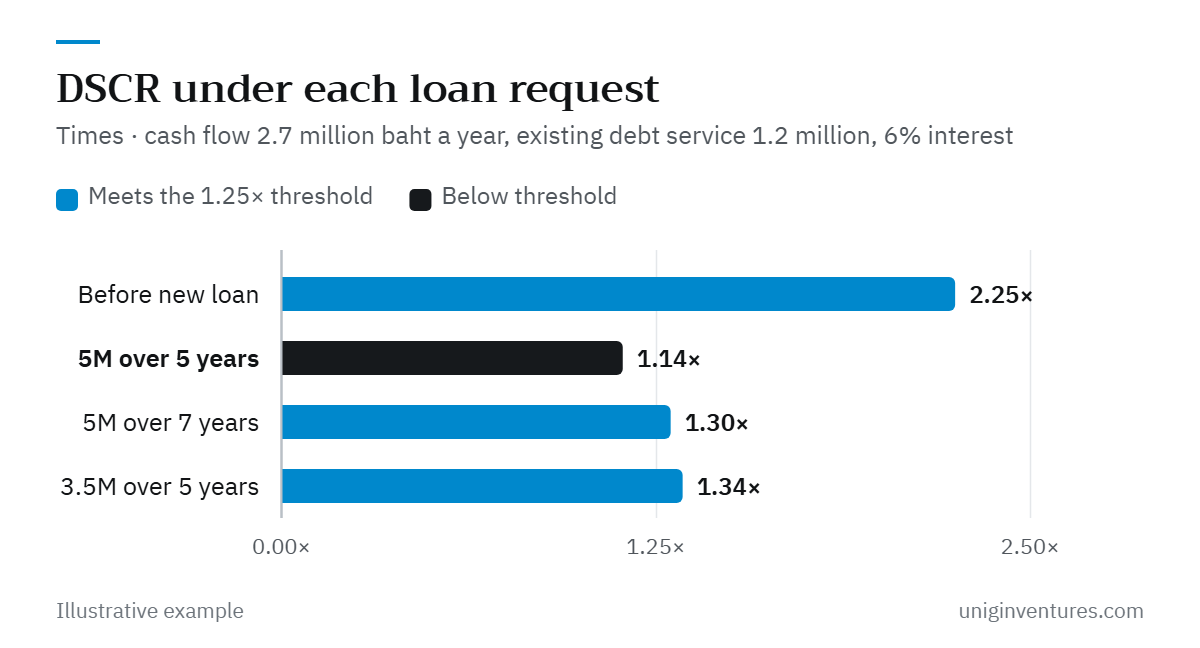
Illustrative example: a packaging manufacturer has EBITDA of 3.0 million baht a year, pays 0.3 million baht in income tax, and services existing loans of 1.2 million baht a year. It wants to borrow another 5 million baht for a new machine. Assume 6% annual interest, equal monthly installments, and a bank threshold of 1.25x.
| Scenario | New monthly payment (baht) | Total annual debt service (million baht) | DSCR |
|---|---|---|---|
| Before new loan | − | 1.20 | 2.7 ÷ 1.20 = 2.25x |
| 5 million over 5 years | 96,664 | 2.36 | 2.7 ÷ 2.36 = 1.14x |
| 5 million over 7 years | 73,043 | 2.08 | 2.7 ÷ 2.08 = 1.30x |
| 3.5 million over 5 years | 67,665 | 2.01 | 2.7 ÷ 2.01 = 1.34x |
The original request, 5 million baht over five years, produces a DSCR of 1.14x, below the threshold. Submitted as is, it is likely to be cut or to trigger a request for more collateral. Stretching the term to seven years (which should match the machine's useful life) or borrowing 3.5 million baht and funding the rest from the company's own capital both clear the bar.
You can also work backward to find the largest payment the business can carry.
Maximum annual debt service = cash flow ÷ DSCR threshold = 2.7 ÷ 1.25 = 2.16 million baht
Less existing debt of 1.2 million leaves at most 0.96 million baht a year, or 80,000 baht a month, for the new loan
At 6% interest, 80,000 baht a month supports a loan of about 4.14 million baht over five years, or about 5.48 million baht over seven. That is the amount to ask for, rather than a round number you then watch get trimmed.
Documents to have ready before the meeting
Every bank's list differs slightly, but this set covers what is requested almost every time.
- Company documents: a current company affidavit (certificate of registration), the shareholder register, the VAT registration certificate (Por Por 20) if registered, and directors' ID cards.
- Audited financial statements for the past two to three years, plus monthly or quarterly accounts for the current year.
- Bank statements for the past 6 to 12 months from the main account where customers pay.
- VAT returns (Por Por 30) for the same period, so sales in the financial statements, the VAT returns and the bank account line up.
- A schedule of existing debt: lender, balance, installment, maturity and collateral for each facility.
- A use-of-funds plan and cash flow forecast covering at least 12 months, with supplier quotations if you are buying equipment.
- A list of major customers and existing contracts or purchase orders, if revenue depends on a few accounts.
The most common reason applications stall is that the three sets of numbers don't match: sales in the financial statements are far below deposits into the bank account, or personal and company money are mixed together. Banks give weight to numbers they can verify, so unrecorded income does nothing for a loan application. Fix this at least one accounting year ahead.
Before applying, check the credit records of the company and its directors with the National Credit Bureau, which lets companies request their own reports. If there is an error or a forgotten debt, you can correct or explain it before the bank sees it.
When collateral falls short: TCG guarantees
The Thai Credit Guarantee Corporation (TCG) is a state agency that guarantees loans for SMEs with viable businesses but insufficient collateral. Borrowers apply through the lending bank: the bank assesses the loan and submits the guarantee request to TCG, and the borrower pays an annual guarantee fee.
The main current program is the TCG SMEs Sustainable guarantee scheme (PGS phase 11), with a total guarantee budget of 50 billion baht. Key terms as published by TCG:
- Applicants are Thai individuals or companies registered in Thailand, with fixed assets excluding land of no more than 200 million baht, whose loans are classified as normal or special mention.
- Total guarantees are capped at 40 million baht per borrower across all lenders and programs.
- The fee averages no more than 1.75% a year, with guarantees of up to 10 years (up to 7 years for some sub-programs).
- Sub-programs have different terms. Smart Biz, for example, guarantees 200,000 to 10 million baht per borrower at 1.5% a year, with the fee waived for the first two years.
- Applications close on December 30, 2026, or earlier if the budget runs out.
Two things to understand before relying on TCG. First, a guarantee does not replace repayment capacity. The bank still looks at DSCR and credit history; TCG only fills the collateral gap. Second, the guarantee fee is a cost on top of interest. On a 5 million baht loan at 1.75% a year, the fee is about 87,500 baht in any year the full amount is still guaranteed, so put it in your cash flow forecast. Program terms change from round to round, so confirm with TCG or your bank before you apply.
Five things that strengthen an application
- Match the loan to its use. Working capital belongs in a revolving line (an overdraft or promissory notes); machinery or buildings belong in a term loan whose tenor is close to the asset's useful life. Using short-term credit to buy long-term assets is a red flag for banks.
- Apply before you run short. A request filed when cash is already tight and money is needed within two weeks has the least bargaining power. Use your cash flow forecast to see when you will need funds, and apply at least two to three months ahead.
- Make the numbers tell one story. Why are sales growing, how will the loan raise profit or cut costs, and can you still make the payments if sales come in 20% below plan?
- Show that owners share the risk. Putting in some of your own capital, such as a down payment on equipment, lowers the loan amount and lifts DSCR at the same time.
- Compare lenders. The Bank of Thailand's Financial Consumer Protection Center publishes a comparison of SME loan products across financial institutions. Use it to check rates and fees before you choose where to apply.
Where to start
- Pull last year's financial statements, calculate EBITDA, and total the payments due on every loan next year.
- Calculate your current DSCR, then work backward to the largest new payment you can carry at 1.25x (or whatever threshold your bank gives you).
- Check that sales in your financial statements, VAT returns and bank account agree, and check the credit bureau records of the company and directors.
- Assemble the documents above, with a 12-month cash flow forecast that includes a lower-sales scenario.
- If collateral is short, ask the bank at the first meeting whether the loan can be paired with a TCG guarantee.
A strong loan application doesn't ask the bank to trust you. It gives the bank numbers it can check for itself and reach the same answer you did. Owners who have already calculated their own DSCR know before they apply how much to ask for and over how many years.
Sources
- TCG SMEs Sustainable Credit Guarantee Scheme (PGS Phase 11) — Thai Credit Guarantee Corporation (in Thai)
- TCG launches Smart One, Smart Biz and Smart Build guarantee programs — Thai Credit Guarantee Corporation (in Thai)
- Debt Service Coverage Ratio (DSCR) — Corporate Finance Institute
- How companies can check their credit bureau records — National Credit Bureau (in Thai)
- SME loan product comparison — Financial Consumer Protection Center, Bank of Thailand