Growth Eats Cash: How Much Working Capital a Sales Increase Needs
Higher sales tie up cash in receivables and stock before the profit arrives. Calculate the extra working capital from days, find the growth your profit can fund, and pick the levers and funding that close the gap.
In this article
Sales are up 30%, profit is up, and yet the bank balance is so thin that you are asking suppliers for a few more days. This happens to businesses that sell well more often than to businesses that struggle to sell. In "How Fast Can Your Company Afford to Grow?" (Harvard Business Review, May 2001), Neil C. Churchill and John Mullins put it plainly: a profitable company that tries to grow too fast can run out of cash, even if its products are great successes.
The reason is that growth needs more working capital before the extra profit arrives. This article shows how to calculate how much cash a sales increase will absorb, how to find the growth rate your business can fund from its own profit, and how to choose between needing less cash and raising more.
Why selling more can leave you with less cash
BDC, the Business Development Bank of Canada, defines working capital as the money a business needs for its short-term operations, calculated as current assets minus current liabilities. It notes that working capital has to rise alongside revenue, especially for companies that sell products, because higher sales require cash to buy inventory and to finance new accounts receivable.
For planning, focus on the part that comes from day-to-day trading, often called operating working capital.
Operating working capital = Trade receivables + Inventory − Trade payables
All three lines grow with sales on their own. If customers pay as slowly as before and stock sits as long as before, every extra baht of sales ties up cash in receivables and inventory in the same proportion. Suppliers fund only part of it.
Calculate the extra cash from days
The simplest method is to express each line in days, the same building blocks as the cash conversion cycle. SET Investnow, the education site of the Stock Exchange of Thailand, gives the formula as: cash cycle = days to sell inventory + days to collect receivables − days to pay payables.
Trade receivables = Annual sales × Collection days ÷ 365
Inventory = Annual cost of sales × Inventory days ÷ 365
Trade payables = Annual cost of sales × Payment days ÷ 365
Illustrative example: a wholesale equipment distributor has sales of THB 60 million this year and a 30% gross margin, so cost of sales is THB 42 million. Customers pay in 60 days on average, stock stays in the warehouse for 45 days, and the company pays suppliers within 30 days. The owner wants sales to grow 30% to THB 78 million next year, with all trading terms unchanged (figures exclude VAT).
| THB thousand | This year | Next year | Increase |
|---|---|---|---|
| Sales | 60,000 | 78,000 | 18,000 |
| Cost of sales (70%) | 42,000 | 54,600 | 12,600 |
| Trade receivables (60 days) | 9,863 | 12,822 | 2,959 |
| Inventory (45 days) | 5,178 | 6,732 | 1,554 |
| Less trade payables (30 days) | −3,452 | −4,488 | −1,036 |
| Operating working capital | 11,589 | 15,066 | 3,477 |
This company's working capital equals 19.3% of sales. Every extra THB 100 of sales ties up about THB 19.30 more, so an extra THB 18 million of sales needs THB 3.48 million of additional cash.
If the company earns a 4% net margin, next year's profit is THB 3.12 million, which is THB 357,000 short of the extra working capital. That is before any dividend and before buying a new truck or new tools. The income statement will show the company's best year, while cash at year-end goes down.
Service businesses tie up cash too
A service business holds no stock, but it pays its team before it delivers and bills. Work done but not yet billed plays the role of inventory. Count the days from when you start paying for a job until you invoice it, and use cost of services in place of cost of sales in the same formula.
How fast you can grow on your own profit
In the example, the cash you need is the working capital ratio multiplied by the increase in sales. The cash you generate is next year's net profit. Where the two are equal is the fastest growth you can fund without outside money.
Self-funded growth rate = Net margin ÷ (Working capital as % of sales − Net margin)
Example: 4% ÷ (19.3% − 4%) ≈ 26%
This is a simplified formula derived from the example in this article. It assumes you keep all profit in the business with no dividends, that receivable, inventory and payable days stay the same, and that capital spending is covered by depreciation. A real business that has to buy machines or add warehouse space can fund less growth than this from its own profit.
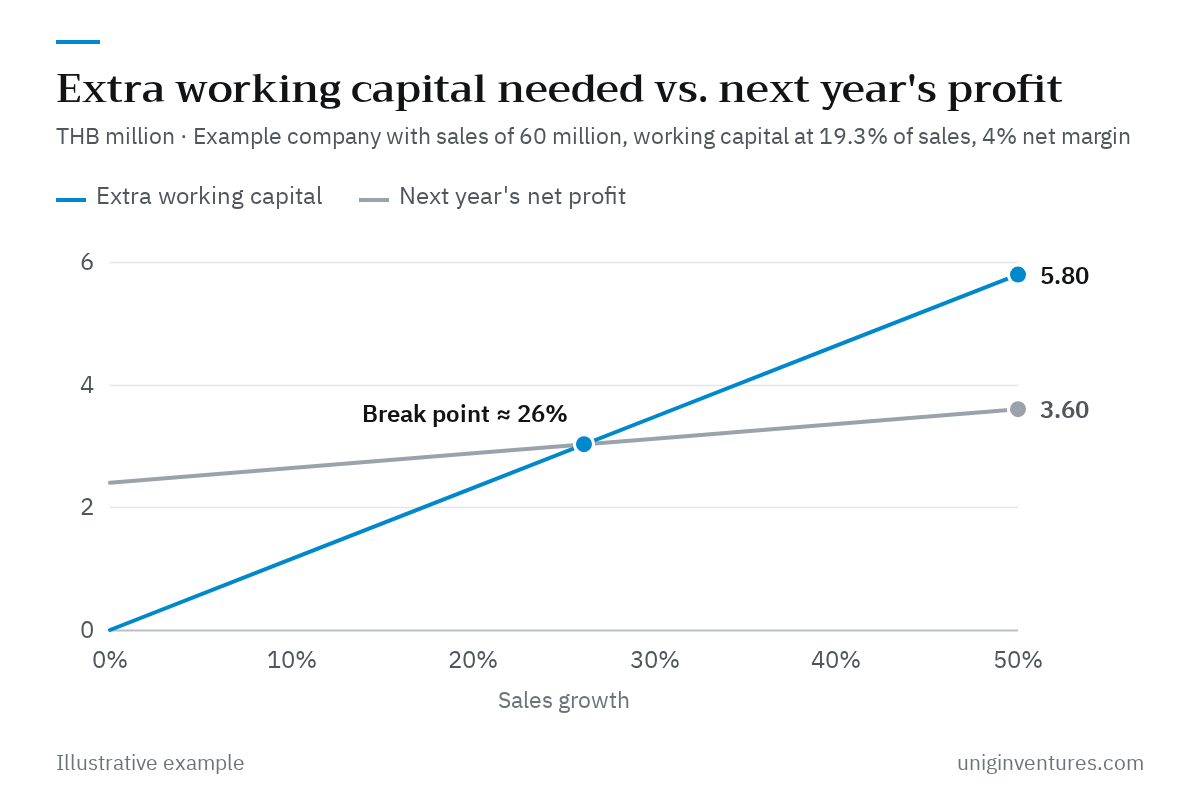
The cash-needed line is almost five times steeper than the profit line. If the example company grew 50%, it would need THB 5.80 million of extra working capital against THB 3.60 million of profit, a gap of THB 2.20 million. The faster the growth, the wider the gap.
Three levers that reduce the cash you need
BDC recommends starting with operations before raising money: collect from customers faster, lower production costs, turn inventory faster and extend supplier payment terms. The table shows the cash each lever releases at the example company's next-year sales of THB 78 million.
| Change | Cash per day (THB thousand) | Change in days | Cash released (THB thousand) |
|---|---|---|---|
| Collect faster | 213.7 | 60 → 45 | 3,205 |
| Hold less stock | 149.6 | 45 → 35 | 1,496 |
| Pay suppliers later | 149.6 | 30 → 40 | 1,496 |
A day of receivables is worth more than a day of inventory because receivables are measured on sales, while inventory and payables are measured on cost of sales. Collecting 15 days faster releases THB 3.21 million on its own, close to the THB 3.48 million of extra working capital. If you managed all three, next year's working capital would be about THB 8.87 million, lower than this year's even with 30% growth.
- Receivables: invoice on the day you deliver, review the aging list every week, and ask for deposits or milestone payments in B2B contracts on large jobs.
- Inventory: cut the days of slow-moving items first, using ABC classification and reorder points.
- Payables: negotiate supplier payment terms as a clear agreement. Paying late without one costs you credibility and cash discounts.
Be careful with a large new customer who asks for 90 or 120 days. A deal like that makes sales jump, but it pushes up receivable days for the whole company. Before you accept it, run the same formula on the deal and build the cost of that cash into the price.
Choose how to fund the gap
If the business is still short after fixing operations, BDC lists three remaining options: reinvest profit, take a working capital loan, or inject shareholder equity. It notes that lenders usually size working capital loans on past and projected cash flows. The options Thai SMEs use most often are these:
- Keep profit in the company. Skip or cut dividends in the year you plan to grow. This money carries no interest cost.
- Bank facilities. Working capital that rises and falls with the season suits a facility you can draw and repay. See overdraft or short-term loan for the differences.
- Turn invoices into cash. This fits when your customers are large companies that pay late but reliably. Read factoring and invoice financing.
- Long-term money or new equity. The working capital that stays for as long as the business is this size is a permanent investment, much like a machine. Funding it with a short-term loan that must be renewed every year leaves you exposed if the bank declines to renew.
Banks and investors want to see numbers like the table above: where the money will sit, how much, and when it comes back. Asking for a facility with that table works better than saying only that sales are growing and you need more cash.
Where to start
- Work out receivable, inventory and payable days from your latest annual statements or the last 12 months.
- Find working capital as a percentage of sales and multiply it by next year's planned sales increase.
- Compare the result with the net profit you expect to keep. If profit is smaller, the difference is the money you need to find.
- Change the days one line at a time to see which lever closes the most of the gap.
- For what is still missing, match the funding source to the need, then track it weekly with a 13-week cash flow forecast.
Growth itself is not the problem. The problem is discovering the cash need after the cash is gone. Owners who run this calculation before they set a sales target can choose to grow as fast as profit allows, or to arrange funding while they still have time to negotiate.
Sources
- How Fast Can Your Company Afford to Grow? (Neil C. Churchill, John Mullins, May 2001) — Harvard Business Review
- How working capital helps you to keep growing — BDC (Business Development Bank of Canada)
- Working capital projection tool — BDC (Business Development Bank of Canada)
- The cash cycle and business liquidity (in Thai) — SET Investnow, Stock Exchange of Thailand