Negotiating Supplier Payment Terms: Value the Days, Price the Discount
Supplier credit is interest-free funding. How much cash extra days free up, what skipping an early-payment discount costs, what to offer in return, and Thailand's new 45-day rule.
In this article
Most SME owners spend a lot of energy getting customers to pay faster and very little on when they pay their own suppliers. Yet supplier credit is often the cheapest money a small business can get: no interest, no collateral, no loan application. Moving a payment date from 30 to 60 days can free more cash than a new bank facility, as long as it is negotiated, not taken.
This article shows how to work out what longer terms are worth, how to judge an early-payment discount, how to prepare and what to offer in the negotiation, and where the limits are.
Supplier Credit Is a Source of Funding
Every day you wait to pay a supplier, their money is funding your business. The amount is easy to estimate:
Cash freed = annual purchases on credit ÷ 365 × extra days of credit
In an illustrative example, a distributor buys 24 million baht of goods a year on credit, about 65,750 baht a day. If it moves its main suppliers from 30-day to 60-day terms, the extra 30 days keep about 1.97 million baht in the business. That cash stays as long as purchases stay at the same level, which makes it similar to a permanent working capital facility with no interest.
Payment terms are one of three levers in the cash conversion cycle, together with how long stock sits and how long customers take to pay (see the cash conversion cycle). Days payable outstanding (DPO), meaning trade payables ÷ purchases × days in the period, tells you where you stand today.
Price an Early-Payment Discount Before You Say No
Some suppliers offer the opposite deal: a discount for paying early. Terms written as "2/10 net 30" mean a 2% discount if you pay within 10 days, otherwise the full amount is due in 30 days. Skipping the discount is the same as borrowing from the supplier for the extra 20 days, and that loan has a price.
Annualized cost of skipping the discount = discount % ÷ (100% − discount %) × 365 ÷ (full credit days − discount days)
For 2/10 net 30: 2 ÷ 98 × 365 ÷ 20 = 37.2% a year. (Some textbooks use a 360-day year, which gives 36.7%. Either way, the answer is the same.) If you can borrow at less than that, or have idle cash earning less, take the discount. The same formula gives very different answers for different terms:
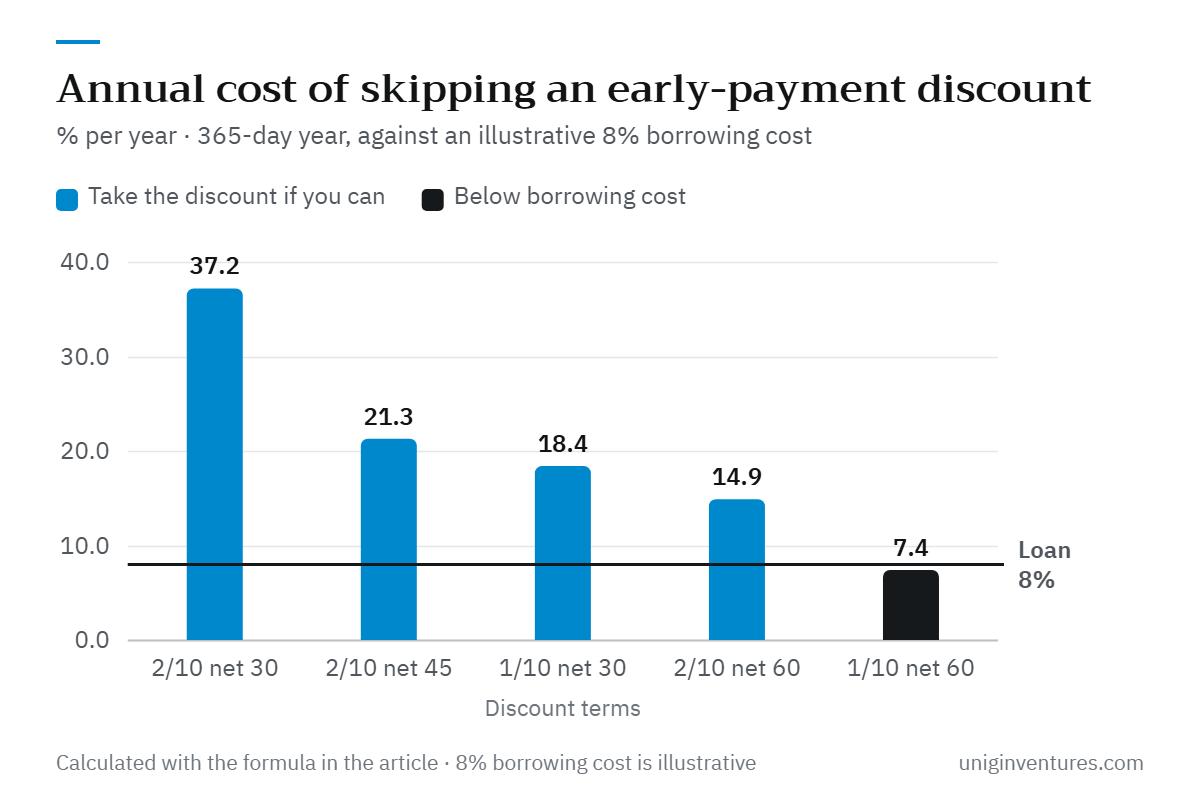
A discount also works as a negotiating tool. If a supplier needs cash and you have it, offering to pay in 10 days for a discount can be worth more to both sides than arguing over price.
Prepare Before You Ask
Suppliers agree to longer terms when they see a reliable customer, not when they hear a demand. Before the meeting, gather:
- Your volume and history with them: purchases over the past 12 months, growth, and your on-time payment record. If you have paid late, fix that first.
- Your plan for the next year: expected volume, new products, or a forecast you are willing to share.
- Market terms: what other suppliers of the same goods offer you. Get at least one written quotation.
- Their position: how much of their sales you represent, whether they are larger or smaller than you, and whether they are likely to be short of cash themselves.
- The value of each step: use the formula above to know what 15, 30 or 45 extra days are worth to you, so you know what you can give in return.
What to Offer in Return
A negotiation goes better when you trade something rather than only ask. Common exchanges include:
| You offer | You ask for |
|---|---|
| A volume commitment or a longer contract | Longer credit terms on all orders |
| A rolling order forecast so they can plan production | Terms starting from the delivery date rather than the order date |
| Payment on one fixed day each month, by bank transfer | An extra 15 days in exchange for certainty |
| Early payment when you have spare cash | A discount, priced with the formula above |
| Larger, less frequent orders | Consignment stock or staged payments for big orders |
Ask for the change in writing: in the supply contract, the purchase order terms or a confirmation email. A verbal promise from a salesperson may not reach the supplier's accounts team, and you will receive reminder calls on day 31.
New Limits When a Large Buyer Buys From an SME
Payment terms between large companies and small suppliers are regulated in Thailand. A new notification of the Trade Competition Commission of Thailand on fair credit terms between large businesses and SMEs was published in the Royal Gazette on 2 October 2026 and takes effect on 2 November 2026. In summary:
- Who counts as a large business: a buyer with revenue in Thailand of at least 500 million baht in the previous financial year, counting related companies under common control together. Large wholesalers and retailers, such as hypermarkets, supermarkets, department stores and convenience stores, are covered on the same basis.
- Who counts as an SME: a manufacturer with no more than 200 employees and revenue of no more than 500 million baht, or a service, wholesale or retail business with no more than 100 employees and revenue of no more than 300 million baht.
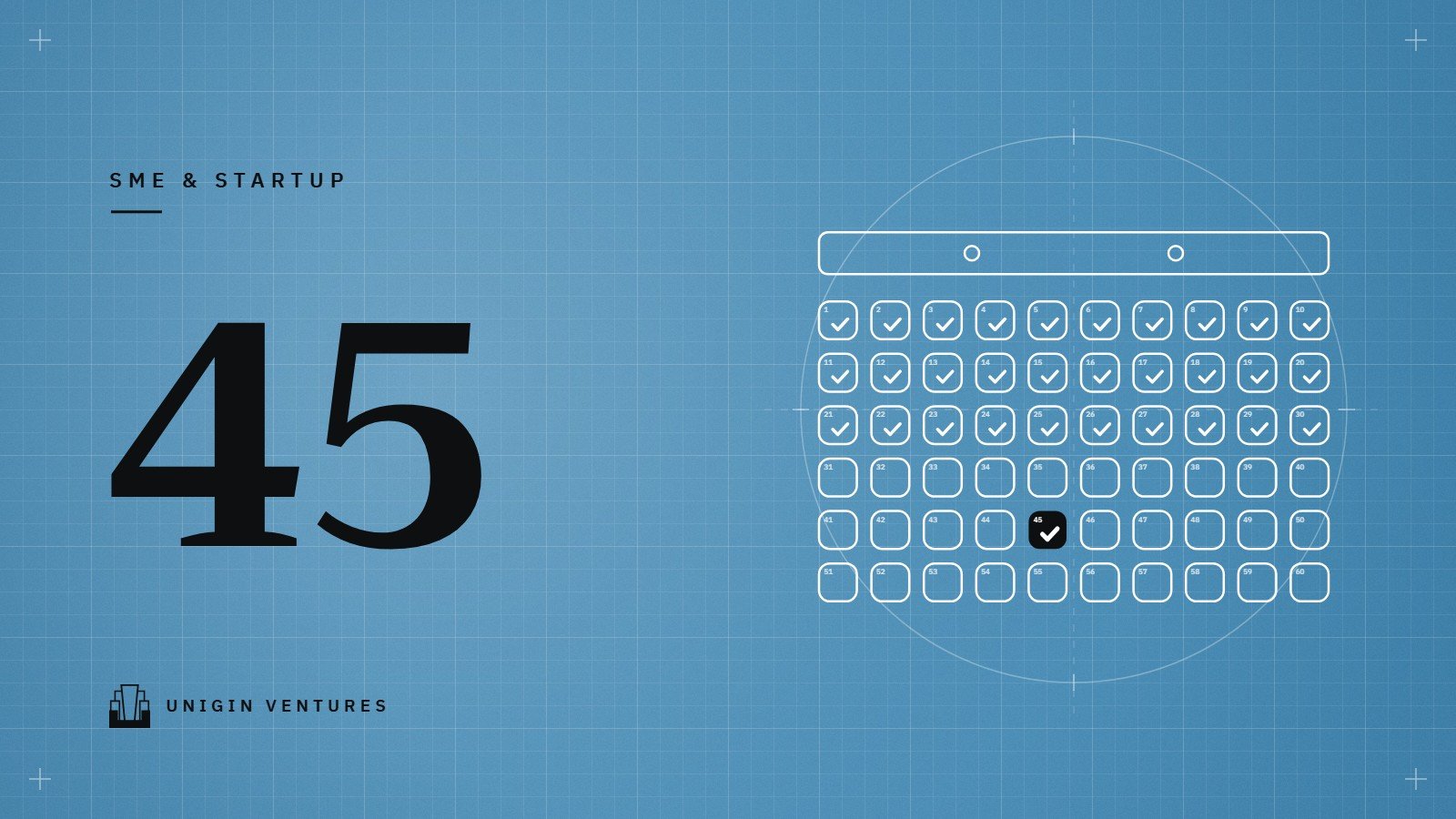
- Maximum credit terms: 30 days for agricultural products and simply processed agricultural products, and 45 days for other goods and services. If a shorter term was already agreed, the shorter term stays. A longer term needs a reasonable business reason, and each case is judged on its facts.
- When the clock starts: when the goods or services have been delivered in full as agreed and complete, correct documents have been submitted. For consignment, it starts when the goods are sold.
- What is treated as unfair: paying late without a reasonable reason, and changing credit terms or other conditions without a reason or without at least 60 days' notice.
This works in both directions. If you are an SME selling to a large company, keep records of delivery dates and document submission, because that is when your credit period starts. If your group is approaching 500 million baht of revenue, check whether your own suppliers are SMEs before asking them for 60 or 90 days.
Do Not Stretch Payments Without Agreement
Paying late without agreement can look like a quick fix, but it is borrowing on the worst terms. The supplier may stop deliveries, move you to cash in advance, or raise prices. A supplier can also claim default interest on overdue amounts under the Civil and Commercial Code, and the contract may set its own late fees. Once one supplier is unhappy, word travels in a small industry.
If you cannot pay on time, call before the due date, explain the reason, and propose a specific date or a partial payment. A supplier who hears early is far more likely to agree than one who has to chase you.
Where to Start
- List your suppliers by annual purchases and note the current terms and your DPO with each. The top five usually make up most of the value.
- Calculate what extra days are worth with each, and the annualized cost of any discount on offer.
- Fix your own payment record before you ask. Pay on the agreed date for two or three months.
- Prepare one offer for each supplier, such as a forecast, a volume commitment or a fixed payment day, and ask for a specific term in return.
- Put the new terms in writing and update your cash forecast so the extra days show up in your plan.
This article is general information, not legal or financial advice for a specific business. Rules are as checked in October 2026. The company and figures in the examples are illustrative.
Sources
- Notification on fair trade practices for credit terms between large businesses and SMEs, Royal Gazette 2 October 2026 — Trade Competition Commission of Thailand
- Thailand Issues New Credit Term Rules for Large Purchasers from SMEs — Tilleke & Gibbins
- Principles of Finance 2e, 19.2 What Is Trade Credit? — OpenStax, Rice University