FX Hedging for Importers and Exporters: When to Use Forwards or Options
Importers and exporters dealing in dollars: measure your exposure and break-even rate, cut it with natural hedges and FCD accounts, then choose between forwards and options, with a worked example.
In this article
An importer that orders goods in dollars, pays in 90 days and has already agreed a baht selling price with its Thai customer loses out the moment the baht weakens in between. The cost in baht rises while the selling price stays put, and the planned profit can disappear. Exporters face the mirror image: when the baht strengthens, the dollars they receive convert into fewer baht.
Hedging is not a bet on where the currency goes. The Bank of Thailand explains that managing exchange rate risk lets a business know the rate at which it can convert, so it can plan its baht income and costs in advance. This article starts with measuring your exposure and finding your break-even rate, covers low-cost ways to reduce the risk, then compares forward contracts with FX options using a worked example.
Measure the Exposure and Find Your Break-Even Rate
Start with one table: months down the side, and the amounts you will receive and pay in each currency across the top. Include only committed items, such as confirmed purchase orders, unpaid invoices and foreign currency loan installments. The difference between receipts and payments in the same currency and month is your net exposure, the amount you need to decide whether to hedge.
Next, work out the exchange rate at which the profit on an order disappears.
Break-even rate (baht per dollar) = agreed selling price in baht ÷ cost of goods in dollars
If today's rate is only a few percent away from the break-even rate, the order carries high risk and should be hedged first. The rate you used to set the selling price, the budget rate, is the benchmark for judging whether your hedging delivered what the plan assumed.
Reduce the Risk Cheaply First
- Natural hedge The Bank of Thailand describes it as managing foreign currency income and expenses so they are in the same currency. It suits businesses with regular foreign currency receipts and payments, such as companies that both import and export. The closer you align the dates of receipts and payments, the less is left to hedge.
- Foreign currency deposit (FCD) account Holds foreign currency to pay future obligations, either bought gradually or kept from foreign currency income. The Bank of Thailand says it suits businesses that do not need the liquidity at the time, and notes the costs of commission in lieu and transfer fees.
- Local currency Price and settle trade in baht or in the trading partner's currency, such as yuan, yen, ringgit or rupiah. The Bank of Thailand says this reduces the impact of exchange rate volatility and the cost of converting currencies.
- Pricing terms Where you have bargaining power, quote customers in baht, or add a clause that adjusts the price when the exchange rate moves beyond an agreed band.
Use the bank's instruments only for what remains after these steps.
Forwards: Lock In the Rate Today
The Bank of Thailand defines a forward contract as an agreement with a commercial bank to buy or sell foreign currency in the future, with delivery on a set date at a rate agreed in advance. It suits businesses that know roughly when they will pay or receive money. There is no upfront fee, but you need a credit line with the bank first.
The forward rate is not the bank's forecast. It is today's spot rate plus forward points, which reflect the interest rate gap between the two currencies. The Bank of Thailand gives this formula:
Forward points = current exchange rate × (baht interest rate − US dollar interest rate) × (days in the transaction ÷ 360)
Forward rate = spot rate + forward points
When baht interest rates are lower than dollar rates, forward points are negative and the forward rate sits below today's rate. An importer buying dollars forward gets a better rate than today. An exporter selling dollars forward gets fewer baht than today, which is the exporter's cost of hedging. When baht rates are higher, the effect reverses.
Before you talk to the bank, check the Bank of Thailand's page of indicative forward points for small businesses. It is published at 10:00 a.m. every business day, split into businesses with revenue of 50–200 million baht a year and more than 200–500 million baht a year. Use it as a benchmark for bank quotes. Your actual price depends on transaction size, your credit standing, how often you trade and the contract tenor.
The trade-off is that a forward is a binding commitment to deliver. If the baht moves in your favor, you do not benefit, and if the actual payment date shifts from the contract date, you must agree with the bank how to handle the contract. Use forwards for amounts and dates you are reasonably sure of.
FX Options: Insurance on the Exchange Rate
The Bank of Thailand describes an option as buying the right to buy or sell foreign currency in the future at a rate, amount and period agreed in advance, much like insurance you can choose whether to claim. If the market rate turns out better than the locked rate, you let the right lapse and convert at the market rate.
- Cost You pay a fee called the option premium, which depends on the rate you want to lock in (the strike rate), the contract term and currency volatility.
- Credit line The Bank of Thailand states that an option does not require a credit line with the bank beforehand.
- Best for Amounts that are not yet certain, such as a tender you are bidding on or an order the customer might cancel, and cases where you want to cap the downside but keep the upside if the currency moves your way. The Bank of Thailand suggests options suit people who understand currencies or can follow the market.
Worked Example: An Importer Paying $100,000 in 90 Days
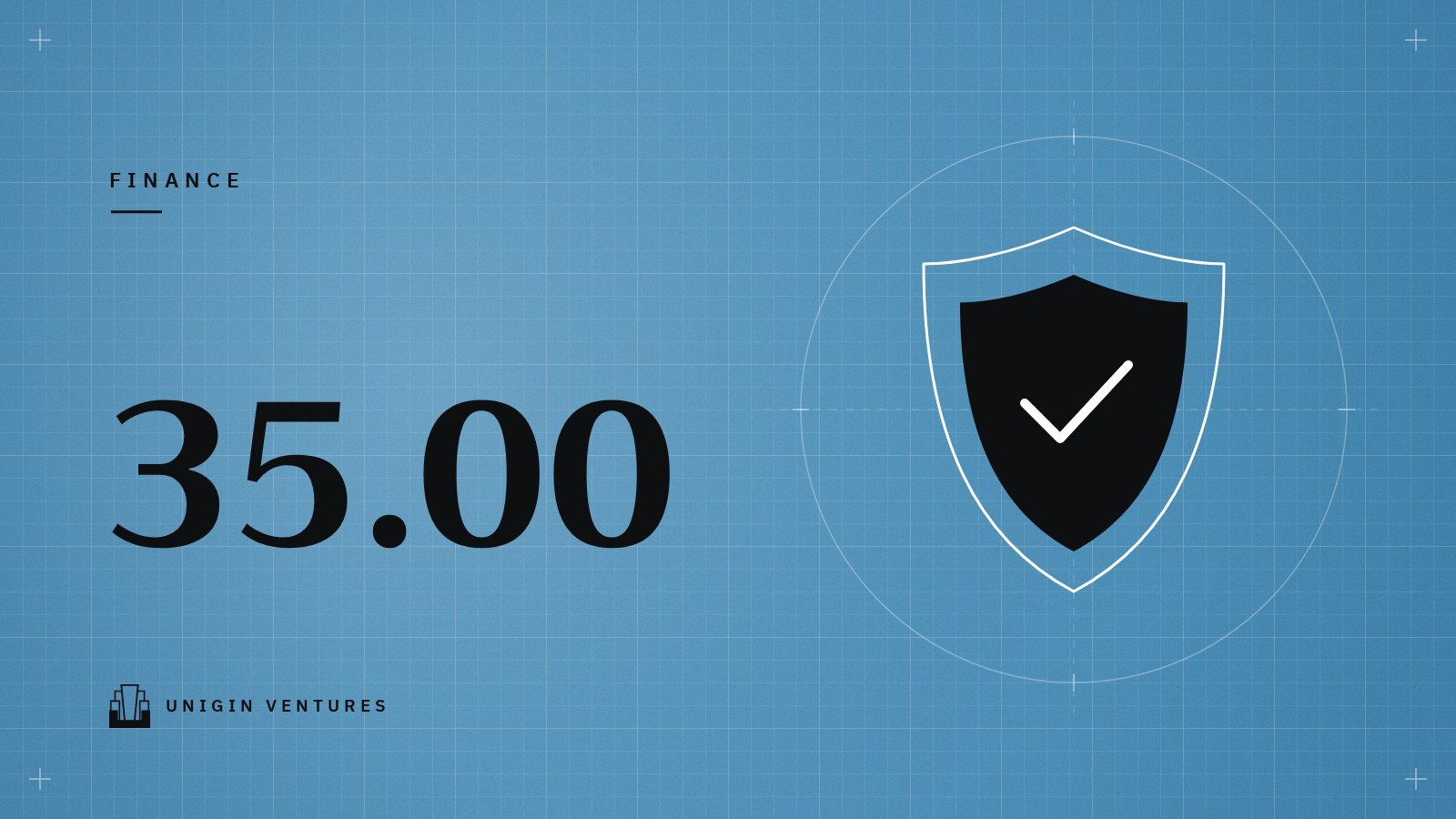
An illustrative example: an importer orders goods worth 100,000 US dollars, payable in 90 days, and has already agreed to sell them to a Thai customer for 3,500,000 baht. Today's rate is 33.00 baht per dollar, so the cost is 3,300,000 baht and the gross profit is 200,000 baht, or 5.7% of sales. The break-even rate is 3,500,000 ÷ 100,000 = 35.00 baht. If the baht weakens by about 6%, the order makes no profit.
Assume baht interest rates are 2.4% a year below dollar rates. Using the Bank of Thailand formula, 90-day forward points are 33.00 × (−2.4%) × 90 ÷ 360 = −0.198, or about −0.20, so the forward rate is 32.80 baht. An option giving the right to buy dollars at 33.00 baht costs an assumed premium of 0.40 baht per dollar, or 40,000 baht, paid when the contract is made.
| Approach | Baht strengthens to 31.00 | Unchanged at 33.00 | Baht weakens to 35.00 |
|---|---|---|---|
| No hedge | 400,000 | 200,000 | 0 |
| Full forward at 32.80 | 220,000 | 220,000 | 220,000 |
| Half forward, half converted on the day | 310,000 | 210,000 | 110,000 |
| Option at 33.00, premium 40,000 baht | 360,000 | 160,000 | 160,000 |
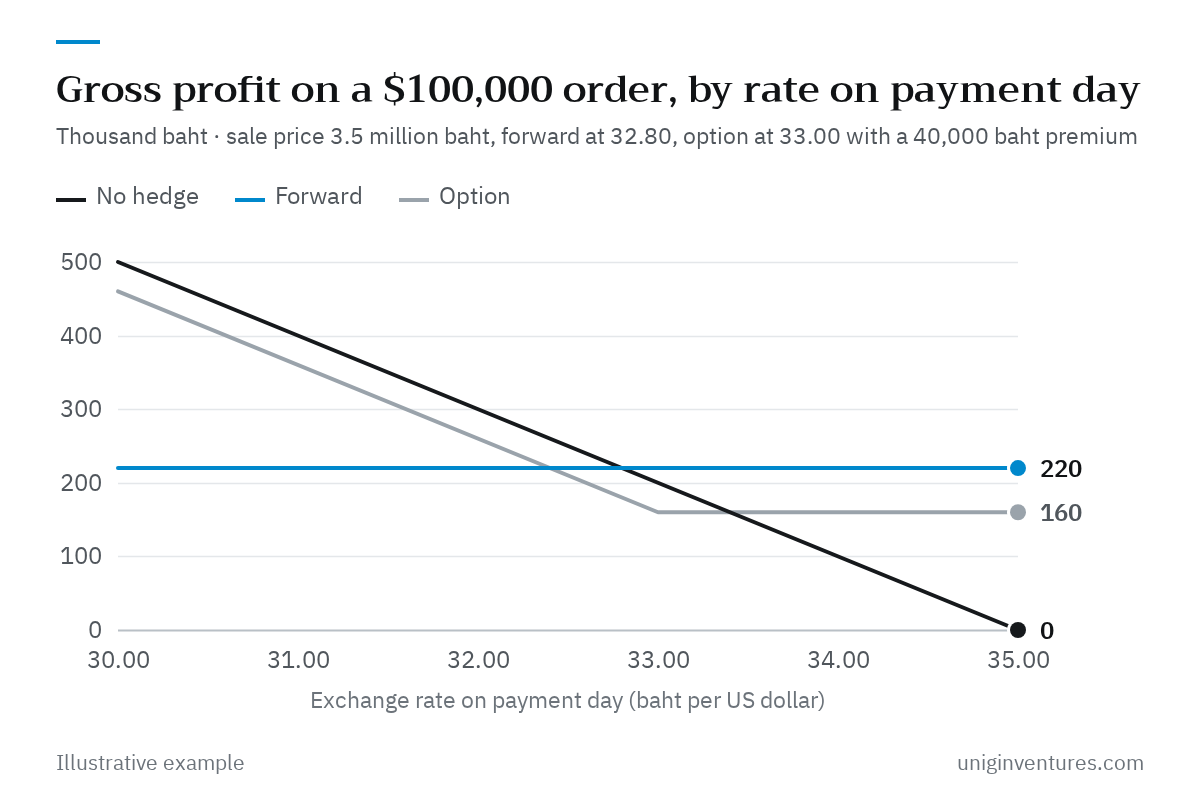
Reading the table, the forward fixes profit at 220,000 baht whichever way the currency moves, but if the baht strengthens to 31.00, the company gives up 180,000 baht compared with not hedging. The option keeps profit at no less than 160,000 baht and still benefits when the baht strengthens, in exchange for a premium that is spent even if the option goes unused. Hedging half with a forward sits in between, with a lowest profit in the table of 110,000 baht.
No approach wins in every case. The deciding questions are how low a profit the company can accept and how certain the amount and payment date are. If both are firm and the margin is thin, a forward fits. If the amount is uncertain or you want to keep the upside, an option fits better.
Set a Policy, Then Start Here
A trap to avoid is hedging only when you feel the currency is about to move against you, which is just another way of guessing the rate. A short, one-page policy agreed in advance keeps decisions from following the mood of the market.
- Build a monthly net exposure table by currency, and update it whenever a new order or invoice arrives.
- Calculate the break-even rate for large orders and set how close today's rate can get to it before an order must be hedged immediately.
- Use natural hedges and FCD accounts first, then hedge only what remains.
- Set the share you hedge by how certain the amount is. For example, use forwards for confirmed items and options or partial hedges for forecasts. Hedge when the selling price is agreed, not when you think the rate looks good.
- Arrange a forward credit line with your bank before you need it, and compare its quotes with the Bank of Thailand's indicative forward points.
- Review every month. Compare the rates you achieved with the budget rate, and record which instrument each item used, so you can refine the policy in the next round.
This article is general information, not a recommendation to buy or sell any financial product. Information on the instruments and the formula was checked against the Bank of Thailand website as of October 2026. The exchange rates, interest rates and premium in the example are assumptions, not market prices or forecasts. Read your bank's terms in full before entering a contract.
Sources
- Foreign exchange risk management — Bank of Thailand (Thai)
- Why manage foreign exchange risk — Bank of Thailand (Thai)
- Forward contracts — Bank of Thailand (Thai)
- Options (currency insurance) — Bank of Thailand (Thai)
- Foreign currency deposit (FCD) accounts — Bank of Thailand (Thai)
- Natural hedge — Bank of Thailand (Thai)
- Local currency settlement — Bank of Thailand (Thai)
- Forward points for small businesses: definition and formula — Bank of Thailand (Thai)
- Indicative outright forward points for small businesses — Bank of Thailand (Thai)