Liquidity Ratios: Current, Quick and Cash Ratios and What Lenders Check
Calculate three liquidity ratios from your own balance sheet, see how a steady current ratio can hide vanishing cash, how a covenant breach reclassifies debt, and how to improve the numbers.
In this article
A company can be profitable every month and still miss payroll if its cash is tied up in receivables and inventory. Liquidity ratios are how banks, investors and auditors ask whether a business has assets that will turn into cash fast enough to pay what falls due within a year. The trouble is that many owners watch only one of them, the current ratio, which can look healthy while the cash runs out.
This article explains three liquidity ratios, how to calculate them from your own balance sheet, an example of a company whose current ratio barely moves while its cash almost disappears, what borrowers need to know about loan covenants, and how to improve the numbers for real.
Three Ratios to Read Together
Current ratio = current assets ÷ current liabilities
Quick ratio = (cash + short-term investments + trade receivables) ÷ current liabilities
Cash ratio = cash and cash equivalents ÷ current liabilities
Working capital = current assets − current liabilities
- The current ratio counts every current asset, including inventory and prepaid expenses, which turn into cash slowly or not at all.
- The quick ratio removes inventory, which must be sold and then collected before it becomes cash. The OpenStax finance textbook counts only cash, short-term investments and receivables, so prepaid expenses are excluded too. The calculation in a Thai SEC consultation document uses current assets minus inventory instead, so results can differ. Ask whoever requests the figure which version they use. This article uses the first.
- The cash ratio is the strictest and counts only cash. A ratio of 1.0 means cash covers all current liabilities, but a figure below 1.0 is not always a problem, because liabilities do not all fall due on the same day.
Whether an item counts as current is set by the Thai Financial Reporting Standard for Non-Publicly Accountable Entities (TFRS for NPAEs), issued by the Federation of Accounting Professions. An asset is current if it is expected to be realized within the normal operating cycle or within 12 months of the reporting date. A liability is current if it is due within 12 months, or if the entity has no unconditional right to defer payment for at least 12 months.
Example: A Steady Current Ratio, Disappearing Cash
An illustrative example. A distributor grows sales every quarter, gives customers longer credit to win orders, and builds inventory ahead of demand. Figures are in thousands of baht.
| Item | Q1 | Q2 | Q3 | Q4 |
|---|---|---|---|---|
| Cash | 2,400 | 1,800 | 1,100 | 600 |
| Trade receivables | 3,100 | 3,400 | 3,800 | 4,200 |
| Inventory | 3,600 | 4,100 | 4,600 | 5,100 |
| Prepaid expenses | 300 | 300 | 300 | 300 |
| Current assets | 9,400 | 9,600 | 9,800 | 10,200 |
| Current liabilities | 4,800 | 4,950 | 5,100 | 5,300 |
| Working capital | 4,600 | 4,650 | 4,700 | 4,900 |
| Current ratio (×) | 1.96 | 1.94 | 1.92 | 1.92 |
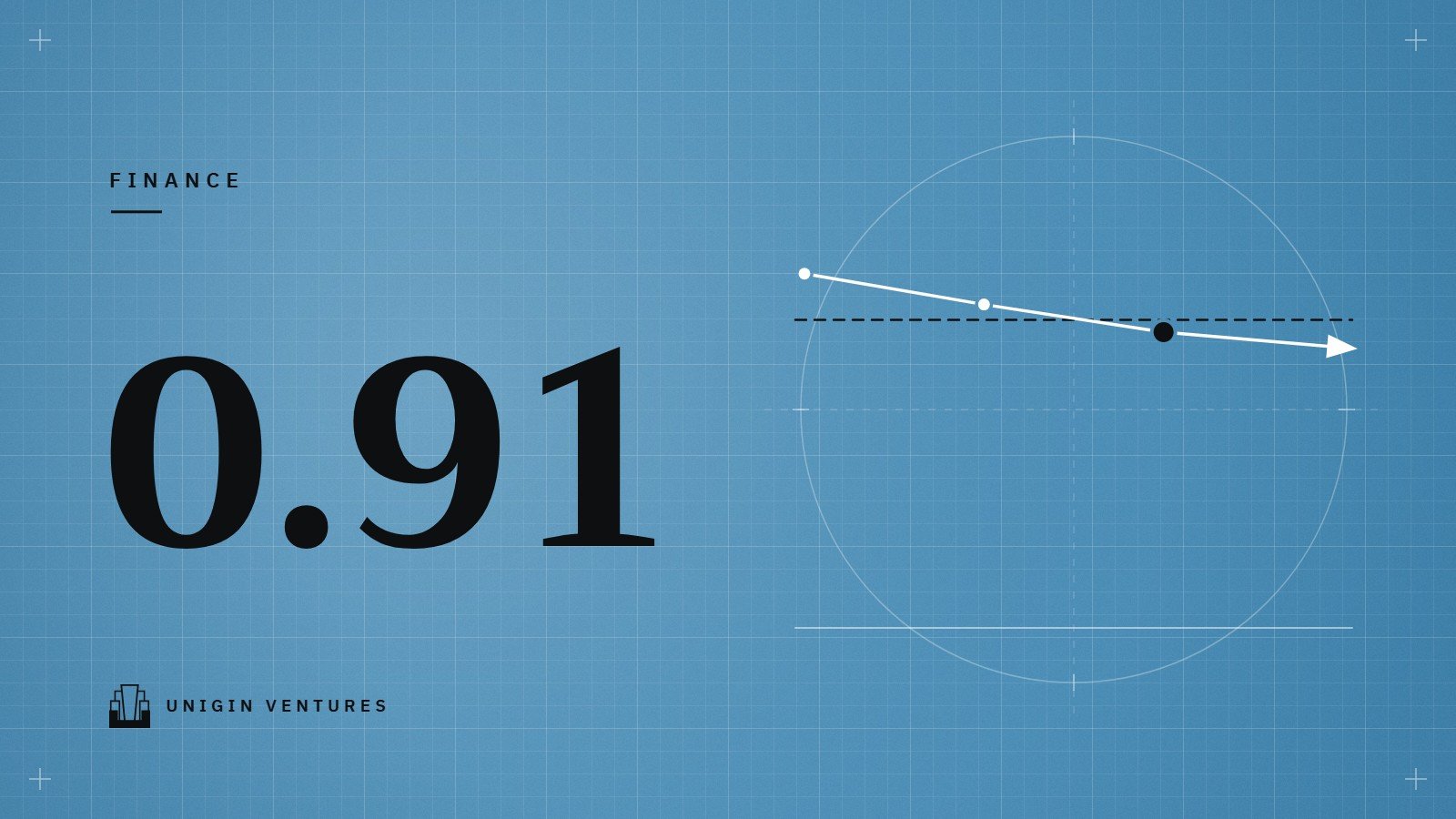
| Quick ratio (×) | 1.15 | 1.05 | 0.96 | 0.91 |
| Cash ratio (×) | 0.50 | 0.36 | 0.22 | 0.11 |
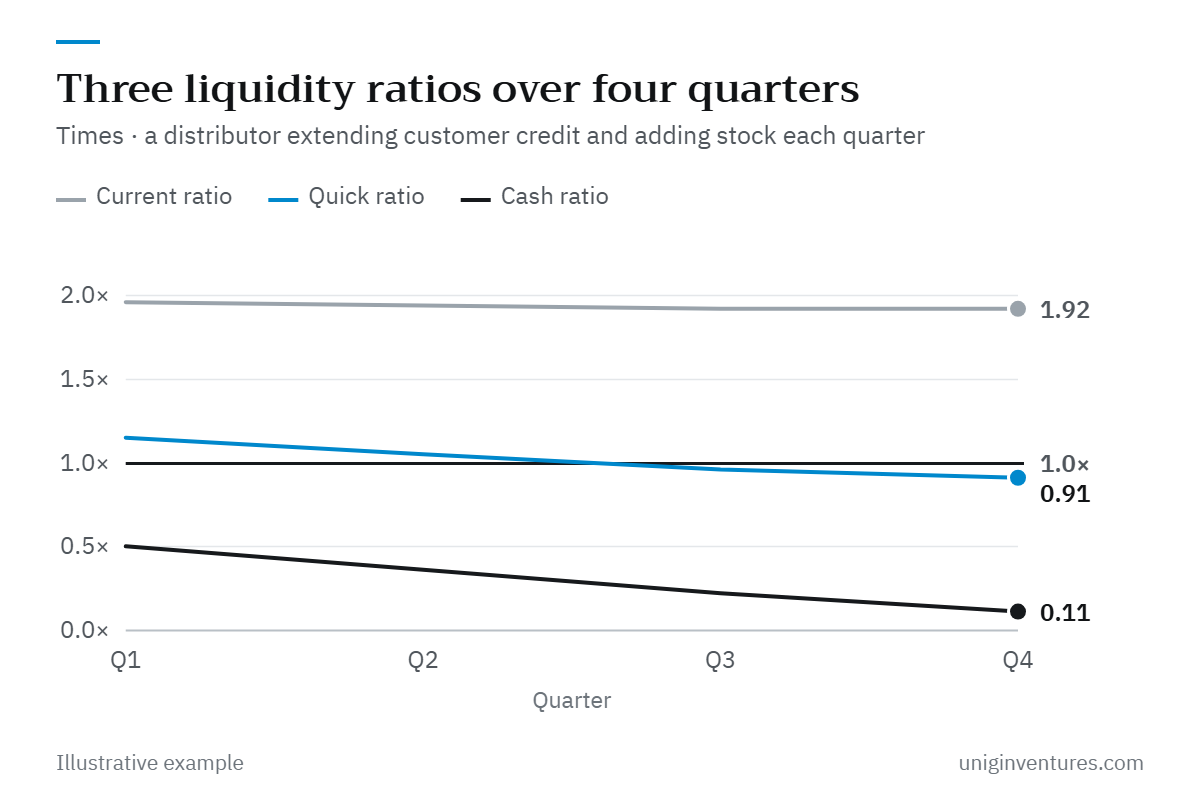
On the current ratio alone, this company looks as solid as before. Working capital even rises from 4,600 to 4,900 thousand baht. But cash drops from 2,400 to 600 thousand baht; the money moved into receivables and stock. The quick ratio falls below 1.0 in Q3, and the cash ratio ends at 0.11. If one large customer pays a month late, the company may have to draw more on its overdraft to pay suppliers.
Using the current-assets-minus-inventory version of the quick ratio, Q4 comes to 0.96 ((10,200 − 5,100) ÷ 5,300). It is higher because it includes prepaid expenses, but the trend is the same.
How Lenders Use These Ratios
Every bank sets its own criteria, but the ratios used to judge debt capacity look similar. One official example is the summary sheet for debt issuers that the Thai SEC proposed in a public consultation: for general businesses, it shows the current ratio alongside the interest coverage ratio and debt-to-equity. For long-term loans, banks tend to put more weight on the debt service coverage ratio (see our DSCR guide).
What borrowers often miss is how a covenant breach hits the financial statements. Under TFRS for NPAEs, if a company breaches a long-term loan covenant on or before the reporting date so that the lender can demand immediate repayment, the loan must be classified as current, even if the lender agrees after the reporting date not to demand payment. It stays non-current only if, by the reporting date, the lender has granted a grace period of at least 12 months.
The effect is severe. In the example above, suppose the company has a 3,000 thousand baht long-term loan and breaches a covenant before the end of Q4. Current liabilities jump to 8,300 thousand baht, the current ratio falls from 1.92 to 1.23, and the quick ratio from 0.91 to 0.58, which may trip covenants on other loans. If you expect a breach, talk to the bank and get a written waiver before the period ends.
Improve the Numbers for Real, Not Cosmetically
- Collect receivables faster. Chase by age, offer early-payment discounts, and stop extending credit to customers who pay late. Collected receivables turn straight into cash (see aged receivables and bad debts).
- Cut slow-moving stock. Rank items by value and sales speed, set reorder points, and clear excess (see ABC inventory and reorder points).
- Match funding to use. Do not pay for machinery or new branches with short-term loans or an overdraft; the debt falls due before the asset earns its cash back (see overdraft or short-term loan).
- Negotiate supplier terms. Longer terms keep cash in the business longer (see negotiating supplier payment terms).
Watch out for period-end window dressing. When the current ratio is above 1.0, using cash to pay suppliers just before the close raises the ratio immediately. In Q4, paying 500 thousand baht of payables leaves current assets of 9,700 and current liabilities of 4,800, so the current ratio rises to 2.02, but cash is down to 100 thousand baht. Banks and investors who follow monthly trends will notice.
Where to Start
- Calculate the current, quick and cash ratios at every month-end for at least the past 12 months, and read the three trends together.
- Open every loan agreement. Note each financial covenant, the formula the agreement uses, and the reporting cycle, then set your own warning level above the covenant.
- If the quick ratio keeps falling, find out whether the cash is stuck in receivables or inventory, and fix the cause.
- Build a cash forecast to see which week gets tight. Ratios are a snapshot of one day; a forecast tells you when (see the 13-week cash flow forecast).
This article is general information, not financial or accounting advice for any specific business. Standards and references were checked in October 2026. The company and figures above are illustrative. Actual thresholds depend on each bank's loan agreement.
Sources
- TFRS for Non-Publicly Accountable Entities (revised 2022, Thai) — Federation of Accounting Professions
- Consultation 15/2566 attachment: financial ratios in the debt issuer summary sheet (Thai) — Securities and Exchange Commission, Thailand
- Key financial ratio calculation methods, consultation 45/2568 (Thai) — Securities and Exchange Commission, Thailand
- Liquidity Ratios, Principles of Finance — OpenStax, Rice University
- Current Ratio and Working Capital, Principles of Financial Accounting — OpenStax, Rice University