The Cost of Capital, Simply Explained: WACC for SMEs as a Hurdle Rate
Loans charge interest and owners' money has a cost too. How to find the after-tax cost of debt under Thai SME tax rates, estimate the cost of equity, combine them into WACC and screen projects.
In this article
Every baht a business uses comes from somewhere: a bank loan, money from the owners, or profit kept in the company. None of it is free. Loans charge interest. Owners' money is not free either: whoever puts it in expects a return that makes the risk worthwhile. The cost of capital is the average return a business must earn on its money to satisfy everyone who provided it.
Knowing this number changes how you judge investments. A project can show an accounting profit and still leave the owners worse off, if it earns less than the money costs. This article explains the cost of debt after tax, the cost of equity, how to combine them into one figure, and how to use it to screen projects.
The Cost of Debt Is Lower After Tax
The starting point is the interest rate on the loan, plus any front-end fees, which raise the effective rate. But interest on money borrowed for the business is a deductible expense, so it reduces the company's taxable profit. The real cost is therefore lower than the stated rate:
After-tax cost of debt = interest rate × (1 − tax rate)
The general Thai corporate income tax rate is 20% of net profit. Companies with paid-up capital of no more than 5 million baht and revenue from sales and services of no more than 30 million baht in the accounting period pay lower rates: net profit up to 300,000 baht is exempt, profit from 300,001 to 3 million baht is taxed at 15%, and profit above 3 million baht at 20%.
Use the rate that applies to the last baht of profit, because that is where the interest deduction saves tax:
| Situation | Tax rate on the last baht of profit | After-tax cost |
|---|---|---|
| General company, or SME with profit above 3 million baht | 20% | 7% × 0.80 = 5.6% |
| SME with profit between 300,001 and 3 million baht | 15% | 7% × 0.85 = 5.95% |
| Company with no taxable profit | 0% | 7% |
The last row matters for startups. A loss-making company gets no tax saving from interest this year, so its debt costs the full rate.
Equity Costs More Than Debt
The cost of equity is the return the owners or investors expect from putting money into the business. It is higher than the cost of debt for two reasons. First, shareholders are paid last: lenders get interest whether or not there is profit, while shareholders get what is left. Second, dividends are paid out of profit after tax, so they bring no tax saving. Under Section 65 ter of the Revenue Code, a company cannot even deduct interest it calculates on its own capital.
No bank statement shows the cost of equity, so it has to be estimated. Large listed companies often use market-based models. For a small company, a practical question for the owner is: what return could I earn on this money in another investment with similar risk? A private SME is usually riskier and harder to sell than a listed share or a bank deposit, so the required return should be clearly higher. In this article we use 18% as an illustrative example only; it is not a market benchmark.
Money the company keeps from past profits also has a cost of equity. It belongs to the shareholders, who could have taken it as dividends and invested it elsewhere.
Combine Them: The Weighted Average Cost of Capital
Most businesses use both debt and equity. The weighted average cost of capital (WACC) weights each cost by its share of total funding:
WACC = (debt share × after-tax cost of debt) + (equity share × cost of equity)
Illustrative example
- Total funding 10 million baht: a 4 million baht bank loan at 7% and 6 million baht of owners' equity
- The company's profit is above 3 million baht, so the tax rate on the last baht is 20%
- The owners require 18% on their money
| Source | Amount (million baht) | Share | Cost | Weighted cost |
|---|---|---|---|---|
| Bank loan | 4 | 40% | 5.6% after tax | 2.24% |
| Owners' equity | 6 | 60% | 18% | 10.80% |
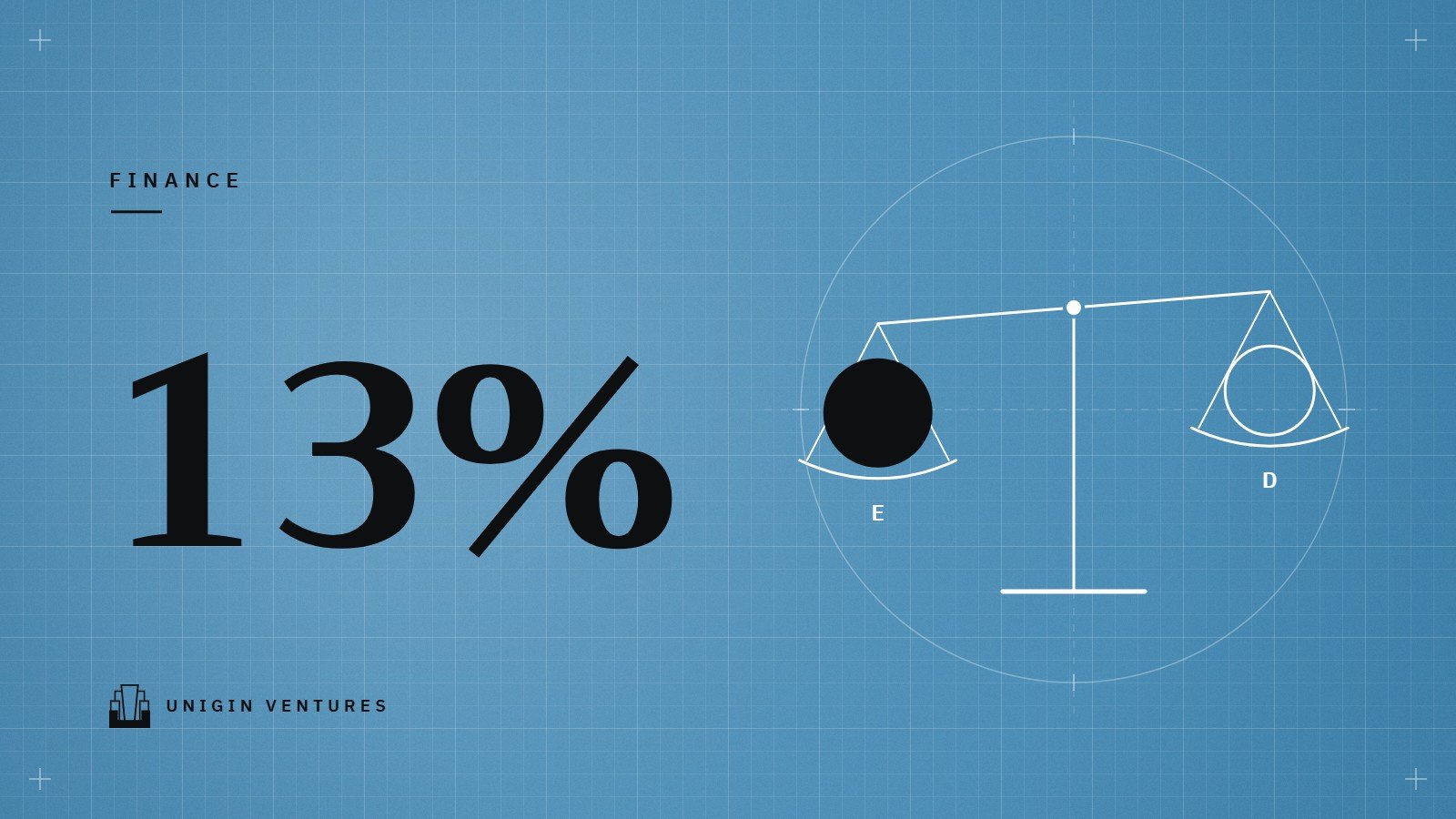
| Total | 10 | 100% | 13.04% |
So this company must earn about 13% a year on the money tied up in the business to pay the lender and give the owners the return they want. Use market values or realistic amounts where you can. Equity recorded in the books at its original amount can understate what the owners' stake is now worth.
Use It as a Hurdle Rate for Projects
The most practical use of the cost of capital is as a hurdle rate: the minimum expected return a new investment must clear. A project that earns less than 13% in our example may still show a profit in the accounts, but it earns less than the money costs, so it lowers the value of the owners' stake.
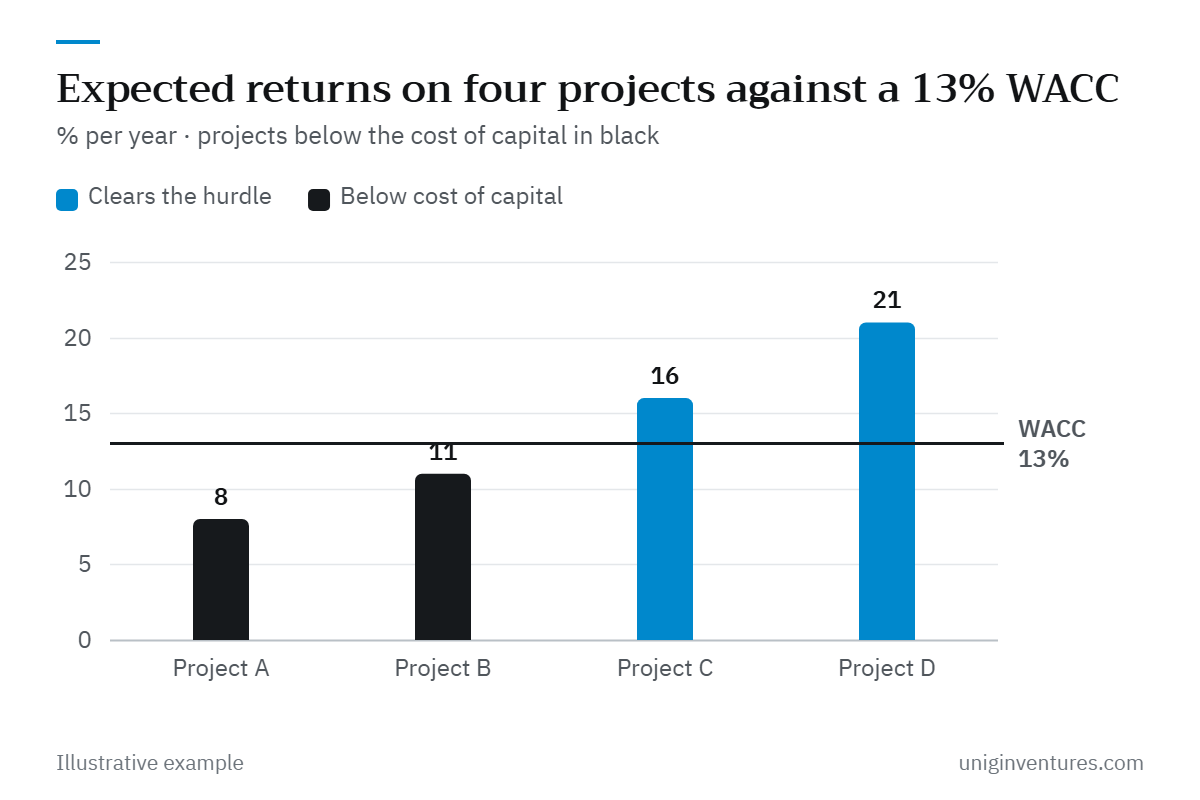
Two adjustments make the hurdle rate more useful:
- Raise the hurdle for riskier projects. WACC reflects the risk of the business as it is today. Replacing an old machine with a similar one fits that risk. Entering a new market or launching an unproven product is riskier and should clear a higher rate.
- Compare like with like. Use the same basis for the project's return and the hurdle: cash flows after tax against a WACC built from after-tax costs.
Common Mistakes
- Using the loan rate as the hurdle. "The bank charges 7%, so any project above 7% is fine" ignores the owners' required return. If the project is partly funded by equity, the hurdle is the weighted cost, not the loan rate.
- Treating owners' money as free. Profit kept in the company and money the founder put in both have an opportunity cost, even if no one sends an invoice for it.
- Assuming more debt always lowers the cost. Debt looks cheaper, but each extra loan adds fixed payments and raises the risk for both lenders and owners. Banks charge more, ask for more collateral, or refuse, and owners should demand a higher return. Check your debt service coverage before borrowing more (see the DSCR guide).
- Forgetting fees and guarantees. Front-end fees, guarantee fees and a personal guarantee from the owner are all part of the real cost of a loan.
- Applying startup thinking to an SME, or the reverse. Venture investors in an early-stage startup expect far higher returns than the owners of a stable business, because most early-stage investments fail. Choosing between a loan and selling shares is a separate decision (see venture debt or equity).
Where to Start
- List every source of funding on the balance sheet: each loan with its rate and fees, owners' capital and retained earnings.
- Work out the after-tax cost of each loan using the tax rate on your last baht of profit.
- Agree a required return on equity with the owners or the board, write down the reasoning, and review it once a year.
- Calculate WACC with a table like the one above, and round it to a simple hurdle rate the team will remember.
- Require every investment proposal above a set size to show its expected return against the hurdle, with a higher hurdle for riskier projects.
This article is general information, not tax or investment advice for a specific business. Tax rates are as of October 2026; check the latest Revenue Department announcements. The returns, rates and projects in the examples are illustrative.