Lease or Buy: Compare the Real Cost of Equipment and Vehicles
Cash, loan, hire purchase or lease? Compare them by the present value of after-tax cash flows, with Thai depreciation rules, car caps, VAT and a worked 2-million-baht example.
In this article
When the business needs a new machine or another vehicle, the first question is how to pay for it: buy outright, borrow to buy, sign a hire purchase contract, or lease. Each seller tends to compare options by monthly payment alone. That number does not tell you which option is cheaper, because it leaves out tax savings, maintenance, resale value at the end, and when the cash actually leaves the company.
This article sets out the real options, explains the Thai tax and accounting rules that make them differ, and compares them the only fair way: the present value of after-tax cash flows. A worked example for a 2-million-baht machine shows every line of the calculation.
There Are Four Real Options
| Option | Ownership | Cash on day one | Who bears resale risk |
|---|---|---|---|
| Buy with cash | Company owns it immediately | Full price | Company |
| Bank loan to buy | Company owns it immediately (often pledged or mortgaged as collateral) | Down payment set by the bank | Company |
| Hire purchase | Transfers when the last installment is paid | Down payment | Company |
| Operating lease or long-term rental | Never transfers; the asset goes back at the end | First rental or deposit | Lessor |
The first three are the same deal underneath. The company owns the asset and carries its benefits and risks; only the source of money differs. The fourth is genuinely different. The lessor bears the risk of what the asset is worth when the contract ends, and many contracts bundle maintenance or insurance into the rent.
In Thailand, "leasing" covers several kinds of contract. Some include an option to buy the asset for a very low price at the end, which for accounting purposes looks more like a purchase than a rental. Read the terms, not the label.
How the Accounts Treat a Lease
Most Thai SMEs report under TFRS for NPAEs (revised 2022). Chapter 14 splits leases into two types:
- Finance lease: a lease that transfers substantially all the risks and rewards of ownership to the lessee (paragraph 14.2). Indicators in paragraph 14.23 include ownership passing at the end, as in a hire purchase contract; a purchase option at roughly 5% or less of fair value; a lease term covering roughly 80% or more of the asset's economic life; or minimum lease payments with a present value of roughly 90% or more of fair value.
- Operating lease: any lease that is not a finance lease (paragraph 14.3).
The two look very different in the statements. A finance lease goes on the balance sheet as an asset and a liability from day one, at the lower of the asset's fair value and the present value of minimum lease payments (paragraph 14.30). Each payment splits into interest and principal (paragraph 14.32), and the asset is depreciated like one the company bought (paragraph 14.34). An operating lease is expensed on a straight-line basis, excluding service costs such as insurance and maintenance (paragraph 14.38), with future minimum payments disclosed in the notes (paragraph 14.39).
In practice, hire purchase adds liabilities to the balance sheet just like a loan. If your bank loans carry covenants, such as a maximum debt-to-equity ratio, check the effect before you sign. An operating lease adds no liability under TFRS for NPAEs, but a bank that reads the notes will still see the rent you have committed to.
The Tax Rules That Change the Answer
Buying or hire purchase: deductions come through depreciation
- Maximum rate: machinery, vehicles and other depreciable assets can be depreciated for tax at up to 20% of cost per year (Royal Decree No. 145, Section 4).
- SME initial allowance: a company with fixed assets, excluding land, of no more than 200 million baht and no more than 200 employees can deduct 40% of the cost of machinery on the day it acquires it, then depreciate the rest normally (Section 4 sexies). That brings tax savings forward.
- Hire purchase: the cost is the total amount payable, but depreciation in each accounting period cannot exceed the installments due in that period (Section 7). The tax benefit never runs ahead of the cash you pay.
- Loan interest paid for the business is deductible in the normal way.
Leasing: rent is deducted as an expense
Rent for machinery used in the business is deductible as paid. The key difference comes at the end: the company has nothing left to sell, so it gets no resale proceeds and pays no tax on a gain from selling.
Passenger cars have their own caps
Passenger cars and vans with no more than 10 seats follow separate rules that change the comparison:
- Bought or on hire purchase: depreciation only on the first 1,000,000 baht of cost per car (Royal Decree No. 145, Section 5).
- Rented: rent is deductible up to 36,000 baht per car per month, or 1,200 baht per day for daily rentals; the excess is not deductible (Royal Decree No. 315, Section 4(2)).
- VAT on buying, hire-purchasing or renting these cars is non-creditable input tax and cannot be offset against output tax (Director-General's Notification on VAT No. 42, clause 2(1)). That VAT becomes a real cost. Exceptions apply to businesses that sell cars or rent out their own cars.
As an illustrative example, if you rent a passenger car for 45,000 baht a month, the 9,000 baht above the cap, or 108,000 baht a year, is not deductible. If you buy a car for 1,500,000 baht, the 500,000 baht above the cap is not depreciable either. When you compare options for a passenger car, put only the deductible portion of each into the model, not the full expense.
For machinery used in a VAT-registered business, input VAT is creditable as usual, so the example below uses prices before VAT.
The Method: Present Value of After-Tax Cash Flows
A fair comparison answers one question: counting every baht in and out over the asset's life, after tax savings, and translated into today's money, which option costs less? You can do it in a spreadsheet in five steps.
- Lay out each option's cash flows by year, from year 0 (the start) to the end of the asset's use.
- Add tax savings: deductible expense × corporate income tax rate, for depreciation, rent, maintenance and interest.
- Add resale proceeds at the end, minus tax on any gain.
- Discount at the company's after-tax borrowing rate, because a lease commitment carries risk close to that of a loan.
- The option with the lower present value of cost is cheaper. Then weigh the factors that are not about money.
After-tax discount rate = borrowing rate × (1 − corporate income tax rate)
Present value = cash flow in year n ÷ (1 + discount rate) to the power of n
For the "borrow to buy" option, do not add the loan payments. Discounting at the after-tax interest rate already accounts for the cost of the money used to buy. Including the payments and discounting again would count it twice.
Worked Example: A 2-Million-Baht Machine, Buy or Lease for Five Years
In this illustrative example, a manufacturer needs a machine priced at 2,000,000 baht before VAT and plans to use it for five years. The assumptions:
- Buy: pay 2,000,000 baht on day one, spend 60,000 baht a year on maintenance, depreciate 20% a year for tax (400,000 baht), and sell it for 300,000 baht after five years.
- Operating lease: five-year contract, 500,000 baht a year paid at the start of each year, maintenance included; the machine goes back at the end.
- The company pays corporate income tax at 20%, the standard rate (an SME that qualifies for the reduced tiered rates should use its own rate), and the tax effect lands at year-end. It borrows at 6%, so the after-tax discount rate is 6% × (1 − 20%) = 4.8%.
To keep the numbers readable, the example ignores the SME initial allowance and the small residual value that must be left on the tax books; both have little effect.
| Year | Buy | Lease |
|---|---|---|
| 0 | −2,000,000 | −500,000 |
| 1–4 (each) | 32,000 | −400,000 |
| 5 | 272,000 | 100,000 |
| Total, undiscounted | −1,600,000 | −2,000,000 |
| Present value at 4.8% | −1,670,840 | −1,845,891 |
Where the numbers come from: in years 1–4, buying costs 60,000 baht of maintenance but saves 12,000 baht of tax on that maintenance and 80,000 baht on depreciation, so the net cash flow is a positive 32,000 baht. In year 5, the sale adds 300,000 baht, less 60,000 baht of tax on the gain, leaving 240,000 baht. Leasing costs 500,000 baht at the start of each year and returns 100,000 baht of tax at each year-end.
Buying comes out about 175,000 baht cheaper in present value. But the answer depends heavily on two assumptions.
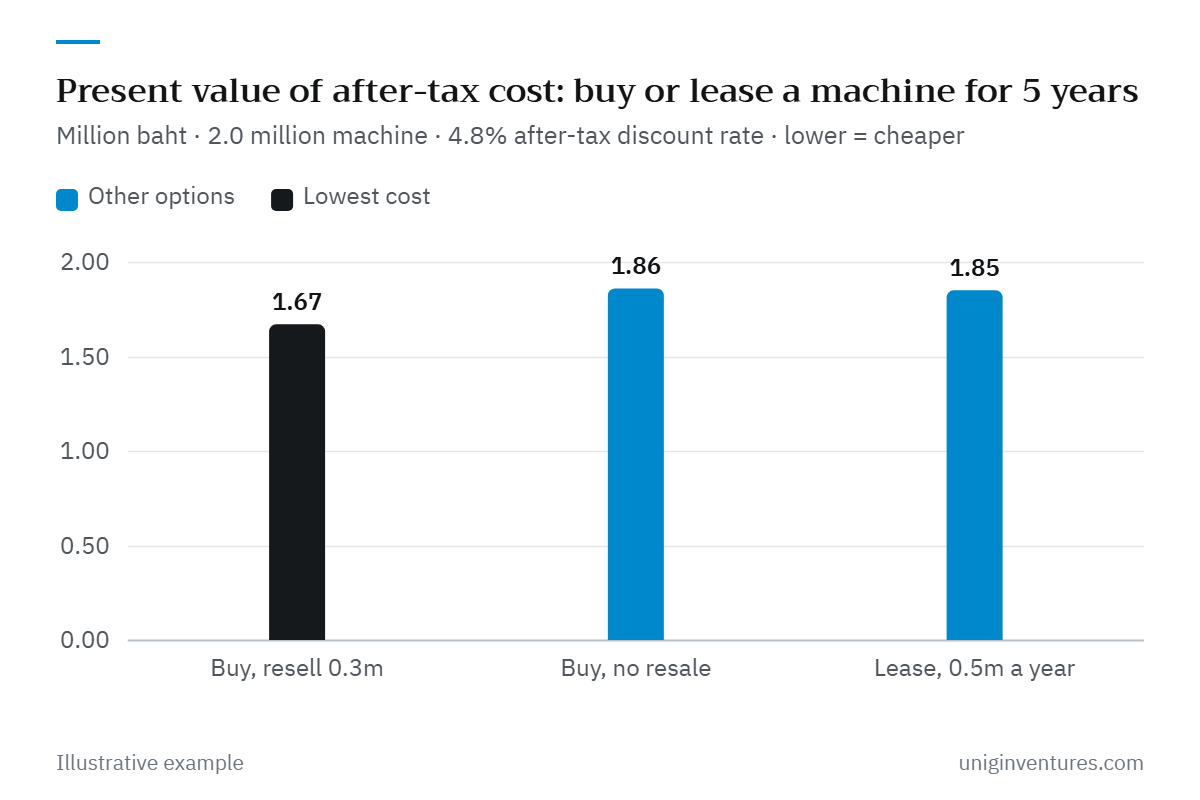
- Resale value: if the machine sells for nothing after five years, the cost of buying rises to 1,860,687 baht, slightly more than leasing. The two options break even at a resale value of about 23,000 baht. For equipment that dates quickly, such as technology replaced every two or three years, be conservative.
- Rent: the annual rent at which both options cost the same is about 452,000 baht. Use that figure as your ceiling when you negotiate with the lessor.
What the Numbers Leave Out
- Cash on day one: buying takes 2,000,000 baht at once; leasing takes 500,000 baht. If cash is tight, or the money can earn more in the core business than your borrowing rate, leasing may be worth more than the model shows.
- Flexibility: most leases cannot be cancelled early, or carry penalties. Read the termination terms, damages and return conditions before you sign.
- Obsolescence risk: leasing shifts this risk to the lessor, who has already priced it into the rent.
- Upkeep: a contract that includes maintenance takes work off a small team, but check the service level, such as how many days a repair takes.
- Bank capacity: hire purchase and loans add liabilities to the balance sheet, which may limit future credit lines.
Where to Start
- Get quotes for every option at the same time: cash price, hire purchase terms and lease terms, showing payment amounts, number of payments and what the rent includes.
- Ask your accountant how the lease will be classified under paragraph 14.23, and whether it affects the ratios your bank uses.
- Check the tax rules for the specific asset: for a passenger car, the 1,000,000-baht cost cap, the 36,000-baht monthly rent cap and the non-creditable VAT; for machinery, whether the company qualifies for the SME initial allowance.
- Build the after-tax cash flow table as in the example, then change resale value and rent to see where the answer flips.
- Use the break-even points to negotiate: if the rent is above break-even, push it down or buy. If resale value is highly uncertain, leasing is how you buy that certainty.
This article is general information, not accounting or tax advice for a specific case. Laws and standards are as of October 2026.
Sources
- TFRS for NPAEs (revised 2022), Chapter 14 Leases — Federation of Accounting Professions
- Royal Decree No. 145 (1984) on depreciation of assets — Revenue Department
- Royal Decree No. 315 (1997) on passenger car expenses — Revenue Department
- Director-General's Notification on VAT No. 42, input tax on passenger cars — Revenue Department
- Corporate income tax guide for SMEs (tax rates) — Revenue Department