Factoring for SMEs: Turn Invoices Into Cash and Know the Real Cost
Customers pay in 60 to 90 days, but your bills can't wait. How factoring works, recourse versus non-recourse, converting fees into an annual rate, and what to check before you assign invoices.
In this article
You delivered the goods and sent the invoice, but the customer pays in 60 or 90 days. Meanwhile, payroll, raw materials and rent are due on schedule. The faster sales grow, the more cash sits in receivables. That is why many Thai SMEs show a profit on paper while the bank balance runs short.
Factoring turns invoices that are not yet due into cash today. This article explains how factoring works, the structural choices you need to make, how to convert the cost into an annual rate you can compare with a loan, the legal points to check before you sign, and the cases where factoring is the wrong tool.
How factoring works
There are three parties: the seller (your company), the buyer (the customer who owes you), and the factor, which may be a bank, a state-owned financial institution, or a company that specializes in factoring. A typical transaction runs like this:
- You deliver goods or services and issue an invoice as usual.
- You assign your right to collect that invoice to the factor and notify the customer to pay into the factor's account.
- The factor advances you part of the invoice value and holds the rest as a reserve.
- When the customer pays in full, the factor deducts its fees and interest and returns the remaining reserve to you.
The key difference from an ordinary loan is that the factor looks mainly at the creditworthiness of your customer, not only at your financial statements or collateral. A young company that sells to financially strong customers may get a facility that a normal loan would not offer, and the facility grows with sales: the more you invoice, the more you can draw.
Choices to make before you sign
Product names differ from one provider to the next, but only a few terms drive your cost and risk. Get a clear answer on each.
With or without recourse
With recourse, if the customer does not pay, the factor can claim the money back from you, so the risk of customer default stays with you. Without recourse, the factor takes on that risk under the terms of the contract. Fees are usually higher, and coverage is often limited to the customer's inability to pay. It typically excludes cases where the customer refuses to pay because of a dispute over the goods. Read the definitions carefully.
This choice also affects your financial statements. If the risk stays with you, your auditor may require you to record the transaction as a loan secured by receivables rather than a sale of receivables, which increases the liabilities on your balance sheet. Talk to your auditor first, especially if other loan agreements set debt ratio limits.
Notified or confidential
Standard factoring requires notifying your customer to pay the factor. Some owners worry the customer will read this as a sign of cash trouble. Explaining up front that it is routine working capital management helps avoid misunderstanding. Confidential arrangements exist, but the factor takes more risk, so they are usually reserved for companies with a strong track record.
Selective or whole-ledger
Some contracts let you choose which invoices to submit. Others require you to assign all receivables from named customers. Selective factoring is more flexible but usually costs more per invoice. Whole-ledger factoring is cheaper per invoice, but you pay fees even in months when you don't need the cash.
Factoring started by your customer
Some large buyers run supply chain finance programs, also called reverse factoring, with a bank. Suppliers can receive early payment once the buyer approves the invoice. The cost is often lower because it is priced on the buyer's credit. If a major customer runs such a program, ask its procurement or accounts payable team before you shop elsewhere.
Convert the cost into an annual rate
Factoring costs usually have two parts: a fee charged as a percentage of the invoice value, and interest charged on the advance for the number of days until the customer pays. You cannot compare the quoted numbers directly with a loan rate. Convert them into an annual rate first.
Total cost = fee + (advance × annual interest rate × days ÷ 365)
Effective annual cost = total cost ÷ advance × 365 ÷ days
Illustrative example: a company issues a 1,000,000 baht invoice. The factor advances 80%, charges a fee of 0.5% of the invoice, plus 7% annual interest on the advance. The customer pays in 60 days.
| Item | Baht |
|---|---|
| Invoice value | 1,000,000 |
| Advance received (80%) | 800,000 |
| Fee (0.5% of invoice) | 5,000 |
| Interest at 7% a year for 60 days (800,000 × 7% × 60 ÷ 365) | 9,205 |
| Total cost | 14,205 |
| Reserve returned when the customer pays (200,000 − 14,205) | 185,795 |
The effective annual cost is 14,205 ÷ 800,000 × 365 ÷ 60 ≈ 10.8%, not the 7% shown on the quote. The gap comes from the flat fee, which you pay regardless of how many days you use the money. The faster the customer pays, the higher that fee becomes as an annual rate.
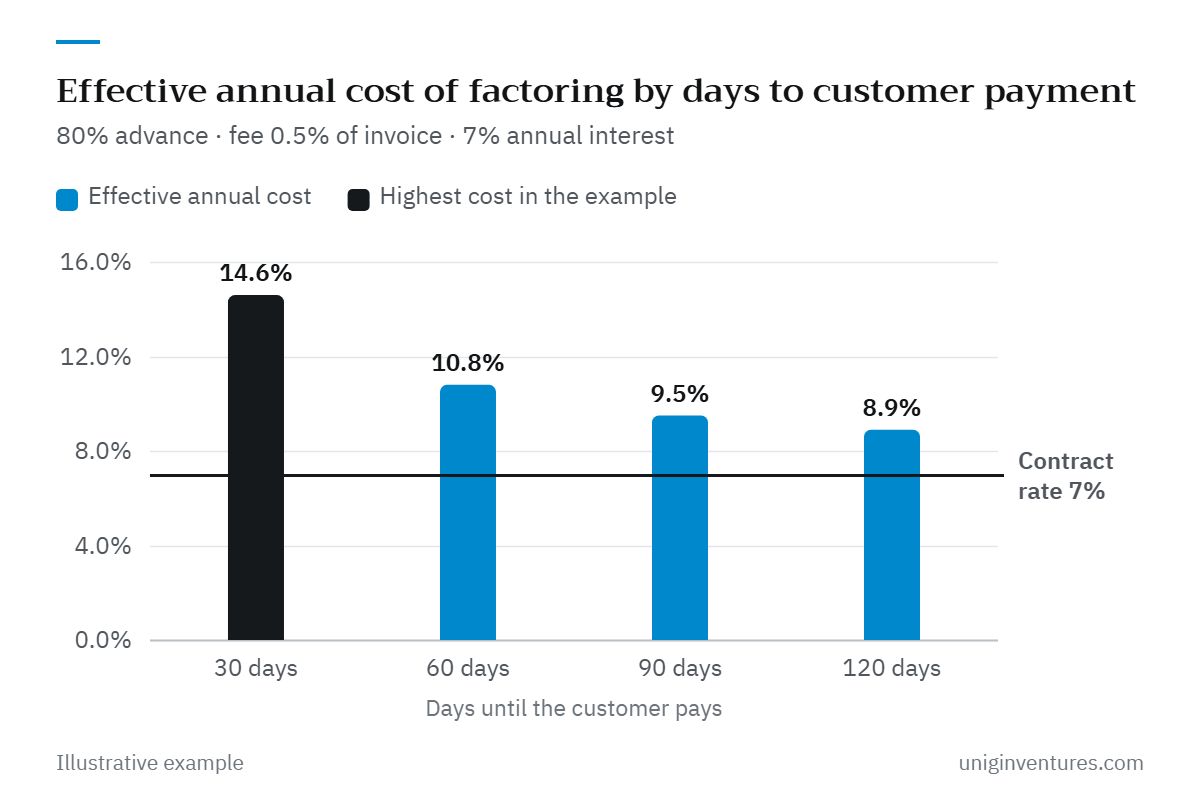
These figures exclude other charges that may apply, such as facility setup fees, customer credit checks, monthly minimum fees, and any tax added to the fees. Ask the provider for a full cost schedule on one sample invoice, then run it through the formula above before you decide.
The other side of the scale is what the earlier cash lets you do. If it lets you accept extra orders whose contribution margin exceeds this cost, or capture early-payment discounts from suppliers, 10.8% a year may be worth it. If the money keeps covering operating losses, factoring only postpones the problem.
Legal and documentation points
The assignment must be in writing
Factoring in Thailand relies on the assignment of claims under the Civil and Commercial Code. Section 306 states that assigning a debt payable to a specific creditor must be done in writing. The assignment can be enforced against the debtor or third parties only after the debtor has been notified or has consented, and that notice or consent must also be in writing. In practice, factors usually ask the customer to sign an acknowledgment of the assignment.
Check your sales contract first
Section 303 makes claims assignable unless the nature of the right does not allow it or the parties have agreed otherwise. Many large companies' purchase contracts prohibit assigning payment rights without consent. Assigning anyway could put you in breach of contract with a key customer. Check this clause before you submit any customer's invoices.
One invoice, one financing
One reason factors hesitate to lend to small SMEs is double financing: using the same invoice to raise money from several providers. In 2021 the Bank of Thailand opened a central database for digital factoring that stores key invoice data and helps detect duplicate financing requests. Providers that use it can see whether an invoice has already been financed. Make sure your invoices carry unique numbers, match delivery notes and leave an audit trail.
A close alternative: receivables as business collateral
If you don't want to assign invoices one by one, the Business Security Act B.E. 2558 (2015) allows claims such as trade receivables to secure a loan without handing them over. The secured creditor must be a financial institution or another party specified by law, which includes companies whose business is factoring, and the agreement must be registered with the Department of Business Development. This works as a revolving loan backed by receivables, and you keep collecting from customers as usual.
When to use factoring, and when not to
Factoring fits when you:
- Sell to financially strong business customers on long terms of 60–120 days.
- Are growing faster than your working capital.
- Have seasonal sales and need cash in waves rather than a fixed loan.
- Lack the collateral or track record to get an overdraft (O/D) facility from a bank.
Be careful, or look elsewhere, when:
- Your customers are many small businesses or individuals with low-value invoices. Per-invoice fees will eat your margin.
- Disputes over quality or delivery are common, and customers deduct or refuse payment. Factoring contracts usually leave those losses with you.
- Your gross margin is well below the effective annual cost you calculated.
- You already have an unused overdraft or revolving loan that costs less.
- A major customer's contract prohibits assigning payment rights.
Before you raise outside money, look at the root cause too. Invoicing faster, chasing payments on the due date and renegotiating terms with newer customers all reduce the cash tied up in receivables at no interest cost.
Where to start
- Run an aged receivables report by customer. See where balances concentrate and how many days each customer actually takes to pay.
- Pick suitable customers: financially strong, on-time payers whose contracts allow assignment.
- Ask your major customers whether they run a supply chain finance program with a bank.
- Get quotes from at least two or three providers, each with a full cost schedule for one sample invoice, and convert them to an annual rate with the same formula.
- Read the key contract terms: recourse, advance rate, minimum fees and termination.
- Talk to your auditor about the accounting treatment and the effect on any existing loan agreements.
Factoring does not make a business more profitable. It puts money you have already earned back to work sooner. If you know the true annual cost and use it on the right invoices, it is a sound working capital tool for a growing SME.
Sources
- BOT opens central database for digital factoring, Bank of Thailand (in Thai)
- Digital Factoring: a liquidity option for small SMEs, Phrasiam magazine, Bank of Thailand (in Thai)
- Central Web Service, Bank of Thailand (in Thai)
- Summary of the Business Security Act B.E. 2558, Department of Business Development (in Thai)
- Civil and Commercial Code, Section 303, Thai Law Online (in Thai)
- Civil and Commercial Code, Section 306, Thai Law Online (in Thai)