Break-Even Analysis for a New Business: How Much You Must Sell Each Day
Split fixed and variable costs, calculate break-even in units and sales, measure your margin of safety, and see how a lower-margin sales channel moves the target, using one coffee shop example.
In this article
Before opening a shop or launching a new business, most owners have a sales estimate in their head. Few can say how many units they need to sell each day just to stop losing money. That number is the break-even point. It takes a few minutes to calculate, and it tells you before you commit any money whether the plan can work.
This article covers how to split fixed and variable costs, the break-even formulas in units and in sales, the margin of safety, the sales you need to hit a profit target, and what happens when sales channels earn different amounts per unit. One coffee shop example runs through the whole piece.
Split costs into two piles
The U.S. Small Business Administration (SBA) describes the break-even point as the point where total cost equals total revenue, so the business makes neither a profit nor a loss. The calculation starts by splitting costs into two piles.
- Fixed costs stay the same over a given period no matter how much you sell: rent, salaries, insurance, interest and depreciation.
- Variable costs rise with each unit sold and are measured per unit: raw materials, packaging, payment fees and sales commissions.
The item most often left out of fixed costs is the owner's own pay. If the owner works in the business full time but does not count their own wage, the business can look as if it breaks even while the owner is actually working for free. Another is depreciation on equipment bought at launch, which is a real cost even though no cash leaves each month. The SBA also suggests adding about 10% for miscellaneous expenses you cannot predict.
The break-even formulas
Contribution margin per unit = selling price − variable cost per unit
Break-even point (units) = fixed costs ÷ contribution margin per unit
Break-even point (sales) = fixed costs ÷ contribution margin ratio
The contribution margin ratio is the contribution margin per unit divided by the selling price. The sales version suits businesses that sell many different products that cannot be counted as one unit.
A coffee shop example
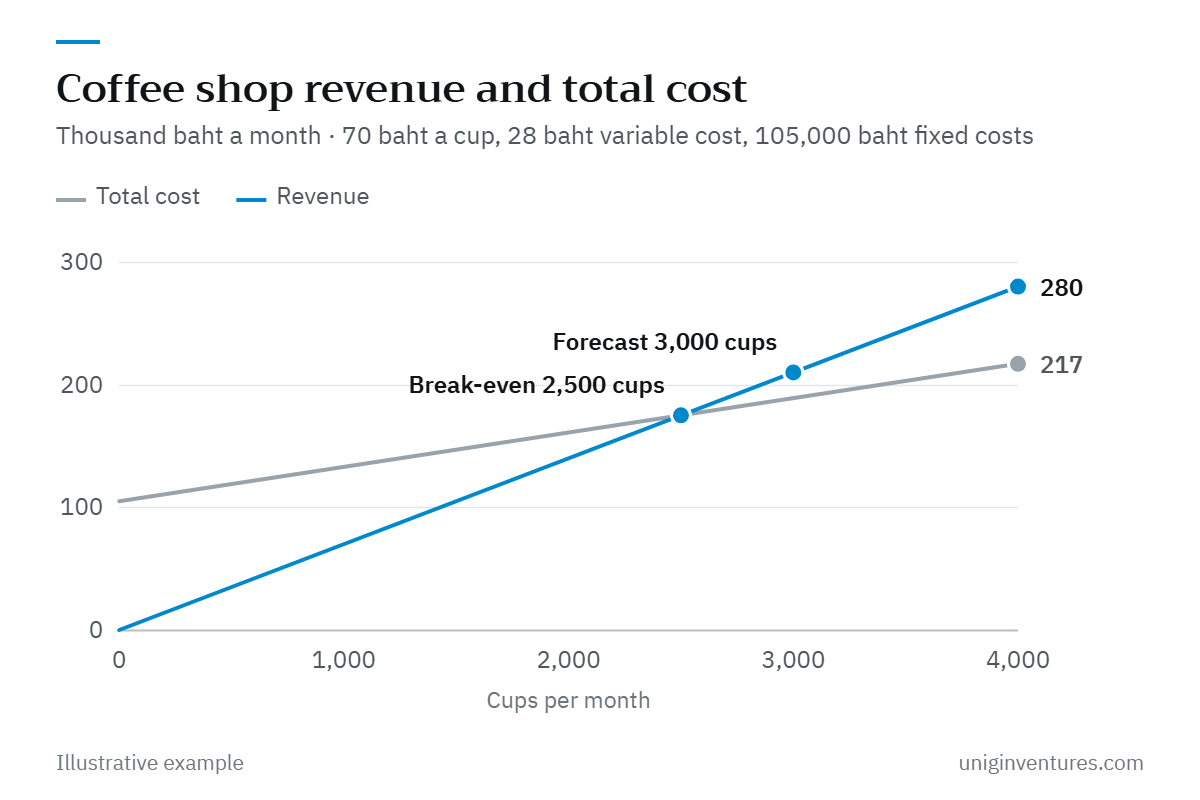
In this illustrative example, a new coffee shop sells drinks at an average of 70 baht a cup. Variable cost per cup, covering beans, milk, the cup and payment fees, is 28 baht. Contribution margin is therefore 42 baht a cup, or 60% of the price.
| Monthly fixed costs | Baht |
|---|---|
| Rent | 35,000 |
| Two staff, including social security contributions | 30,000 |
| Water and electricity | 8,000 |
| Depreciation on 300,000 baht of equipment over 5 years | 5,000 |
| Loan interest | 2,000 |
| Point-of-sale system, internet and bookkeeping | 4,000 |
| Total before owner's pay | 84,000 |
| Owner's pay | 21,000 |
| Total fixed costs | 105,000 |
- Without the owner's pay, break-even is 84,000 ÷ 42 = 2,000 cups a month, or about 67 a day over 30 days.
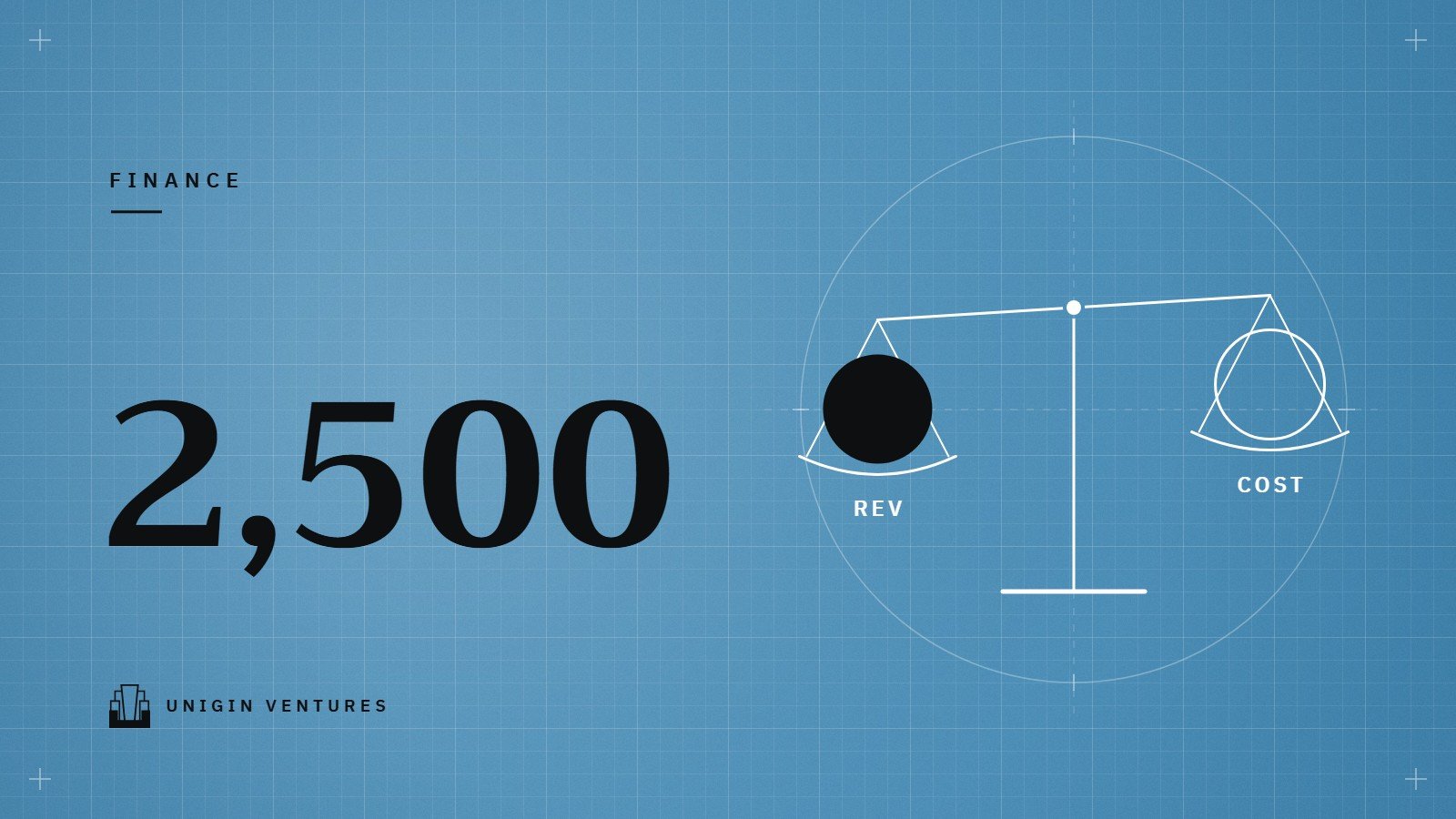
- With the owner's pay, break-even is 105,000 ÷ 42 = 2,500 cups a month, or about 84 a day. In sales terms, that is 105,000 ÷ 60% = 175,000 baht a month.
Margin of safety and target profit
Break-even tells you how much you must sell to avoid a loss, but not how risky the plan is. The margin of safety answers that: how far expected sales can fall before you start losing money.
Margin of safety (%) = (expected sales − break-even sales) ÷ expected sales
Sales for a target profit (units) = (fixed costs + target profit) ÷ contribution margin per unit
If the shop expects to sell 100 cups a day, or 3,000 a month, its margin of safety is (3,000 − 2,500) ÷ 3,000 = 16.7%. If sales come in more than about one-sixth below plan, the shop loses money. And if the owner wants a profit of 42,000 baht a month on top of their own pay, the shop must sell (105,000 + 42,000) ÷ 42 = 3,500 cups a month, or about 117 a day.
No margin of safety is right for every business. But if the margin is thin and the sales forecast is still a guess, review the plan before you put money in.
When channels earn different margins
If you sell through several channels or products, use a contribution margin weighted by each one's share of sales. The formula only holds while that sales mix stays constant.
Continuing the illustrative example, the shop starts selling through a food delivery app. Assume the platform takes a 21-baht commission per cup and the shop charges the same price as in store. Each app cup now contributes only 21 baht.
| Channel | Share of cups | Contribution per cup (baht) |
|---|---|---|
| In store | 60% | 42 |
| Delivery app | 40% | 21 |
| Weighted average | 100% | 33.60 |
Break-even rises from 2,500 to 105,000 ÷ 33.60 = 3,125 cups a month, above the 3,000 the shop expects. If total cups stay the same, the shop loses 4,200 baht a month while selling just as much. A channel that adds sales can lower profit if the extra volume does not make up for the margin lost on each unit.
Three ways to break even sooner
Three variables move the break-even point. Here is the effect of changing each one, starting from the in-store-only case.
| Change | Contribution per cup | Fixed costs | Break-even (cups/month) |
|---|---|---|---|
| Base case | 42 | 105,000 | 2,500 |
| Raise price by 5 baht to 75 | 47 | 105,000 | 2,235 |
| Cut variable cost by 3 baht to 25 | 45 | 105,000 | 2,334 |
| Cut rent by 10,000 baht | 42 | 95,000 | 2,262 |
In this example, the 5-baht price increase lowers break-even the most, though you also need to judge how many customers it might cost you. Fixed costs are best negotiated before you sign, because an agreed lease usually runs for years.
The limits of break-even analysis
Cost-volume-profit analysis rests on several assumptions. ACCA lists them: a constant sales mix, linear costs and revenue, costs that split cleanly into fixed and variable, and fixed costs that hold steady across the range of output being considered. In practice:
- If sales outgrow what two staff can handle, you have to hire. Fixed costs jump in a step, and the break-even point moves with them.
- The average price per cup shifts with the menu mix and with any promotions you run.
- Accounting break-even is not cash break-even. Depreciation is not a cash payment, while loan principal is real cash going out even though it never appears in the income statement.
Use break-even to test whether a plan is workable, and track actual cash flow alongside it.
Run the numbers for your business
- List every expense from the last three months, or estimate them if you have not opened yet, and mark each as fixed or variable.
- Add the owner's pay, depreciation and a buffer of about 10% to fixed costs.
- Calculate the contribution margin per unit for your main product, or a weighted average ratio if you sell many products, and do it separately for each sales channel.
- Find your break-even point, convert it to a daily number, and ask whether it is realistic given your foot traffic or production capacity.
- Calculate the margin of safety, then change price, cost and channel mix to see which one breaks the plan fastest.