Annual Budgets vs. Rolling Forecasts: Which to Use for Targets and Decisions
An annual budget sets targets and approves spending. A rolling forecast always looks 12 months ahead. How they differ, how to build one from a few drivers, and what it shows when sales miss plan.
In this article
Many companies spend most of a month at year-end building their annual budget. One quarter later, the numbers no longer match what is actually happening. A large customer delays an order, material costs rise, or a competitor cuts prices. Managers are left deciding on hiring and investment with figures they already know are wrong.
The common fix is a rolling forecast, which always looks 12 months ahead. This article explains how a budget and a forecast do different jobs, why you should not throw the budget away, how to build a rolling forecast from a handful of drivers, and what one shows for a company whose first-quarter sales missed plan.
Budgets and forecasts answer different questions
A budget answers "What do we intend to achieve this year, and how much spending have we approved?" A forecast answers "Given what we know now, what is likely to happen?" Using one set of numbers for both jobs causes trouble. Managers who know a number will become their target tend to set it low, and the numbers used for decisions never get updated.
| Feature | Annual budget | Rolling forecast |
|---|---|---|
| Main purpose | Set targets and approve spending limits | Estimate what is likely to happen so you can decide in time |
| Horizon | The fiscal year, shrinking as year-end approaches | Always the next 12 months |
| How often | Once a year | Monthly or quarterly |
| Level of detail | Full chart of accounts, by department | Coarser, focused on key drivers |
| Changes during the year | Stays fixed as the yardstick | Updated every cycle with new information |
ACCA describes a rolling budget as one updated more often than once a year, quarterly or even monthly, with a new period added each time one expires, so the budget always extends a year into the future. AICPA & CIMA define a rolling forecast the same way: each time actual results are reported, a further forecast period is added and the periods in between are updated.
Where an annual budget alone falls short
ACCA's article on Beyond Budgeting summarizes several criticisms Hope and Fraser made of traditional budgeting. The ones small businesses run into most often are:
- High effort, low value. Managers spend weeks on numbers that go stale within months.
- Numbers come from bargaining rather than from working out what resources are needed. Sales asks for a low target, and other teams pad their spending.
- Too little external focus. A budget set once a year does not reflect what changes in the market during the year.
- Behavior that works against the company, such as rushing to spend what is left before year-end so next year's budget is not cut.
Another problem is the shrinking horizon. If you budget by calendar year, by October the budget only looks three months ahead. Many decisions, such as renewing a lease, ordering equipment or planning a fundraise, need a longer view than that.
Example: first-quarter sales miss plan
In this illustrative example, a company selling equipment to business customers budgets 24.0 million baht of sales for 2026. The key assumption is that each customer who buys in a quarter (an active customer) orders twice a quarter at 50,000 baht an order, so each one brings in 100,000 baht a quarter. The budget assumes active customers grow from 54 in the first quarter to 66 in the fourth.
At the end of the first quarter, the company has only 45 active customers, so actual sales are 4.5 million baht, 0.9 million below budget. The sales team re-estimates that customers will climb gradually to 50, 56 and 62 in the second through fourth quarters, and adds the first quarter of 2027 at 60 (the first quarter of the year tends to be slower).
| Quarter | Budget customers | Budget (million baht) | Forecast customers | Actual / forecast (million baht) |
|---|---|---|---|---|
| Q1/26 | 54 | 5.4 | 45 (actual) | 4.5 (actual) |
| Q2/26 | 58 | 5.8 | 50 | 5.0 |
| Q3/26 | 62 | 6.2 | 56 | 5.6 |
| Q4/26 | 66 | 6.6 | 62 | 6.2 |
| 2026 total | 24.0 | 21.3 | ||
| Q1/27 | – | – | 60 | 6.0 |
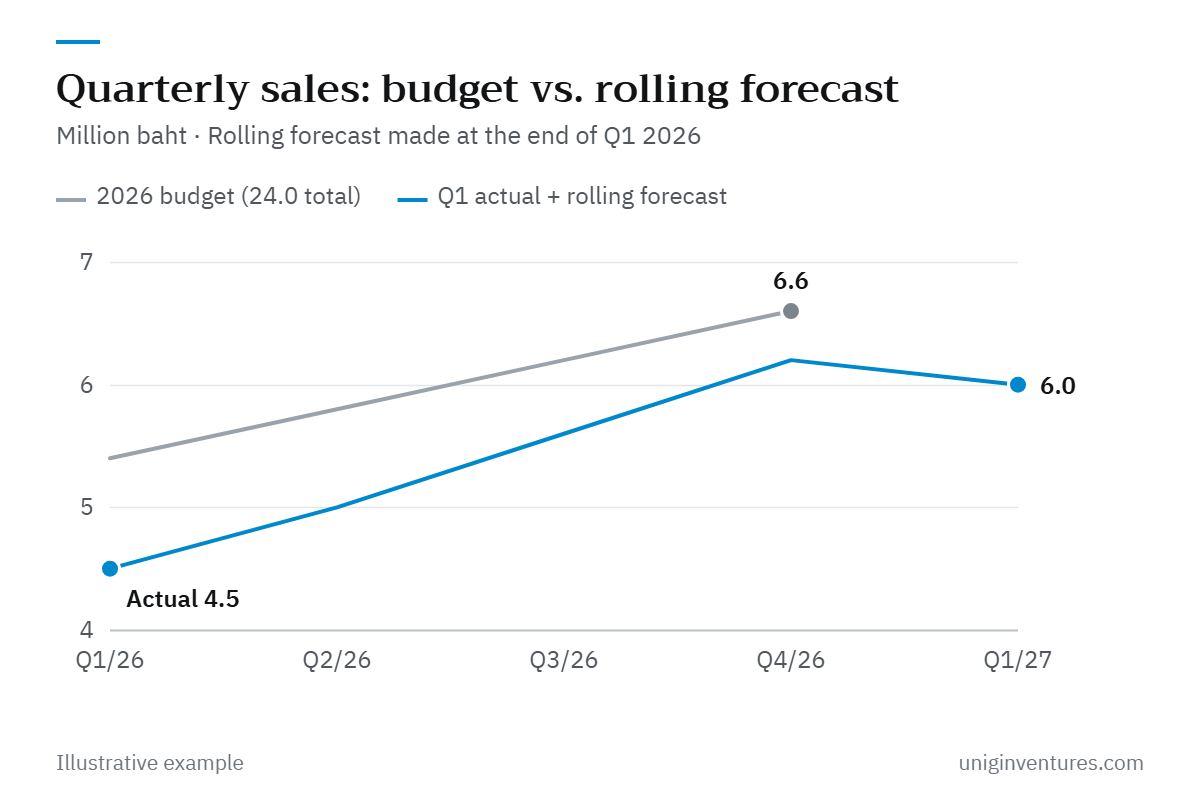
The picture is very different from the budget. Full-year sales now look like 4.5 + 5.0 + 5.6 + 6.2 = 21.3 million baht, 2.7 million or about 11% below budget. At a 40% gross margin, that is roughly 1.08 million baht of gross profit gone.
A company watching only the budget would go ahead with its planned sales hires on the assumption that the second half will catch up. With a rolling forecast, management sees the gap in April and can choose to delay some hires, cut other spending or push harder on new customers, knowing how much each option moves the numbers.
Note that the budget has not changed. It is still 24.0 million baht and still measures performance at year-end. What changed is the number used to make decisions.
Build the forecast from a few drivers
A common mistake is to rebuild the whole budget every month. ACCA warns that this can leave managers spending too much time preparing numbers and too little time controlling the business. A lighter approach is a driver-based forecast: pick a few business measures that determine the financial results and let everything else calculate from them.
Sales = active customers × orders per customer × average order value
Cost of sales = sales × (1 − gross margin)
Staff cost = headcount each month × average cost per person
In the example, only one driver changed: the number of customers. The team can discuss why customers fell short and what to do about it, instead of arguing over individual budget lines.
Rules that keep it workable:
- Always 12 months ahead. Forecast the first three months monthly and the rest by quarter.
- Less detail than the budget. Group small items into one line, such as "other office costs."
- Follow your close cycle. When you close the month or quarter, replace the forecast with actuals and add a new period at the end.
- Include cash flow. When lower sales hit your cash depends on payment terms, not just on profit.
- Keep old forecasts. Compare them with actual results later to see whether you consistently miss in one direction.
Keep targets separate from forecasts
ACCA points out that changing numbers often can cause conflict over targets, with managers complaining about moving goalposts. The fix is to be clear about which number does which job.
- Targets and bonuses tie to the annual budget or to separately set goals, not to the forecast.
- The forecast must be what the team believes is likely, not what it hopes for. If the forecast is linked to pay, people will shade it to look good and it stops being useful.
- Spending limits are still approved through the budget but can be reviewed when the forecast shows conditions have changed. For example, set a rule that if forecast full-year sales fall more than 10% below budget, the hiring plan must be reviewed before it continues.
How a small business can start
You do not need expensive planning software. ACCA does warn that standalone spreadsheets not linked to the accounting system risk data integrity problems, so design yours to pull actuals from the closed books every time. Then:
- Keep the annual budget, but make it shorter. Use it for targets and spending limits.
- Pick three to five drivers that explain most of your sales and costs, such as customer count, average price, gross margin and headcount.
- Build a 12-month table that calculates the income statement and cash from those drivers.
- Each time you close a month or quarter, enter actuals, update assumptions, add a new period, and write a short note on why the numbers moved.
- Bring the forecast to management meetings and focus on what you will decide from it, not just on why results missed budget.
If you are planning to raise funding, a forecast kept up to date this way also helps you answer investors' questions about how long your cash will last and what assumptions sit behind your business plan.