Scenario Planning for SMEs: Protect Your Cash Before Sales Fall
How to build scenarios in one spreadsheet: pick the drivers that move cash, calculate year-end cash in four cases, set a cash floor, and agree on triggers and actions in advance.
In this article
Most business plans contain one set of numbers: next year's sales grow by this much, costs are this much, cash at year end is this much. When actual sales miss the plan two months in a row, everyone knows the plan no longer works, but nobody knows what to do next, because no one decided in advance how to respond.
Scenario planning fixes this by calculating ahead of time how much cash would be left if key drivers turn out better or worse than expected, and by agreeing in advance which signals trigger which actions. This article shows a version an SME can run in a single spreadsheet, with a worked example of four scenarios.
Scenarios Are Not Predictions
In McKinsey's "The use and abuse of scenarios," Charles Roxburgh writes that scenarios let leaders steer between the false certainty of a single forecast and the paralysis that uncertainty can bring. Three points from that article matter most here:
- Plan on the most likely scenario, backed by clear contingency plans for the others. Holding several scenarios should not stop the company from having one clear plan.
- Find the "no-regret" moves that pay off whichever scenario unfolds.
- Do not cut off the extremes. People tend to pick scenarios just slightly better or worse than today, yet risk is probability times magnitude, so a low-probability, high-impact event can still sink a business. Heading into a slowdown, pessimistic cases should go further than feels comfortable.
For an SME, the key question is not which scenario will happen. It is whether cash falls below an acceptable level in the worst plausible case, and if so, what must start now.
Choose the Drivers That Actually Move the Result
A model can have hundreds of inputs, but only a few move an SME's cash:
- Sales volume, especially from a handful of large customers
- Gross margin, which falls when you cut prices or input costs rise
- Collection period, since customers tend to pay later at the same time sales drop
- Fixed costs, mainly salaries and rent
A common mistake is flexing one driver at a time. In reality these drivers tend to worsen together. Each scenario should be one consistent story, such as "a major customer cuts orders, we discount to keep the rest, and customers pay later," with every driver adjusted to fit that story.
Worked Example: Four Scenarios for a Distributor
Illustrative example: a distribution company has 4.0 million baht in cash today, monthly sales of 3.0 million baht, a 30% gross margin, fixed costs of 750,000 baht a month, and collects from customers in 45 days on average. Trade receivables today are therefore 3.0 × 45 ÷ 30 = 4.5 million baht. The owner sets a cash floor of two months of fixed costs, or 1.5 million baht.
To keep the picture clear, the example leaves out tax, capital spending and debt repayment, and assumes the collection period changes from the start of the year.
| 12-month assumptions | Upside | Base | Downside | Severe |
|---|---|---|---|---|
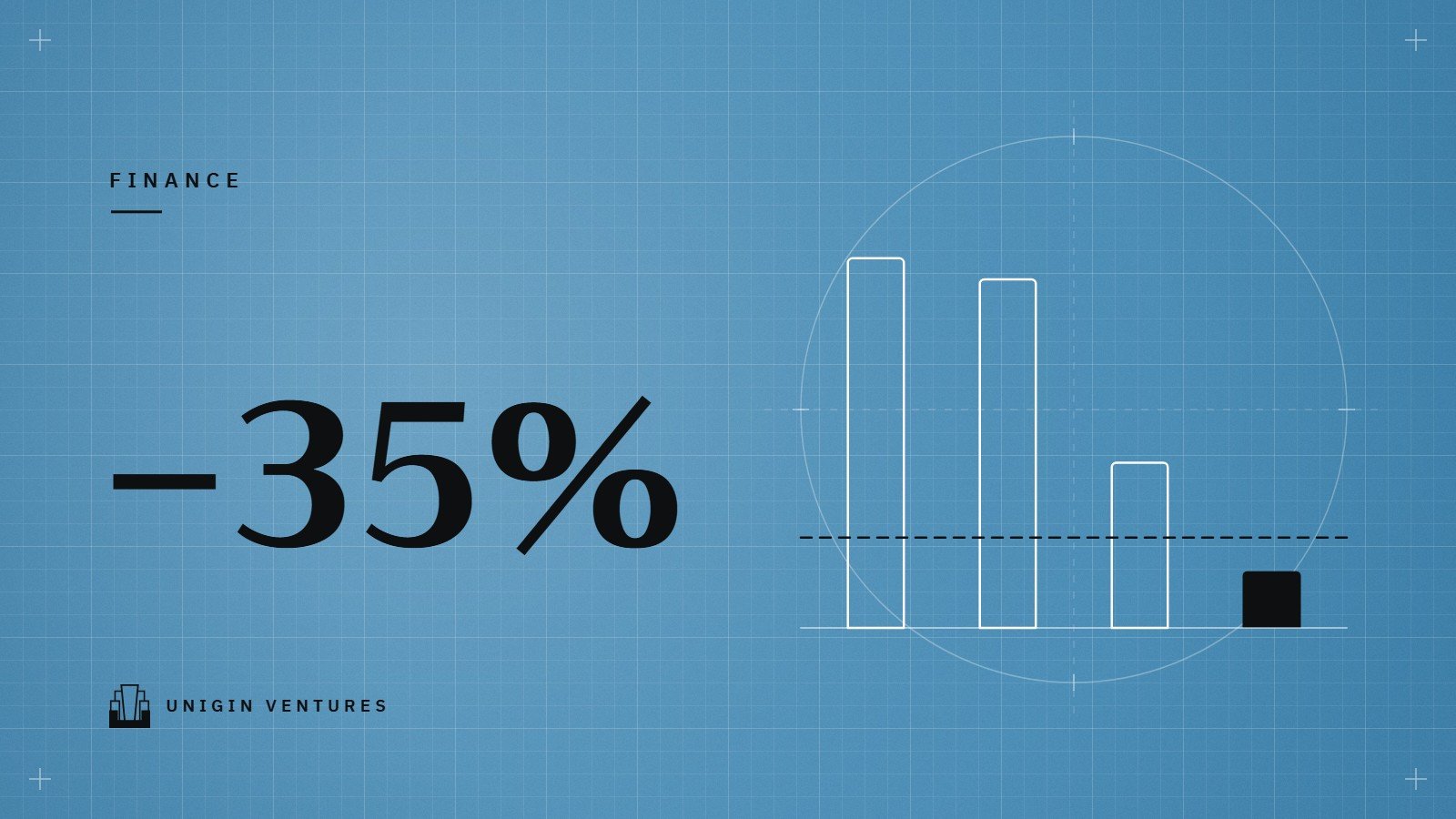
| Monthly sales (million baht) | 3.45 (+15%) | 3.00 | 2.40 (−20%) | 1.95 (−35%) |
| Gross margin | 30% | 30% | 28% | 27% |
| Monthly fixed costs (baht) | 800,000 | 750,000 | 750,000 | 750,000 |
| Collection period (days) | 45 | 45 | 60 | 75 |
Monthly operating profit = Sales × Gross margin − Fixed costs
Trade receivables = Monthly sales × Collection days ÷ 30
Year-end cash = 4.0 + 12-month profit − Increase in receivables
| Results (million baht) | Upside | Base | Downside | Severe |
|---|---|---|---|---|
| Monthly profit | 0.235 | 0.150 | −0.078 | −0.2235 |
| 12-month profit | 2.820 | 1.800 | −0.936 | −2.682 |
| Year-end receivables | 5.175 | 4.500 | 4.800 | 4.875 |
| Increase in receivables | 0.675 | 0 | 0.300 | 0.375 |
| Year-end cash | 6.15 | 5.80 | 2.76 | 0.94 |
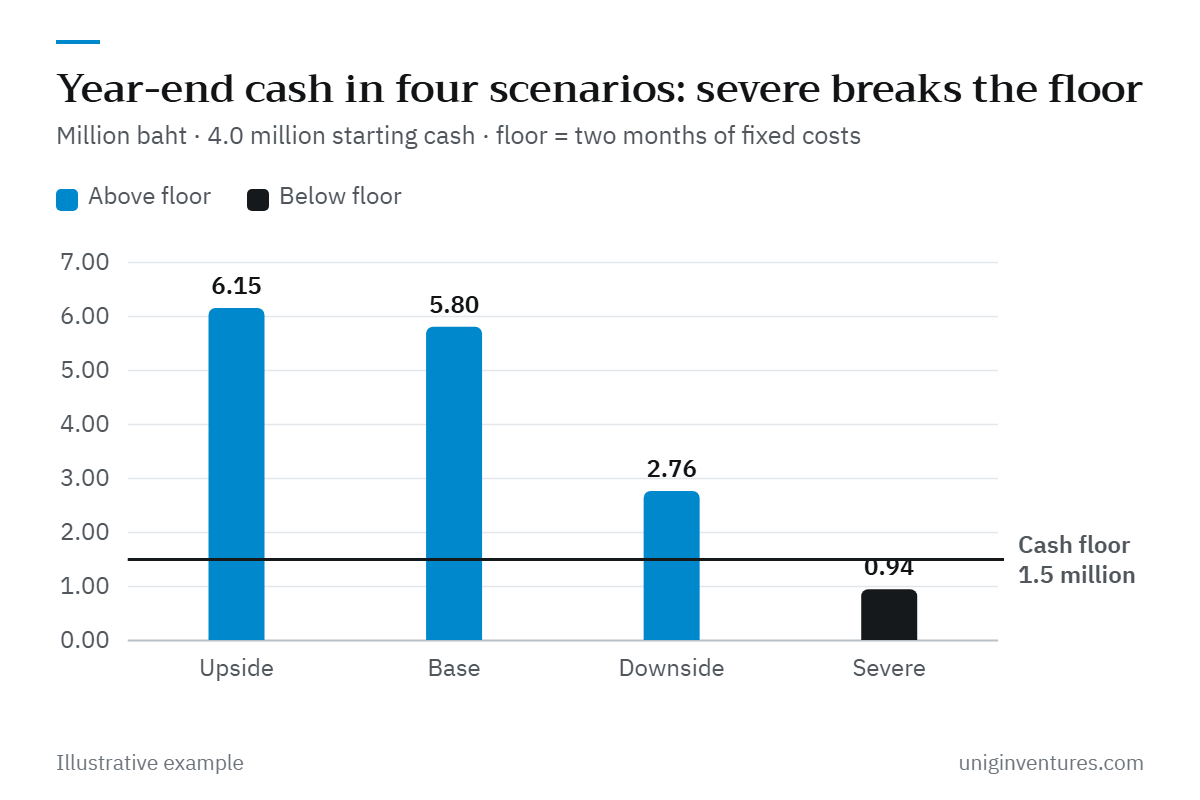
These numbers reveal three things a single forecast would not:
- The upside consumes cash. Sales growth of 15% adds more than one million baht of profit, but receivables also grow by 0.675 million baht, so year-end cash is only 0.35 million baht above the base case. If inventory must grow with sales too, the gap shrinks further.
- The downside survives. Cash falls to 2.76 million baht, still above the floor, but with little room to spare.
- The severe case breaks the floor. Cash ends at 0.94 million baht, about 0.56 million baht short. If the company waits until this happens to ask a bank for a credit line, its financial statements will look weak at that moment and borrowing will be much harder.
Set Triggers and Pre-Agreed Actions
Scenarios are only useful when they connect to decisions. For each bad scenario, write down in advance which signals show it is starting and what you will do.
| Trigger | Action |
|---|---|
| Sales below 2.55 million baht (−15%) for two months in a row | Pause new hires, review discretionary spending, negotiate supplier payment terms |
| Collection period above 60 days | Stop extending more credit to overdue customers, follow up each debtor weekly |
| 13-week cash forecast below 2.0 million baht | Draw on the standby credit line, cut fixed costs from the pre-agreed list |
The thresholds in the table are illustrative. Each company should set its own from its own model. What matters is agreeing on them while there is no pressure, because in the moment, decisions to cut costs tend to get postponed again and again.
In this example, at least two moves make sense in every scenario: arrange a revolving credit line while the accounts still look good, and chase overdue receivables. Both cost little in the base case and help a great deal in the severe one.
Where to Start
- Pick three or four key drivers that move your cash the most. Look at which ones swung hardest over the past year.
- Write each scenario as a one-sentence story, then set every driver to match it. Include a case worse than feels comfortable.
- Calculate ending cash for every scenario, including the effect on receivables and inventory, not just profit.
- Set a cash floor and see which scenarios fall below it.
- Write triggers and actions, agree on them with partners or the management team, and review them monthly alongside your 13-week cash forecast.
- Refresh the scenarios every quarter. Drop the ones no longer relevant and add new ones in their place.
Good scenario planning does not make forecasts more accurate. It means that when conditions change, the company knows what to do and has time to do it, which is also what banks and investors want to see from management.
All figures in this article are illustrative examples.