Overdraft or Short-Term Loan: Match Working Capital to How You Use Cash
How overdrafts and promissory notes charge interest differently, how to cost each one from your monthly funding needs, what MOR means, and which contract terms to check before you sign.
In this article
Before a peak season, or when you take on a large job from a customer who pays slowly, the business needs extra working capital for a while. Many owners respond by borrowing one lump sum equal to the highest amount they will ever need, then paying interest on all of it for a full year, even though they only use the full amount for a few months.
This article compares the two main tools Thai banks offer SMEs for this: an overdraft (O/D) facility and a fixed short-term loan, such as a promissory note (P/N). It walks through a worked example of the real cost under a monthly usage pattern and lists the contract terms to read before you sign.
How the two tools differ
Overdraft: a limit attached to your current account
The bank approves a limit, and the company can pay checks or transfer money out of its current account beyond its balance, up to that limit. Interest accrues daily on the amount actually overdrawn each day. Customer payments reduce the balance as soon as they arrive, so there is no separate drawdown or repayment for each use.
Legally, an overdraft rests on a current account contract. Section 856 of the Civil and Commercial Code defines it as an agreement to set off the debts arising from dealings between two parties and pay only the net balance. One consequence matters: Section 655 generally prohibits charging interest on unpaid interest, but it carves out the commercial custom of compounding interest in current accounts. Unpaid overdraft interest can therefore be added to the balance and earn interest itself. Check in the contract how often the bank capitalizes interest.
Short-term loan: a lump sum with a due date
The company receives the full amount on the drawdown date and repays principal plus interest at maturity, for example after 3 or 6 months. Thai banks commonly do this through promissory notes drawn under an approved line. At maturity, a note can sometimes be rolled into a new one if the bank agrees. Interest runs on the whole principal for the life of the note, whether you use the money or leave it sitting in the account.
| Feature | Overdraft | Promissory note |
|---|---|---|
| How you use it | Draw and repay any day up to the limit | One lump sum for a set amount and date |
| Interest base | Daily overdrawn balance | Full principal for the life of the note |
| Common reference rate | MOR plus or minus a margin | Rate fixed at drawdown, or linked to MLR |
| Best for | Needs that move daily and are hard to predict | Large needs with a known duration |
| Main risk | The bank may review or call the line under the contract | You must repay in full at maturity or get a rollover |
Read the reference rates
The Bank of Thailand describes MOR (Minimum Overdraft Rate) as the rate commercial banks charge their best large customers on overdraft facilities, and MLR (Minimum Loan Rate) as the rate for the same customers on long-term loans with a fixed term. Both are floating rates that move with each bank's funding cost, and each bank announces its own.
Most SMEs are not "best large customers," so they usually pay MOR plus a margin, such as MOR + 1%. When the bank changes its MOR, your rate changes immediately without any contract amendment. When you compare offers, ask for the annual percentage rate in effect today, not just the margin, because each bank's MOR differs. You can find current rates on bank websites and on the BOT Financial Consumer Protection Center's SME loan comparison page.
Worked example: cost depends on how you use the money
Illustrative example: a distributor needs a different amount of working capital each month. Normally it uses 0.4 to 1.0 million baht, but during three months of pre-season stocking it needs 3.0 million baht. Adding up each month's need gives 15.0 million baht-months for the year, an average of 1.25 million baht per month.
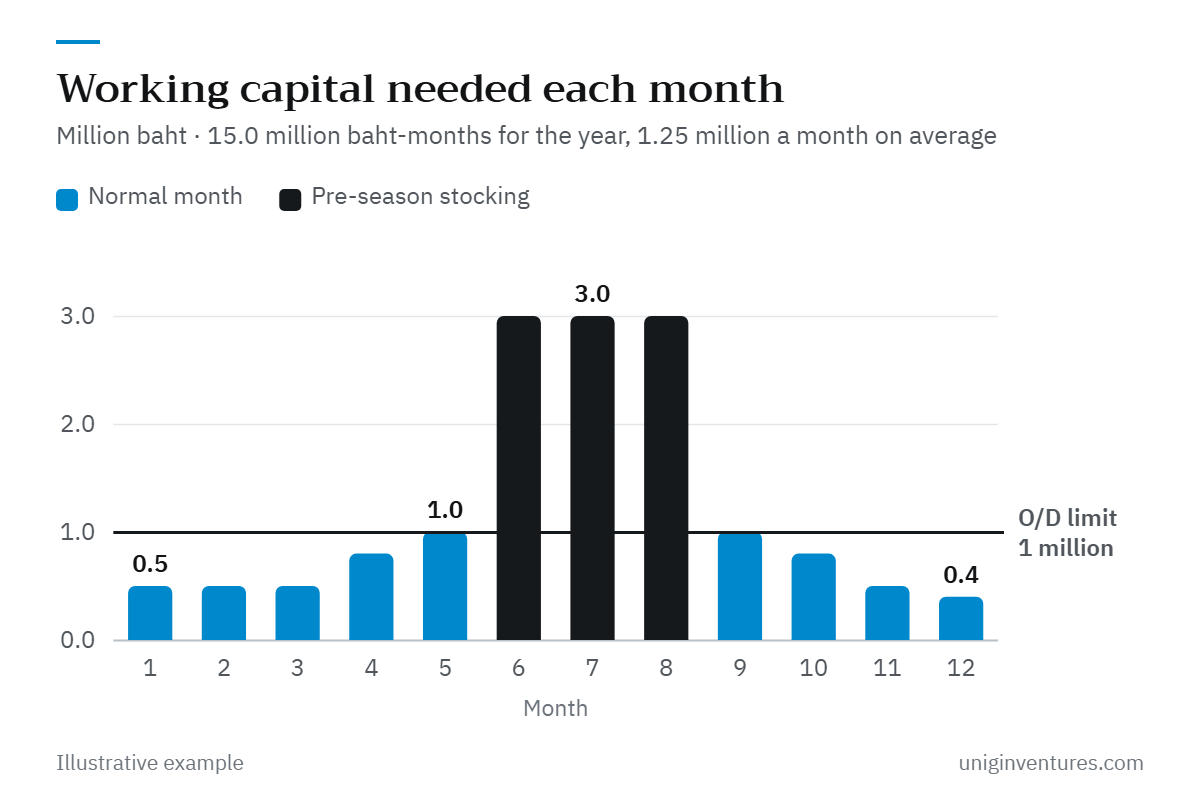
Assume these terms, which are for illustration only and are not any bank's actual rates: the overdraft charges 7.5% a year plus a 0.5% annual fee on the unused part of the limit; a 12-month short-term loan charges 6.5%; a 3-month promissory note charges 6.75%. There are three options.
| Option | Calculation | Cost |
|---|---|---|
| A. Overdraft, 3 million baht limit | Interest 15.0 million × 7.5% ÷ 12 = 93,750 + unused fee 21.0 million × 0.5% ÷ 12 = 8,750 | 102,500 |
| B. 3 million baht loan for 12 months | 3,000,000 × 6.5% | 195,000 |
| C. 1 million baht overdraft + 2 million baht note for 3 months | Overdraft interest 9.0 million × 7.5% ÷ 12 = 56,250 + fee 3.0 million × 0.5% ÷ 12 = 1,250 + note 2,000,000 × 6.75% × 3 ÷ 12 = 33,750 | 91,250 |
"Baht-months" is the sum of each month's balance. Divide by 12 and multiply by the annual rate to get a year's interest. In option A, the limit over 12 months totals 36.0 million baht-months; the company uses 15.0, leaving 21.0 unused. In option C, the overdraft carries only balances up to 1 million baht, which add up to 9.0 million baht-months, and the note covers the excess in months 6 to 8.
Three lessons stand out:
- A lower rate is not a lower cost. The 12-month loan has the lowest rate but costs almost twice as much, because the company pays interest on 3 million baht all year while using only 1.25 million on average.
- Use the overdraft for the part that moves every day. Move large, predictable needs to a cheaper short-term loan.
- Fees can swing the answer. Without the unused-limit fee, option A costs 93,750 baht and option C costs 90,000 baht, almost the same. Always run the numbers with the actual terms you are offered.
Annual overdraft interest ≈ sum of average monthly balances × annual rate ÷ 12
Lump-sum loan interest = principal × annual rate × months ÷ 12
The input you need is a monthly or weekly cash flow forecast that shows how much you need in each period. If you don't have one yet, start with a 13-week cash flow forecast.
Contract terms to read before you sign
Review and recall of the line
Overdraft contracts usually have a term and an annual review, and many let the bank demand repayment. Don't use an overdraft as permanent funding for machinery or new branches. If the bank cuts the limit or doesn't renew it, you will need to repay the whole balance on short notice. Long-term assets belong on long-term loans or equity.
Fees outside the interest rate
Ask about front-end fees, unused-limit fees, renewal fees, collateral appraisal fees and note issuance fees, and include all of them in your calculation. As the example shows, a small annual fee can change the answer.
Default interest and payment order
The BOT caps default interest at the contract rate plus 3% a year, charged only on the principal of the installment actually in default and not on future installments, effective April 1, 2021. Payments must be applied to the oldest overdue installment first, effective July 1, 2021. These rules are written around installment loans. For an overdraft or a single-payment note, ask the bank what rate applies when you exceed the limit or default, and on what base.
Collateral and guarantees
Banks often require collateral or a personal guarantee from directors for SME working capital lines. Check whether the guarantee covers only this facility or every debt to the bank. If your collateral falls short, ask the bank about combining the loan with a Thai Credit Guarantee Corporation (TCG) program.
Stamp duty
Under item 5 of the stamp duty schedule, a loan or a bank overdraft agreement carries duty of 1 baht for every 2,000 baht, or fraction of 2,000 baht, of the loan amount or agreed limit, capped at 10,000 baht. In the example, a 3 million baht limit carries 1,500 baht of duty. Banks typically tell you this cost when you sign.
Signs you picked the wrong tool
- The overdraft never returns to positive. If the balance stays near the limit all year, you are using it as permanent funding. Convert the permanent part into an amortizing term loan.
- A lump-sum loan sits in the account for months. You are paying interest on idle money. Shrink the loan and let an overdraft handle the swings.
- You roll every note without ever reducing it. The need is no longer short term.
- You draw more to pay interest. The problem is profitability or your cash cycle, not the tool. Review your cash conversion cycle before asking for a bigger line.
Where to start
- Build a table of monthly funding needs for the next 12 months. Separate the base amount you always use from the seasonal or project-driven part.
- Get offers from at least two banks. Ask for today's annual rate, the reference rate it is based on and every fee.
- Calculate each option's annual cost with the formulas above, including a mix of overdraft and short-term loan.
- Read the review, default interest and guarantee clauses before you sign.
- Review every quarter whether the overdraft balance returns close to zero as planned.
The right tool is the one whose shape matches your funding need. Let the overdraft absorb the unpredictable swings, use short-term loans for the known lumps, and pay interest only on money you actually use.
Sources
- Loan interest: fixed, floating, MLR, MOR and MRR, Bank of Thailand (in Thai)
- Rules on default interest and payment application, Bank of Thailand (in Thai)
- SME loan comparison, Financial Consumer Protection Center, Bank of Thailand (in Thai)
- Stamp duty rate schedule (item 5: loans and bank overdrafts), Revenue Department (in Thai)
- Civil and Commercial Code, Section 655, Thai Law Online (in Thai)
- Civil and Commercial Code, Section 856, Thai Law Online (in Thai)