Equal principal or level payments: read the cash schedule first
Compare two repayment schedules for the same ฿120,000 loan. Follow interest, principal and opening cash month by month to see which promise the business can keep.
In this article
A business can finish a month comfortably and still miss a payment due three days before its largest customer transfers cash. Two offers for the same amount, term and interest rate can place different demands on that particular day. Ask for the schedule showing how much principal and interest will come out of the account on each due date. A headline monthly rate supplies only one input.
Consider an illustrative loan of ฿120,000, drawn once, with three equal interest periods and payments at each period end. The rate is fixed at 1% per period on outstanding principal. We exclude fees, insurance, grace periods and missed payments. This is a small model you can audit with a calculator. It is not an advertised rate or a quote for a Thai lending product.
Start every row with the opening balance
Set up five columns: opening principal, interest, principal repaid, total payment and closing principal. Calculate interest on the opening balance. Subtract that interest from the payment to find the amount that reduces the debt. Carry the closing principal into the next row. None of these columns should rely on a manually entered closing balance after the first draw.
Check the dates before comparing a lender’s table with yours. A contract might use actual days, an unusual first period, a variable rate or a different payment date when a holiday intervenes. A monthly due date on the calendar does not establish the day-count convention. Our model gives every period the same length so that a single periodic rate applies throughout.
Hold principal repayments constant
Divide ฿120,000 by three. Each installment returns ฿40,000 of principal. The first period starts with the whole loan outstanding and earns ฿1,200 of interest. The second starts at ฿80,000 and earns ฿800. Interest in the final period is ฿400.
| Period | Opening balance (฿) | Interest | Total payment | Closing balance |
|---|---|---|---|---|
| 1 | 120,000 | 1,200 | 41,200 | 80,000 |
| 2 | 80,000 | 800 | 40,800 | 40,000 |
| 3 | 40,000 | 400 | 40,400 | 0 |
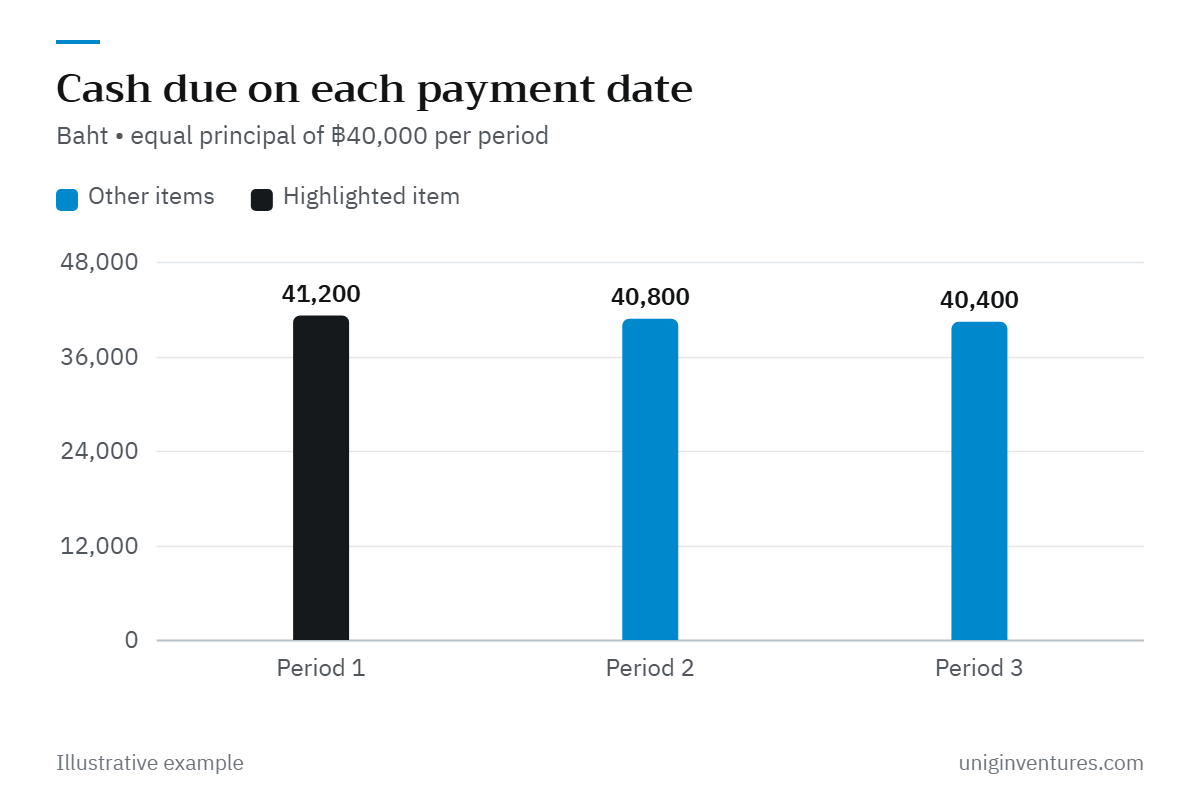
Add the interest column and the business pays ฿2,400 for the use of the money. Add all three payments and the bank account supplies ฿122,400. A budget that reserves the quoted principal installment of ฿40,000 for the first month falls short by ฿1,200. Selecting the correct column matters more than the precision of the spreadsheet.
Hold the combined payment constant
A level-payment amortizing loan makes the total outflow stable at a given fixed rate. The interest portion still begins at ฿1,200. The difference is that the first payment returns slightly less principal, leaving a larger balance to earn interest in the second period. The CFPB describes this shift from interest to principal in its explanation of mortgage amortization. The arithmetic works for this example with the assumptions stated above.
Payment = P × r ÷ [1 − (1 + r) to the power −n], where P is principal, r the rate per period and n the number of periods.
The result is about ฿40,802.65 per period. The first payment reduces principal by approximately ฿39,602.65 and leaves ฿80,397.35. Interest on that balance is approximately ฿803.97. By the third payment the interest portion is only about ฿403.99. Use unrounded figures for the calculation and round for display. An actual lender may adjust the final payment by a satang.
Total interest is approximately ฿2,407.96. The difference of about ฿7.96 between the two schedules is small here because the loan is short and the first payments are close. It tells you nothing about the gap on a multiyear loan. Recalculate when any of the amount, term or periodic rate changes.
Put the due date into the cash forecast
Suppose the business has ฿41,000 available for debt service on the first due date, after protecting payroll and committed materials payments. Equal principal leaves a shortfall of ฿200. The level installment leaves roughly ฿197.35. Now move just ฿1,000 of expected collections to the following week. Both schedules have a gap. Matching the debit date to the actual collection cycle could matter more than the entire difference in interest.
Prepare one forecast using contractual customer dates and a second using the late-payment experience of the largest account. Carry forward available cash, excluding restricted balances. Enter fixed outflows on their actual dates. Read the lowest daily balance as well as the month-end result. If one customer receipt changes the lending decision, note its amount and date beside the comparison so the owner sees the dependency.
Ask for a fresh schedule before making an extra payment
Suppose there is THB 10,000 available after the first installment. Ask the lender for a revised schedule for each offer showing the date an extra payment reduces principal and how future installments change. If the whole amount reduces principal before the next full month at 1%, interest in that next month alone falls by 100. The total saving over the remaining term depends on whether the lender keeps the installment or the maturity date fixed and on any contractual fees.
Check the lowest projected operating cash balance both before and after the extra payment. If wages fall due next week, a small near-term interest saving may be a poor use of cash that the company cannot redraw. Put the lender's calculation beside those two cash balances when asking the owner to approve early repayment.
Request four items before accepting a schedule
- Get the draw date, first due date, full breakdown of principal and interest, and final payment after rounding. Reconcile all principal installments to the amount drawn.
- Ask whether fees are deducted from proceeds or paid separately. If the bank disburses less than the face amount, enter actual cash received in the first row of the business forecast.
- Ask what happens to the timetable after an early principal payment. A smaller installment and a shorter remaining term solve different cash problems.
- Identify the rate reset rule and when the revised schedule will arrive. A level payment illustrated at today’s rate can change under a floating-rate contract.
Bring three figures to the decision meeting: cash required on the first due date, total interest under the agreed assumptions, and the lowest available balance in the operating cycle. When the first debit arrives, reconcile its date, fee lines and interest amount before changing the principal ledger. That single comparison establishes whether the business is following the schedule it actually signed.