Business Cash Reserve: How Much to Hold and Where to Keep It
Split your cash reserve into three parts, size it from the bills you cannot stop, see a worked example that ends at 2.7 million baht, and learn what Thai deposit protection covers.
In this article
- A cash reserve has three parts, and each does a different job
- Size the safety reserve from the bills you cannot stop
- The right number of months depends on your risks
- Worked example: cash you should hold at the start of the month
- Use a 13-week forecast to see when you will dip below the floor
- Where to keep the reserve
- Set rules for using and rebuilding the reserve
- Where to start
A profitable business can still run out of cash. A large customer pays a month late, a machine breaks in the middle of the peak season, or the annual tax bill lands in the same week as payroll. An owner with no cash reserve then makes decisions under pressure: an expensive loan, a fire sale, or late payments that damage supplier relationships.
This article shows how to size a cash reserve from your own numbers, split into three parts that do different jobs. It walks through a worked example, the factors that call for a bigger or smaller reserve, and where to keep the money, including what Thailand's Deposit Protection Agency (DPA) does and does not cover.
A cash reserve has three parts, and each does a different job
People use "reserve" for everything at once, which makes it impossible to say how much is enough. Split it into three parts and you can size each one.
- Operating float. Money you need because cash goes out and comes in on different days. Payroll leaves on the 25th, while most customers pay early in the month. You use this money every month and it comes back.
- Set-asides for known large payments. Corporate income tax due when you file, annual insurance premiums, bonuses, or a lease renewal. None of these is a surprise, so put money aside for them every month instead of drawing on the emergency reserve.
- Safety reserve. Money you do not plan to spend. It keeps the business paying the bills it cannot stop when cash inflows fall or stop without warning.
Your normal cash schedule gives you parts 1 and 2. Part 3 is the owner's decision about how much risk the business can carry.
Size the safety reserve from the bills you cannot stop
The base for the safety reserve is not every expense on the income statement. It is the cash you must pay even if sales stop. Depreciation is not cash, so leave it out. Leave out raw materials that fall with sales, too. Do include loan installments in full, even though only the interest shows up on the income statement.
Safety reserve = fixed monthly cash outflows × number of months the business should survive with no cash coming in
Illustrative example: a distribution company has these fixed monthly cash outflows.
| Item | Per month |
|---|---|
| Salaries including the employer's social security contribution | 600,000 |
| Office and warehouse rent | 120,000 |
| Loan installments (principal and interest) | 150,000 |
| Utilities, software, accounting firm and other | 80,000 |
| Total | 950,000 |
If the owner wants the company to last 2 months with no cash coming in, the safety reserve is 950,000 × 2 = 1,900,000 baht. That number is the floor: the cash balance should not drop below it, even on the lowest day of the month.
The right number of months depends on your risks
No single number of months fits every business. This example uses 2 months so you can follow the arithmetic. Choose yours from the way your business works.
| Factor | Hold more when | Hold less when |
|---|---|---|
| Revenue stability | Revenue is seasonal or project-based | Recurring revenue from many customers |
| Customer concentration | A few customers bring most of the revenue | Customers are spread out, none is large |
| Collection period | Long credit terms or customers often pay late | Cash sales or payment in advance |
| Other sources of cash | No approved credit line | An approved, unused overdraft line |
| Share of fixed costs | Most costs cannot be cut in the short term | Costs can be cut quickly when sales fall |
A credit line helps, but do not count it as a full substitute for cash. A bank may review a line when results weaken, which is exactly when you need it. The trade-offs between credit lines are in Overdraft or short-term loan. If a few customers carry your revenue, see how to measure that risk in Customer concentration risk.
A loss-making start-up living on investor money faces a different question. All of its cash is already planned for spending, so the number to watch is how many months the money will last. See Burn rate and runway.
Worked example: cash you should hold at the start of the month
Continuing the example, the company reviews its daily cash balances and finds that the balance falls by at most about 400,000 baht from the start of each month before customer payments arrive. It also has two known large payments in the next three months: annual corporate income tax of 300,000 baht and an annual property insurance premium of 100,000 baht.
| Part | How it is set | Amount |
|---|---|---|
| Operating float | Largest drop within a month | 400,000 |
| Known large payments | Annual tax 300,000 + insurance 100,000 | 400,000 |
| Safety reserve | 950,000 × 2 months | 1,900,000 |
| Total | 2,700,000 |
Starting a month with less than 2,700,000 baht does not mean the business is in trouble. It means part of the safety reserve is in use and you need a plan to rebuild it.
Use a 13-week forecast to see when you will dip below the floor
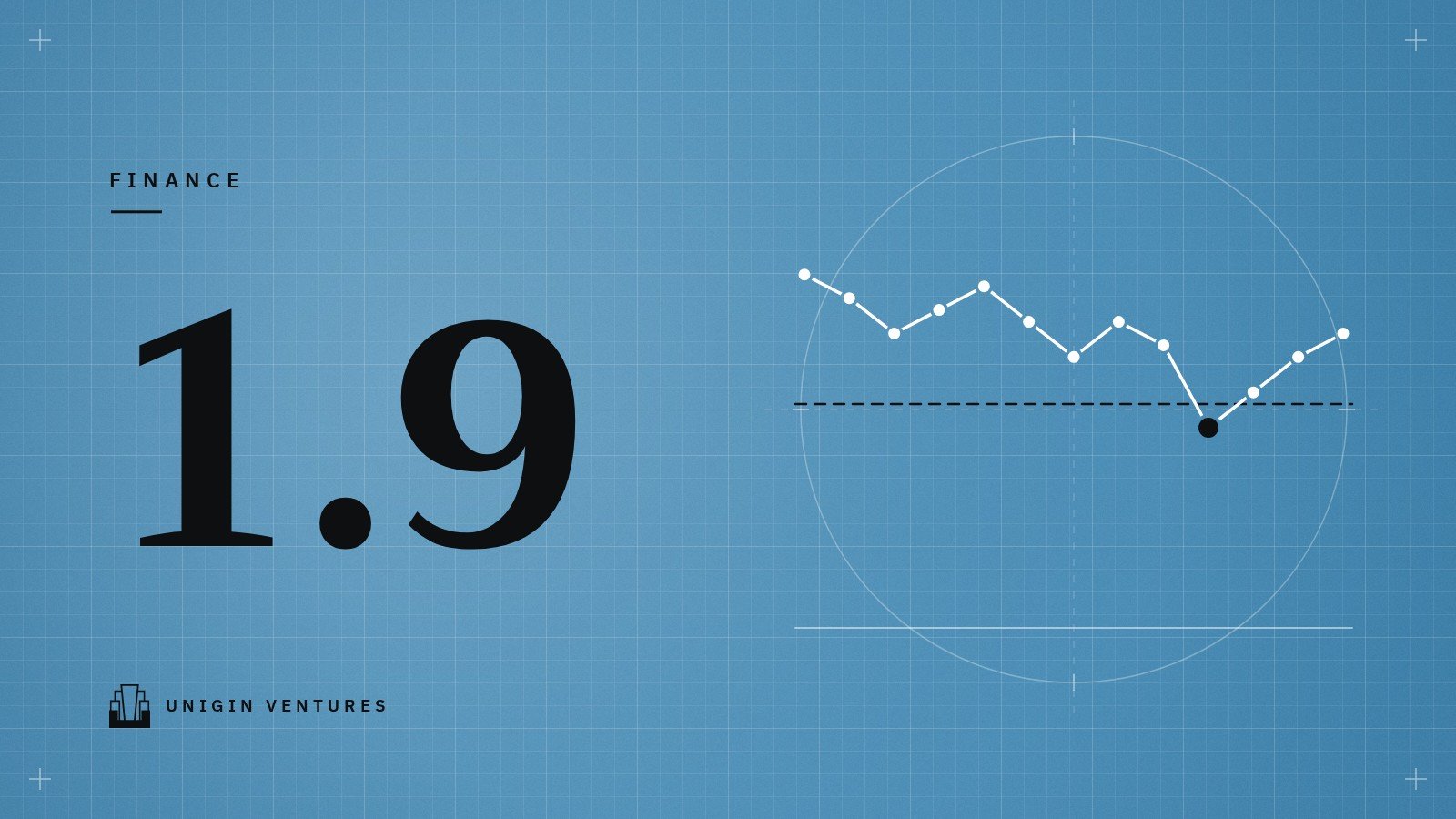
The 1,900,000 baht floor is most useful next to a weekly cash forecast. The forecast shows ahead of time which week the balance will fall below the floor, so you can act before that week arrives.
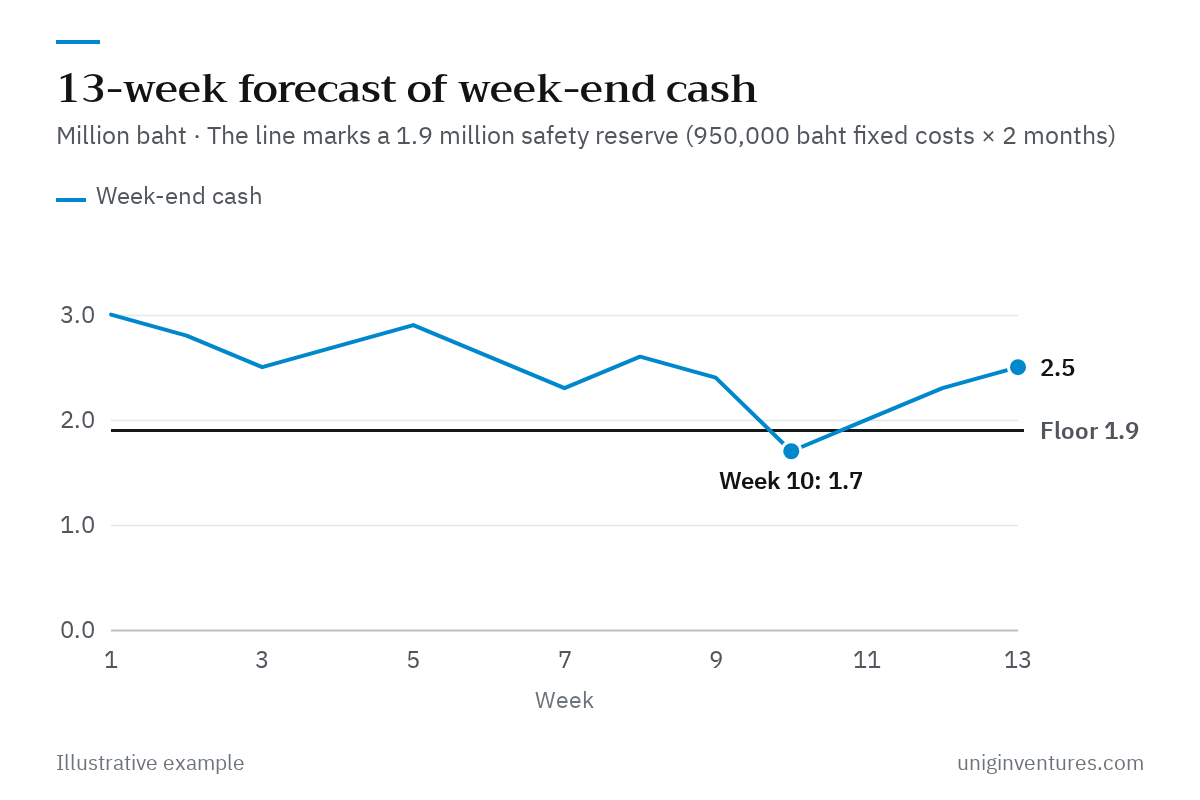
In this example, payroll, the annual tax payment and a large inventory order all fall in week 10, so the balance drops to 1,700,000 baht, 200,000 below the floor. From weeks 7 and 8 the company can chase overdue receivables, ask the supplier to split payment for that order, delay purchases that can wait, or tell the bank it will draw on its credit line for a short time. All of these are far easier with several weeks to spare. The weekly template is in 13-week cash flow forecast.
Where to keep the reserve
Reserve money must be available when you need it and must not be at risk of loss. Yield comes second. Keep each part in its own place.
- Operating float stays in the account you pay from, such as a current or savings account.
- Set-asides for large payments go into a separate account so they do not get spent by accident. If you know the payment date, a fixed deposit that matures before that date works.
- Safety reserve also stays apart from the spending account. If you put part of it in a fixed deposit, ask the bank first whether you can withdraw early and how much interest you would give up.
Instruments whose price moves, such as shares or mutual funds with price risk, do not suit this money. The day you need the cash may be the day prices are down.
What Thai deposit protection covers
As the reserve grows, know what deposit protection covers. According to the Deposit Protection Agency's website as of November 2026:
- Coverage is 1 million baht per depositor per financial institution. The DPA adds up the depositor's money in every account and every branch of that institution.
- Juristic persons, such as companies, that hold deposit accounts at a covered institution are protected.
- Five deposit types are covered: current, savings and fixed deposits, certificates of deposit, and deposit receipts.
- Not covered: foreign currency deposits, investment instruments such as bonds, debentures and fund units, bills of exchange, cashier's checks, deposits in cooperatives, e-money and cryptocurrency.
- Covered institutions are the commercial banks, foreign bank branches, finance companies and credit foncier companies on the DPA's list. When an institution's license is revoked, the DPA pays depositors within 30 days.
This has three consequences for your reserve. First, all of a company's accounts at one bank count together, so opening more accounts at the same bank does not raise the coverage. Second, exporters that park money in foreign currency deposit accounts should know that money is not covered. Third, bills of exchange and debentures that pay more than a deposit are not deposits, so they are not covered even when a financial institution issues them.
Spreading the reserve across several banks so that each balance stays within the coverage limit is one option. It adds account upkeep and reconciliation work, so weigh whether it is worth it for the amount you hold.
Set rules for using and rebuilding the reserve
A reserve without rules tends to leak into things that are not emergencies. Write a few short rules in advance, for example:
- The safety reserve is for falling inflows or unexpected costs, not for buying assets or expansion.
- A withdrawal from the reserve account needs approval from a second authorized person, not the one making the transfer.
- After you use it, set a monthly amount to rebuild it, for example a share of each month's cash profit until it is full.
- Review the numbers every quarter, or when fixed costs change: new hires, a new office, or a new loan.
- Move money for taxes and annual payments into a separate account every month so it never mixes with the safety reserve.
Where to start
- Add up the cash you must pay even if sales stop, using the last three months of bank statements.
- Choose a number of months from the factor table above and calculate the safety reserve.
- Look back at daily balances to find the largest drop within a month, and list the known large payments for the next three months.
- Open separate accounts for the reserve and for annual set-asides, and check that each deposit is a type the DPA covers.
- Put the floor into your 13-week forecast and check every week whether any week falls below it.
The numbers in the example are illustrative. Deposit protection details were checked on the Deposit Protection Agency's website in November 2026; the limit and conditions can change by law, so check with the DPA again before you decide. This article is general information, not financial or investment advice for any particular business.
Sources
- Coverage limit — Deposit Protection Agency
- Protected financial products — Deposit Protection Agency
- Financial institutions under protection — Deposit Protection Agency
- Questions and answers (juristic person depositors) — Deposit Protection Agency
- Reimbursement of depositors — Deposit Protection Agency