TCG Credit Guarantees: What the Fees Add to Your Loan's Real Cost
Which TCG fees an SME pays, a total-cost example for a 3 million baht five-year loan at Credit Plus rates, why a guarantee that does not shrink with the loan gets costly, and what to ask the bank.
In this article
Many Thai SMEs run viable businesses but lack the land or other assets a bank wants as collateral. The usual answer from the bank is a credit guarantee from the Thai Credit Guarantee Corporation (TCG), for which the borrower pays a fee every year. So the question to ask before signing is not just "what is the interest rate?" but "including the fees, what does this loan really cost?"
This article explains the fees TCG charges, using the Credit Plus program as listed on TCG's website as the example. It works out the total cost of a five-year loan, shows the point where the fees quietly become expensive, and ends with the questions to put to your bank.
What TCG guarantees, and whose debt it remains
TCG guarantees loans that SMEs take from financial institutions, so a bank can lend even when collateral falls short. Borrowers apply through a participating institution and must pass the program's screening; the Credit Plus program, for example, requires the borrower to pass TCG's credit scoring. Each TCG program has its own eligibility rules, limits and fee rates.
Understand one thing first: a guarantee does not make the debt go away. If the borrower defaults and TCG pays compensation to the bank, the borrower still owes that money to TCG. That is why TCG runs measures for "compensation debtors," such as "TCG Ready to Help" (บสย. พร้อมช่วย), which offers repayment over five to seven years. The fee buys access to the loan. It is not insurance that pays the debt on your behalf.
How many fees: the Credit Plus example
TCG's fee page splits each program's charges into those the SME pays and those the bank pays. The table below covers the "TCG SMEs Credit Plus 2%" variant as shown on TCG's website in November 2026.
| Item | Rate | Paid by |
|---|---|---|
| Guarantee fee | 1.75% a year | SME |
| Guarantee management fee | 0.25% a year of the approved guarantee amount | SME |
| Processing fee (issuing the letter of guarantee) | 500 baht up to 20 million baht · 1,500 baht for 20–40 million · 3,000 baht above 40 million | SME |
| Fee on compensation paid | 2% of the amount TCG pays in compensation | Bank |
The guarantee fee and management fee add up to 2% a year. The Credit Plus 2.5% variant carries a 2.25% annual guarantee fee instead. Other Credit Plus conditions listed on TCG's website:
- The borrower is a Thai national or a juristic person registered in Thailand, with fixed assets, excluding land, of no more than 200 million baht.
- For loans above 500,000 baht, the borrower must have filed tax returns, and the new loan cannot be used to repay existing debt.
- The guarantee is capped at 100 million baht per borrower across all institutions, for up to 10 years.
- Applications are accepted until December 30, 2027, or until the program's total amount is used up, whichever comes first.
In some programs the government pays the fee for the early years. Under the "TCG SMEs Ignite Biz" variant of PGS Phase 11, for example, the government pays the 1.5% annual fee on the SME's behalf in years 1 to 3, and from year 4 the SME pays 1.5% a year of the guarantee amount itself. These programs have limited amounts and deadlines, so ask your bank whether one is still open, and price in the years when you will pay the fee yourself.
Worked example: a 3 million baht loan over five years
Take an illustrative company that borrows 3,000,000 baht for five years under Credit Plus 2%, with the whole loan guaranteed. Interest is 7% a year (an assumed rate, not any bank's offer). The company repays 600,000 baht of principal each year, and interest is charged annually on the balance at the start of the year, which keeps the numbers easy to check.
Before calculating, you need to know what the fee is charged on. TCG's FAQ says the guarantee is renewed annually, the bank may reduce the guarantee amount at renewal, and fees are then paid on the reduced amount. The example therefore has two cases.
- Case A: the guarantee amount stays at 3,000,000 baht for all five years.
- Case B: the bank reduces the guarantee amount each year to the outstanding loan balance, while the management fee is still charged on the original approved amount.
| Item | Case A: fixed guarantee amount | Case B: reduced with the balance |
|---|---|---|
| Interest at 7% | 630,000 | 630,000 |
| Guarantee fee at 1.75% | 262,500 | 157,500 |
| Management fee at 0.25% | 37,500 | 37,500 |
| Processing fee | 500 | 500 |
| Total cost | 930,500 | 825,500 |
| Annual cost relative to average balance | 10.34% | 9.17% |
The balances at the start of years 1 to 5 are 3.0, 2.4, 1.8, 1.2 and 0.6 million baht, which add up to 9,000,000 baht, so interest is 7% × 9,000,000 = 630,000 baht. In case A the guarantee fee is 1.75% × 3,000,000 × 5 years = 262,500 baht. In case B it is charged on each year's balance: 1.75% × 9,000,000 = 157,500 baht. The management fee in both cases is 0.25% × 3,000,000 × 5 years = 37,500 baht.
The last row divides total cost by 9,000,000 baht, which equals the average outstanding balance of 1,800,000 baht times five years. It is an approximation that ignores the time value of money, but it is enough to show that a "2% a year" fee adds 3.34 percentage points to the real cost of the money you use in case A, and 2.17 points in case B. For a more precise rate, use the effective-rate method in Flat Rate vs Effective Rate.
Why a fee on a fixed amount gets more expensive every year
As you repay principal, the outstanding loan shrinks. If the guarantee amount does not shrink with it, the fee stays the same every year. In case A, the guarantee and management fees total 60,000 baht a year, which is 2.0% of the balance in year 1 but 10.0% in year 5, when only 600,000 baht is left on the loan. In case B, year 5 comes to 3.0%.
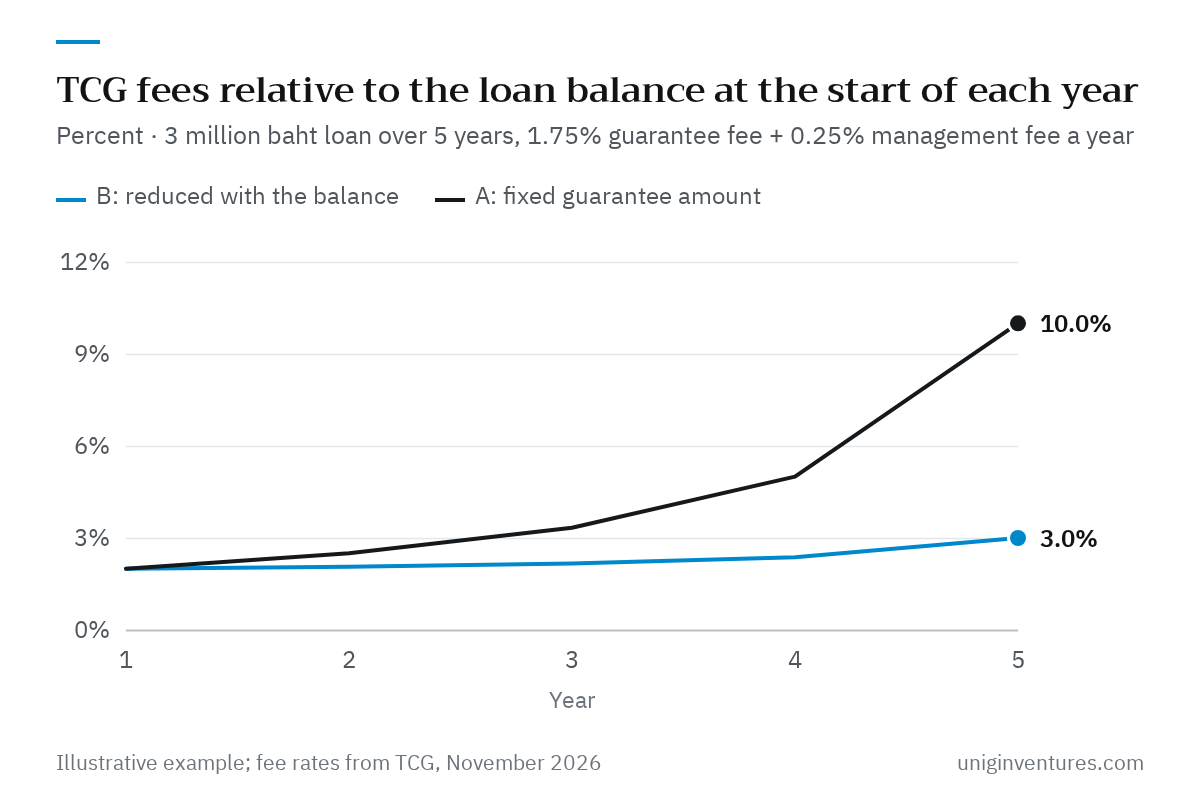
This does not mean the guarantee must always be cut every year. The bank may have risk reasons to keep it in place. But you should know on the day you sign how the guarantee amount will change, and bring the numbers for both cases into the negotiation.
How to compare it with other options
Whether a TCG guarantee is worth it depends on the option you really have without it. If you have enough collateral and the bank would lend at the same rate without a guarantee, the fees are pure extra cost. If the alternative is an unsecured loan at a higher rate, compare total costs the same way.
A TCG-guaranteed loan is cheaper when: the alternative's interest rate > the guaranteed loan's interest rate + the fees as an annual percentage of the average outstanding balance
Continuing the example, if the alternative is an unsecured loan at 12% a year (an assumed rate) with the same repayments, total interest would be 12% × 9,000,000 = 1,080,000 baht, which is 149,500 baht more than case A and 254,500 baht more than case B. If the alternative charged 9%, total interest would be 810,000 baht, below both cases, and the guarantee would not be worth it.
The numbers a bank checks before approving, such as the debt service coverage ratio (DSCR), still apply. A TCG guarantee does not make up for cash flow that cannot cover the repayments. See Preparing an SME loan application.
Questions to ask your bank before signing
- Which TCG program and variant is this, and what are the guarantee fee, management fee and processing fee?
- What is the guarantee amount, all of the loan or part of it, and will it be reduced to the outstanding balance at each annual renewal?
- When and how are the fees collected, for example deducted from the drawdown or paid separately?
- Are there years in which the government pays the fee, and from which year do you pay it yourself?
- If you repay early or cancel the guarantee, is any fee refunded under TCG's published refund rules?
- Is the interest rate fixed or floating? If floating, see how to estimate the impact in Floating-rate loans.
Where to start
- Open TCG's program fee page and find the variant your bank is offering.
- Build a total-cost table like the one above with the actual amount, term and interest rate the bank offers, for both a fixed guarantee amount and one reduced with the balance.
- Divide total cost by the sum of each year's outstanding balance to get an approximate annual cost.
- Compare it with the options you really have, both a loan secured on your own assets and an unsecured loan.
- Get answers to every question on the list before you sign, and put the guarantee's annual renewal date in your calendar.
The figures in the example are illustrative. TCG's fee rates and program conditions were checked on TCG's website in November 2026 and can change with each program announcement, so confirm them with your bank and TCG before deciding. This article is general information, not financial advice for any particular business.