Operating Leverage: Why a 10% Sales Drop Can Halve Your Profit
Fixed costs make profit swing several times harder than sales. Calculate DOL from your own numbers, see why it spikes near break-even, and learn how to turn fixed costs into variable ones.
In this article
Many business owners have lived through a year when sales slipped only a little and profit fell by half, or the reverse: sales grew modestly and profit jumped. The cause is usually not price or customers but cost structure, meaning the split between fixed costs you pay every month no matter what you sell and variable costs that rise and fall with sales.
The measure for this is operating leverage. This article shows how to calculate it from your own income statement, compares two businesses with the same profit and very different risk, explains why the number climbs as sales approach break-even, and covers the ways to cut fixed costs or turn them into variable ones.
What operating leverage is
OpenStax's Principles of Managerial Accounting defines operating leverage as a measure of how sensitive net operating income is to a percentage change in sales, and notes that companies with a high proportion of fixed costs have higher operating leverage. CFA Institute describes it the same way: it measures the sensitivity of operating profit to changes in sales and is driven mainly by the mix of fixed and variable costs in operating expenses.
The number used to measure it is the degree of operating leverage (DOL).
DOL = Contribution margin ÷ Operating income
Contribution margin = Sales − Variable costs · Operating income = Contribution margin − Fixed costs
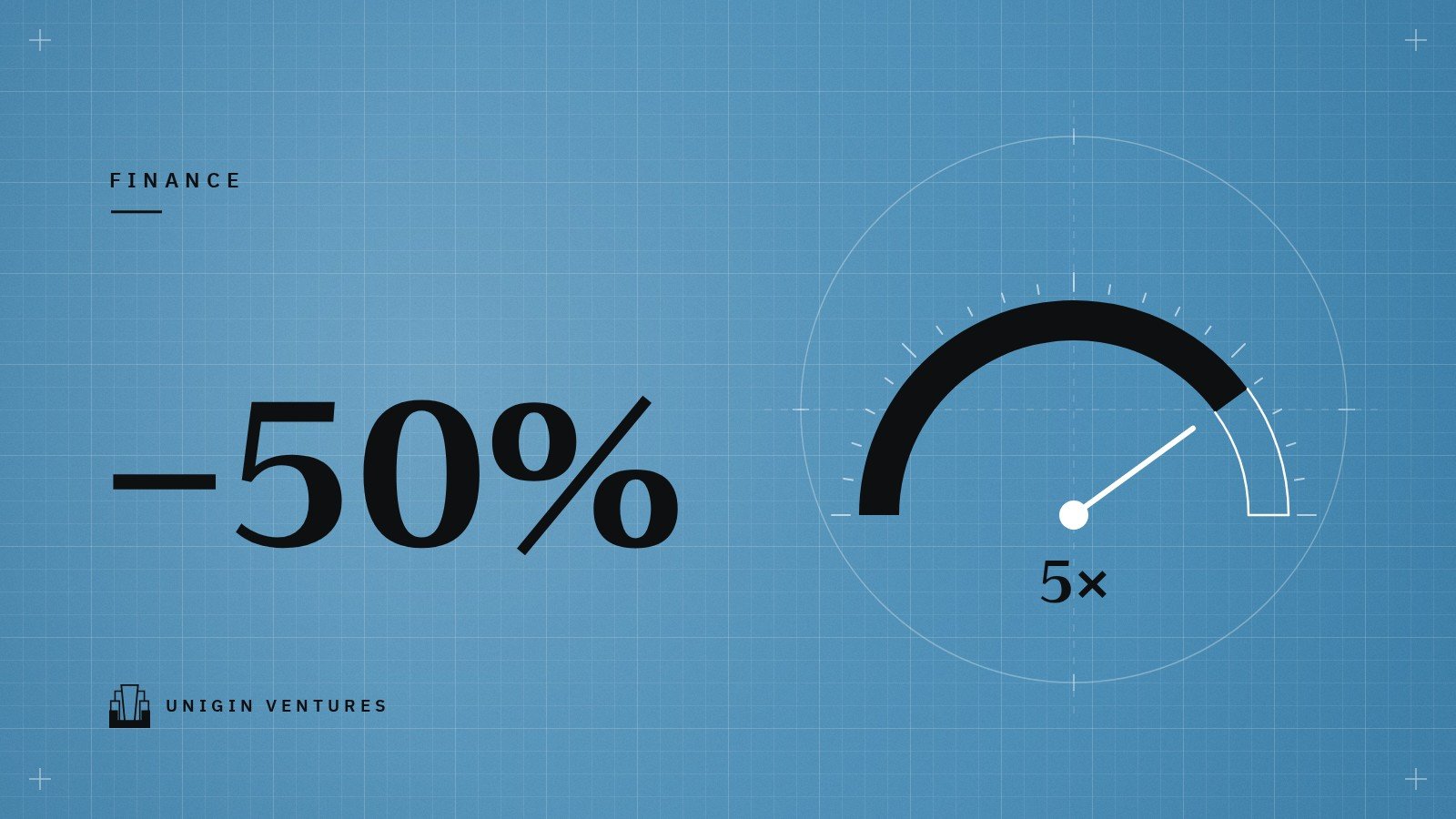
The simplest reading: with a DOL of 5, a 1% change in sales moves operating income about 5% in the same direction. A 10% drop in sales therefore cuts profit by roughly 50%. The rule holds well as long as the selling price and variable cost per unit stay the same and fixed costs stay at their current level.
Example: same profit, different risk
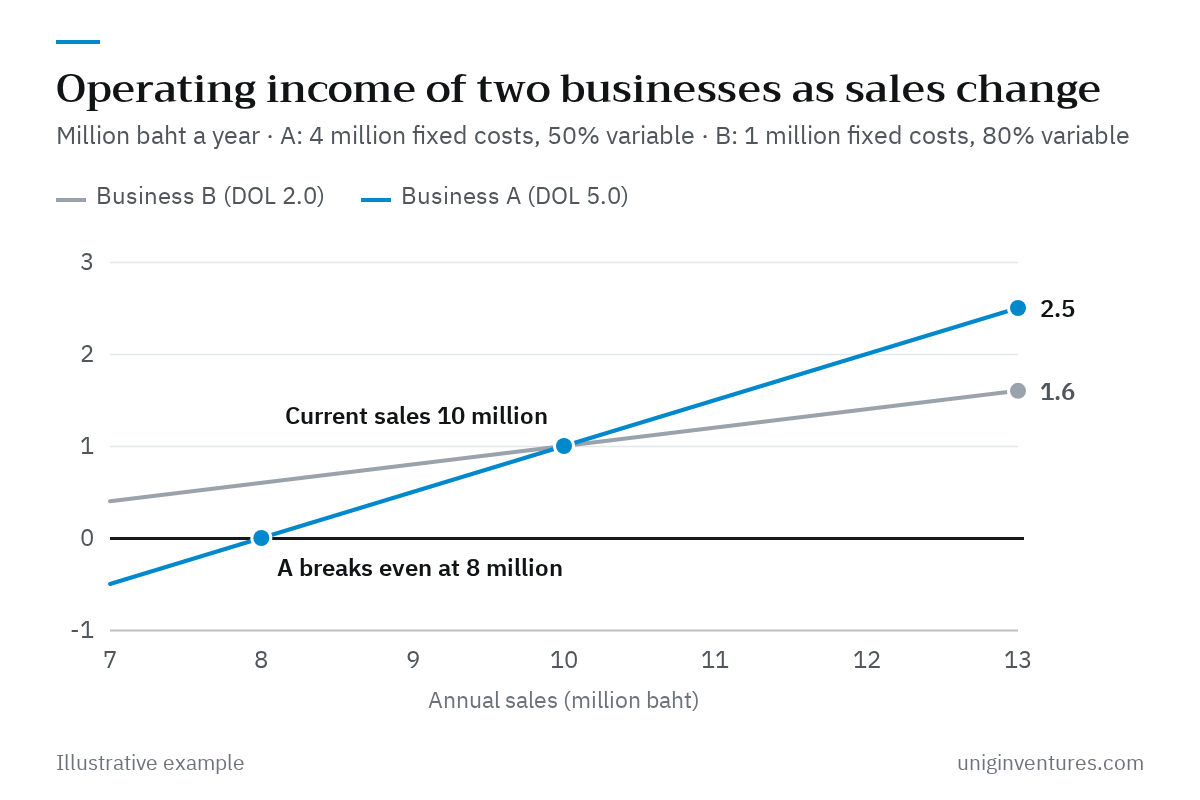
Illustrative example. Business A makes snacks in its own rented plant with permanent staff and its own machines. Business B sells the same snacks but pays another factory per piece to make them. Both have annual sales of 10 million baht and operating income of 1 million baht.
| Item | Business A | Business B |
|---|---|---|
| Sales | 10,000,000 | 10,000,000 |
| Variable costs | 5,000,000 (50%) | 8,000,000 (80%) |
| Contribution margin | 5,000,000 | 2,000,000 |
| Fixed costs | 4,000,000 | 1,000,000 |
| Operating income | 1,000,000 | 1,000,000 |
| DOL | 5.0× | 2.0× |
This year the two look identical. Once sales move, they do not.
| Sales | Business A | Business B |
|---|---|---|
| 11,000,000 (+10%) | 1,500,000 (+50%) | 1,200,000 (+20%) |
| 10,000,000 (current) | 1,000,000 | 1,000,000 |
| 9,000,000 (−10%) | 500,000 (−50%) | 800,000 (−20%) |
| 8,000,000 (−20%) | 0 (−100%) | 600,000 (−40%) |
A 10% fall in sales costs Business A half its profit, because the 4 million baht of fixed costs still has to be paid in full, while most of Business B's costs shrink with sales on their own. In a year when sales grow 10%, Business A's profit rises 50% and Business B's rises 20%. Fixed costs speed up profit and losses alike.
DOL is not fixed: it rises near break-even
OpenStax points out that as sales fall toward break-even, the lower income produces a higher operating leverage, which means a higher level of risk. Here is Business A's DOL at different sales levels.
| Sales (baht) | Contribution margin | Operating income | DOL |
|---|---|---|---|
| 12,000,000 | 6,000,000 | 2,000,000 | 3.0× |
| 10,000,000 | 5,000,000 | 1,000,000 | 5.0× |
| 9,000,000 | 4,500,000 | 500,000 | 9.0× |
| 8,500,000 | 4,250,000 | 250,000 | 17.0× |
This is why bad years get worse quickly. Once sales start to fall, DOL rises, so each further small drop in sales eats a larger share of the profit that is left.
A shortcut: DOL and the margin of safety
OpenStax defines the margin of safety as the difference between current sales and break-even sales. Expressed as a percentage of sales, it gives a mathematical relationship you can use to check your numbers quickly.
DOL = 1 ÷ Margin of safety as a percentage of sales
Business A breaks even at 4,000,000 ÷ 50% = 8,000,000 baht. Current sales exceed break-even by 2,000,000 baht, or 20% of sales, so DOL is 1 ÷ 0.20 = 5.0. Business B breaks even at 1,000,000 ÷ 20% = 5,000,000 baht, a 50% margin of safety, so its DOL is 2.0. In other words, lowering operating leverage is the same thing as moving sales further away from break-even. (For how to find break-even, see break-even analysis for a new business.)
Debt on top of fixed costs: the risks multiply
Loan interest is another layer of fixed charges. CFA Institute calls the sensitivity of net income to operating income the degree of financial leverage (DFL) and explains that it is driven mainly by the company's capital structure.
DFL = Operating income ÷ (Operating income − Interest expense)
Combined effect = DOL × DFL
Suppose Business A borrowed to buy its machines and pays 500,000 baht of interest a year. Profit before tax is 500,000 baht, and DFL is 1,000,000 ÷ 500,000 = 2.0. Multiplied by the DOL of 5.0, the combined effect is 10×. If sales drop 10%, operating income falls to 500,000 baht, just enough to pay the interest, and profit before tax disappears. If Business B took the same loan, its DFL would also be 2.0 but its combined effect would be 4×, so a 10% drop in sales would cut profit before tax by about 40%.
The lesson: a business that already carries high fixed costs should be especially careful about borrowing more, and if the loan has a floating rate, this layer of fixed charges can rise further (see floating-rate loans).
How to reduce the risk from fixed costs
Fixed costs are not bad in themselves. A business with high fixed costs grows profit quickly when sales grow. The point is to match DOL to how predictable your sales are. If sales are volatile or still uncertain, these are the levers.
- Turn fixed costs into variable costs. Outsource production or services and pay per unit instead of keeping a permanent team, pay sales commission instead of raising base salaries (see commission on gross profit), or rent machines and vehicles by use instead of buying them (see lease or buy).
- Cut fixed costs that do not generate sales. Go through them line by line: space you rent but do not use fully, systems or services billed monthly that nobody uses. Every baht you remove lowers break-even.
- Raise contribution margin per unit. Raise prices or push products with a higher contribution margin. Break-even falls without touching fixed costs (see contribution margin by product).
- Hold more cash when DOL is high. A high-DOL business slides into losses fast when sales fall, so keep enough cash to cover several months of fixed costs and prepare a plan for several cases in advance (see scenario planning).
Example: moving 1 million baht of fixed costs out
Continuing the illustrative example, Business A closes its own packing team and delivery truck, which cost 1,000,000 baht a year in fixed costs, and hires an outside firm that charges 10% of sales. Assume that at current sales the outside fee exactly equals the old cost.
- Fixed costs fall from 4,000,000 to 3,000,000 baht, and variable costs rise from 50% to 60% of sales.
- At 10 million baht in sales, contribution margin is 4,000,000 baht and operating income stays at 1,000,000 baht, but DOL falls from 5.0 to 4.0.
- Break-even falls from 8,000,000 to 3,000,000 ÷ 40% = 7,500,000 baht, and the margin of safety rises from 20% to 25%.
- If sales drop 10%, profit is 600,000 baht (down 40% instead of 50%). If sales grow 10%, profit is 1,400,000 baht (up 40% instead of 50%).
That is the trade: the business accepts slower profit growth in good years in exchange for smaller losses of profit in bad ones. If the outside fee costs more than the old setup, profit at current sales goes down, so work out both sides before deciding.
Where to start
- Open the last 12 months of your income statement and sort each expense line into fixed costs (rent, permanent salaries, depreciation, monthly service fees) and variable costs (materials, packaging, per-unit delivery, commissions, payment fees). Split mixed lines, such as factory electricity, by your best estimate of each part.
- Calculate contribution margin, operating income and DOL, then check it with 1 ÷ margin of safety. If the two do not match, the cost split has an error somewhere.
- If you have loans, calculate DFL and DOL × DFL to see how far sales can fall before profit before tax is gone.
- Ask how far your sales could fall in a bad year and compare that with your margin of safety. If the possible drop is larger, pick at least one of the levers above to lower fixed costs.
- Recalculate DOL every quarter, and every time you are about to add a large fixed cost such as new premises, a machine or more permanent staff.
The businesses and figures in this article are illustrative examples. This article is general information, not financial advice for any particular business.