Floating-Rate Loans: What a Change in MLR or MOR Costs Your Business
How floating rates tied to MLR and MOR work, a quick formula for extra interest, a worked example of installments, overdraft interest and DSCR at 0.25% to 1.00% higher, and what to do first.
In this article
Most SME term loans and overdraft (O/D) lines in Thailand carry floating rates, written into the contract as MLR minus or plus a margin, or MOR plus a margin. Many owners know the rate they pay today but have never worked out how much their installments, overdraft interest and the ratio the bank uses to judge repayment capacity would change if the bank raised its reference rate.
This article explains how floating rates work, gives a quick formula for the extra cost, walks through three scenarios with numbers, and lists what you can do before rates move.
How a floating rate works
A floating rate changes with the lender's cost of funds, as and when the lender announces it. A fixed rate, by contrast, is a set figure for the agreed period. The Bank of Thailand (BOT) describes the common reference rates this way:
- MLR (Minimum Loan Rate) is charged to large, creditworthy customers with good financial records and adequate collateral, mostly for loans with a fixed term.
- MOR (Minimum Overdraft Rate) is charged to large, creditworthy customers on overdraft lines.
- MRR (Minimum Retail Rate) is charged to creditworthy retail customers, for example on personal loans and mortgages.
Your contract rate therefore has two parts: the reference rate the bank announces, and the margin (spread) you agreed, such as MLR − 0.50%. The margin is fixed by contract, but the reference rate can move whenever the bank makes an announcement. Each bank sets its own rates, so follow the announcements of the bank you borrow from.
These reference rates follow the policy rate, but not necessarily all by the same amount. A BOT article from June 2023 found that when the Monetary Policy Committee (MPC) raised the policy rate six times starting in August 2022, large commercial banks raised MLR by more than MRR. Businesses borrowing against MLR or MOR may therefore feel more of a change than retail borrowers. At its most recent meeting on October 28, 2026, the MPC voted unanimously to hold the policy rate at 1.00% a year and said private-sector borrowing costs through bank credit remained stable in line with the policy rate.
A quick formula for the extra cost
Before opening a repayment schedule, use this formula to see the size of the impact in a minute:
Extra interest per year ≈ (outstanding loan principal + average O/D usage) × change in rate
In an illustrative example, with 10,000,000 baht of loan principal outstanding and 2,000,000 baht of average O/D usage, a 0.50% rise in the reference rate adds about 12,000,000 × 0.50% = 60,000 baht of interest over the next year. The figure is slightly high because principal falls during the year, but it is good enough to decide whether you need a detailed calculation.
What the formula does not tell you is the cash that actually leaves each month. That depends on whether the contract lets the bank change the installment, or keeps the installment and extends the term. If the installment stays the same, less of it goes to principal and the loan is paid off later than planned. If the installment falls below that month's interest, the principal does not go down at all.
A worked example: three rate scenarios
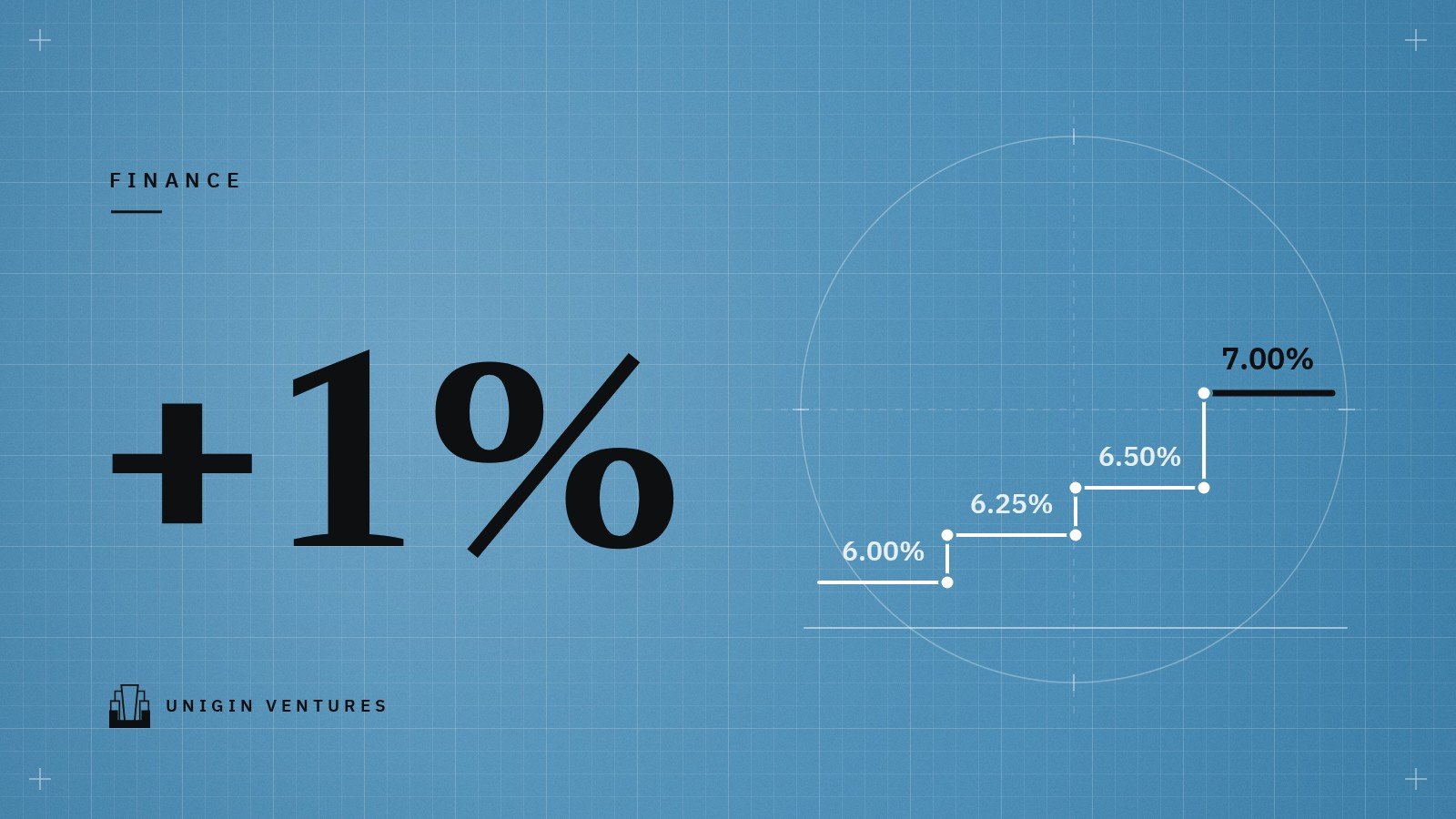
In an illustrative example, a company has a 10,000,000-baht term loan repaid in 60 equal monthly installments at MLR − 0.50%, which is 6.00% a year today. It also has a 3,000,000-baht O/D line, with average usage of 2,000,000 baht, at MOR + 0.50%, which is 7.00% a year today. The company generates 3,200,000 baht a year of cash available for debt service, and its loan agreement requires a debt service coverage ratio (DSCR) of at least 1.25 times. To keep the comparison simple, the table recalculates the installment over all 60 months as if the rate changed on day one.
| Item | Current rate | +0.25% | +0.50% | +1.00% |
|---|---|---|---|---|
| Term loan rate | 6.00% | 6.25% | 6.50% | 7.00% |
| Monthly installment (baht) | 193,328 | 194,492 | 195,661 | 198,012 |
| Installments per year (baht) | 2,319,936 | 2,333,904 | 2,347,932 | 2,376,144 |
| O/D interest per year (baht) | 140,000 | 145,000 | 150,000 | 160,000 |
| Total debt service per year (baht) | 2,459,936 | 2,478,904 | 2,497,932 | 2,536,144 |
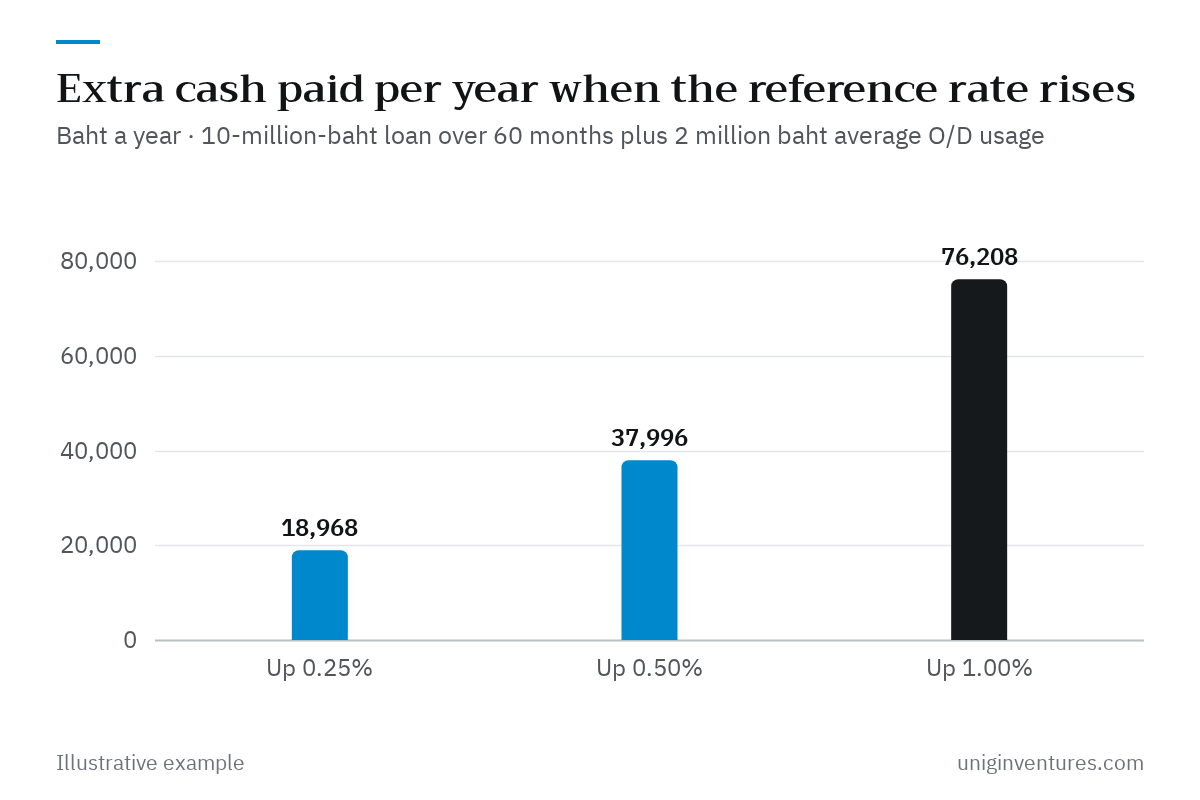
| Extra cash out per year (baht) | — | 18,968 | 37,996 | 76,208 |
| DSCR (times) | 1.30 | 1.29 | 1.28 | 1.26 |
Three things stand out:
- Installments rise less than the quick formula suggests. For a 1.00% rise, the formula gives about 120,000 baht of extra interest in the first year, but installments plus O/D interest rise by only 76,208 baht a year, because equal installments spread the extra interest over all five years. Interest expense in the first year's income statement rises by more than the installment, because principal is still high.
- DSCR falls a little, but headroom disappears fast. DSCR drops from 1.30 to 1.26 times. That looks small, but the headroom over the 1.25 covenant shrinks from 0.05 to 0.01. If cash flow dips even slightly in the same year, the company breaches. See how to track it in Loan Covenants.
- The O/D feels it immediately. O/D interest is charged on the balance actually used each day, so the cost changes as soon as the rate does. Higher average usage when customers pay late makes the effect worse.
Read the contract to know what can change
Before you calculate, open your loan agreement and facility letter and answer these questions:
- What is the reference rate (MLR, MOR, MRR or another rate), and what is the margin?
- Is there a fixed-rate period in the early years, and what floating rate applies after it?
- When the rate changes, does the bank adjust the installment, or keep it and extend the term?
- If you breach a financial covenant or default, what default rate applies?
- What fees apply if you repay early or refinance with another bank?
What to do before rates move
- Run the three-scenario table every quarter. Put your actual balances into a table like the one above, check both the extra cash and the DSCR, and carry the result into your 13-week cash flow forecast.
- Reduce O/D balances that act as long-term funding. A balance that never comes down during the year is permanent funding and should be compared with a term loan. See Overdraft or Short-Term Loan.
- Ask your bank about fixed rates or interest rate hedges, such as fixing the rate for part of the term, or an interest rate swap for larger facilities. Compare the cost of certainty with the results of your scenario table rather than betting on the direction of rates.
- Renegotiate the margin when your numbers improve. The margin reflects the company's risk on the day you borrowed. When DSCR and collateral improve, use those numbers to ask for a lower margin. See what banks look at in Preparing an SME Loan Application.
- Keep a cash reserve that covers the worst case in your table. In the example, that is 76,208 baht a year, or about 6,350 baht a month.
Where to start
- List every loan and credit line in one table with the outstanding balance, reference rate, margin and how installments are adjusted.
- Use the quick formula to estimate the effect of 0.25%, 0.50% and 1.00% rises. If the effect on profit or DSCR is material, build a detailed repayment schedule.
- Follow your bank's rate announcements and the MPC decisions, which the BOT publishes after every meeting.
The company, balances, interest rates and cash flows in this article are an illustrative example, not any bank's rates. Installments assume equal monthly payments and are rounded to the baht. The policy rate is as of October 28, 2026. This article is general information, not a forecast of interest rates or financial advice for any particular business.
Sources
- Fixed and floating loan rates; definitions of MLR, MOR and MRR — Bank of Thailand (in Thai)
- Monetary Policy Committee decision, meeting 5/2026 (October 28, 2026) — Bank of Thailand (in Thai)
- From the policy rate to commercial bank rates: this time is different (June 2023) — Bank of Thailand (in Thai)
- Policy interest rate — Bank of Thailand (in Thai)